October is Kerouac Month in my personal literary liturgy, but she is now long gone, as if in epitomization of the transiency of all things. She passes too quickly. So I have re-named November October 2.0. A futile extension, and sentimental to boot. This by way of justification, if any should be thought necessary, of posting the below. The commentary is open-hearted, yet critical. Found it on Facebook; no idea who the author is. I conclude with some commentary of my own.
……………………..
A famous author sits in a Mexico City room with a woman who’s high on morphine and a houseful of animals, a hen, a rooster, a dove, a cat, and a little dog, and decides he’s in love. That’s the odd, tender picture at the heart of Tristessa, and Allen Ginsberg’s description of it, a narrative meditation on a hen, a rooster, a dove, a cat, and a ravishing, ravished junky lady, is the best summary I’ve found. Jack Kerouac wrote it in two bursts, during visits to Mexico in 1955 and 1956, and it was published in 1960. It’s short, barely eighty or ninety pages, and I read it in one sitting, feeling like I was walking through a church with the lights off.
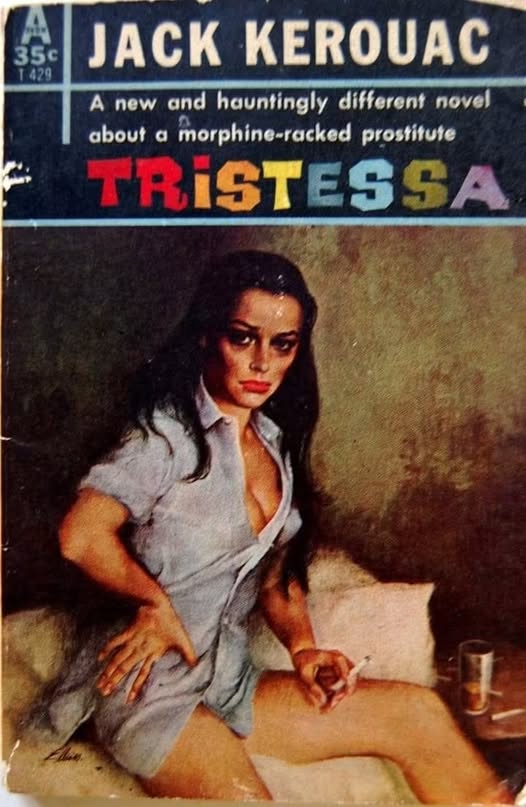
It’s based on his real affair with a woman named Esperanza Villanueva, a morphine addict and street prostitute whose name means “hope” in Spanish, which Kerouac changed to Tristessa, a name close to the word for “sadness.” He’d gone to Mexico City in 1955, where a circle of expatriate addicts he knew from New York had gathered, and an old, long-term junkie friend introduced him to her. Tristessa lives in a shabby room with an altar to the Virgin Mary, and she’s devout, funny, and gently fatalistic. Kerouac follows her through taco stands, drunken streets, and slum rooms at dawn. In the second part, he returns a year later and finds her worse, thin, sick, and sinking, while he himself drifts on.
What I loved is the tenderness. Kerouac’s prose is long, rolling, and prayerful, and the Mexico City he sketches is dreamlike and a little holy, with rain, candles, and dim lamps. He writes about her with reverence, and the scenes of the two of them lying side by side in the dark, with the animals stirring around them, are strangely beautiful. The ending of the first part, a quiet moment between the two, made my throat tighten. It’s a book about pity, and about how love and helplessness can look almost the same.
It’s a complicated book, though, and I’ll be honest. Tristessa is seen entirely through Kerouac’s romanticizing eyes, as saintly, exotic, and suffering, and that treatment, which leans on stereotypes about race, poverty, and addiction, made me wince, and critics have argued about it ever since. She barely gets to speak for herself, and the book’s reverence can slide into using her as a symbol. The drug use is described with a lyrical gloss that some readers will find troubling, and the rolling style can wear on you. It’s slight and repetitive, and it won’t win you over if you don’t already like him.
But if you love Kerouac, I’d say it’s one of his most moving small books, with all its blind spots. It made me think about how easily we turn the people we pity into poems, and I closed it quiet, uneasy, and a little sad for both of them.
……………………………………
If you love Kerouac, it is indeed one of his most moving small books, and you will look past the down sides of his sloppy spontaneous prose, mocked by John Updike and other Eastern literary establishmentarians who wrote well about suburban hanky-panky and auto car dealerships. Interesting that Richard Yates was also never quite accepted by the New Yorker crowd, and never published in The New Yorker, despite his being a meticulous literary craftsman and a veritable anti-Kerouac. I am re-reading his 1961 Revolutionary Road, which missed the Zeitgeist and never found the resonance of Jack’s 1957 On the Road. I can appreciate Yates, his superb writing, and his analysis of the plight of restless youth in the post-war world of the staid and conformist ‘fifties, but Yates doesn’t move me. Kerouac does. This passage in particular from Tristessa, (written 1955-56, first published in 1960), original sensationalist 35 cent paperback cover below, p. 59:
Since beginningless time and into the never-ending future, men have loved women without telling them, and the Lord has loved them without telling, and the void is not the void because there’s nothing to be empty of.