
Meditation as Reduction to the Root of Ordinary Mind

I said earlier that  one aim of meditation is to “to dis-cover the root of all thinking, that which is transcendentally-ontologically prior to all thinking.”  Tom Carroll asked me about this and what, if anything, it has to to with what Kant and Husserl mean by ‘transcendental.’

1) The basic idea is that, below the surface of ordinary mind, with its chaos of thoughts, images, good and evil feelings, useful and useless memories, and other detritus, there lies a ‘depth dimension’ that some of us have experienced. It is ‘prior’ in some sense to ordinary mind  and its discursive operations. The experience of this depth dimension cannot be brought about by one’s own effort. It occurs on its own initiative.  Phenomenologically, the experience has a gift-character.  It is as if one has been granted this experience by a Power external to oneself.  Whether one has in reality been granted this experience by an external Power is a  metaphysical question that goes beyond the phenomenology of the situation.  But it is reasonable to take the experience as evidence of an external power that is prior to and deeper than anything on the phenomenal plane.

One can have this experience, or gain this glimpse,  without any preparatory spiritual exercises whatsoever.  Or one can make preparations.  The preparations at most prepare the soul; they cannot of themselves initiate the growth. If one prepares with discursive prayer, one first touches upon this depth dimension in the transition from what Augustin Poulain calls the “prayer of simplicity” to the non-discursive “prayer of quiet.” If one experiences this transition, then one has reached the initial and lowest level of mystical experience, properly so-called.  See here.

In addition to the planting metaphor, there is a metaphor for this preparation from al-Ghazali that I like very much. A desert-dweller  is more likely to catch a cooling breeze at the top of a minaret than at its base. So he climbs to the top of the minaret. But whether he is granted a cooling breeze is not in his power.  So  the first step into the mystical cannot be achieved by own-power alone.  It is not just that own-power is insufficient; own-power is neither necessary nor sufficient. Other-Power, however,  is both necessary and sufficient. Preparations are merely ancillary or auxiliary.

2) By ‘thinking’ I mean discursive thinking.  So a meditator qua meditator is not a thinker. Discipline thinking is at best a springboard beyond discursion toward the transdiscursive.

3) I said earlier that the root of all thinking is transcendentally-ontologically prior to all thinking. What sort of priority is this?

‘Prior’ has several senses, among them: temporal, logical,  transcendental, ontological.  If one event occurs before another in time, then the first is temporally prior to the second. The priority of the parts of a whole to the whole is in many cases logical but not temporal.  This is especially clear in cases in which neither the whole nor its parts are in time. The numbers 2, 7, and 9 are logically but not temporally prior to the set, {2, 7, 9}.   In this example there cannot be temporal priority because neither the parts (the elements) not the whole (the set) are in time.

In the case of a wall made of stacked stones, both whole (the wall) and the parts (the constituent stones) are in time. Moreover, the wall came to be at a time and will cease to be at a later time. Nonetheless, at any given time t in the wall’s career, the stones at t are logically, not temporally, prior to the wall at t.

A third example. The definitions and axioms in an axiomatic system are logically, not temporally, prior to the theorems that follow from the axioms. And note that ‘follow’ here does not have a temporal sense, despite the fact that the writing of a proof on a blackboard involves a temporally sequential series of steps.

A fourth example.  Trump and the true sentence ‘Trump exists’ uttered or written by someone both exist in time.  Does the man exist because the sentence is true, or is the sentence true because the man exists? The latter. The existing man, as the truth-maker of the true sentence,  is logically prior to the true sentence.

4) Transcendental  priority  is different from both temporal and logical priority. It refers to the priority of consciousness over every object of consciousness, where ‘object’ is taken in a maximally broad way  to cover concrete particulars, abstract particulars (tropes), events, event-sequences, abstracta (ideallia) of all sorts including Fregean propositions, mathematical sets of every cardinality,  functions, series, finite and infinite, relations  of consistency, inconsistency, and entailment, introspectible mental items whether intentional or non-intentional, Meinongian nonentities, concepts in minds, exemplified and unexemplified universals,  all distinctions and differences between and among anything and anything else . . . , in short, everything that can be brought before consciousness  as an object for consciousness.

Transcendental consciousness is thus the ultimate Other to every actual and possible object in the maximally broad sense of the term.  It is the ultimate condition of the  possibility of anything’s appearing.  You can think of it as the transcendental Light of mind without which nothing would appear, including physically illuminated things such as yonder mesa, or physical sources of physical light such as the Sun, or the lambent spaces between them.

5) Ontologically prior to this transcendental Light stands its onto-theological Source.  Augustine claims to have glimpsed this eternal Source of Transcendental Light upon entering into his “inmost being.” Entering there, he saw with his soul’s eye, “above that same eye of my soul, above my mind, an unchangeable light.” He continues:

It was not this common light, plain to all flesh, nor a greater
light of the same kind . . . Not such was that light, but
different, far different from all other lights. Nor was it above my
mind, as oil is above water, or sky above earth. It was above my
mind, because it made me, and I was beneath it, because I was made
by it. He who knows the truth, knows that light, and he who knows
it knows eternity. (Confessions, Book VII, Chapter 10)

6) I didn’t get around to Kant and Husserl. Tomorrow’s another day.
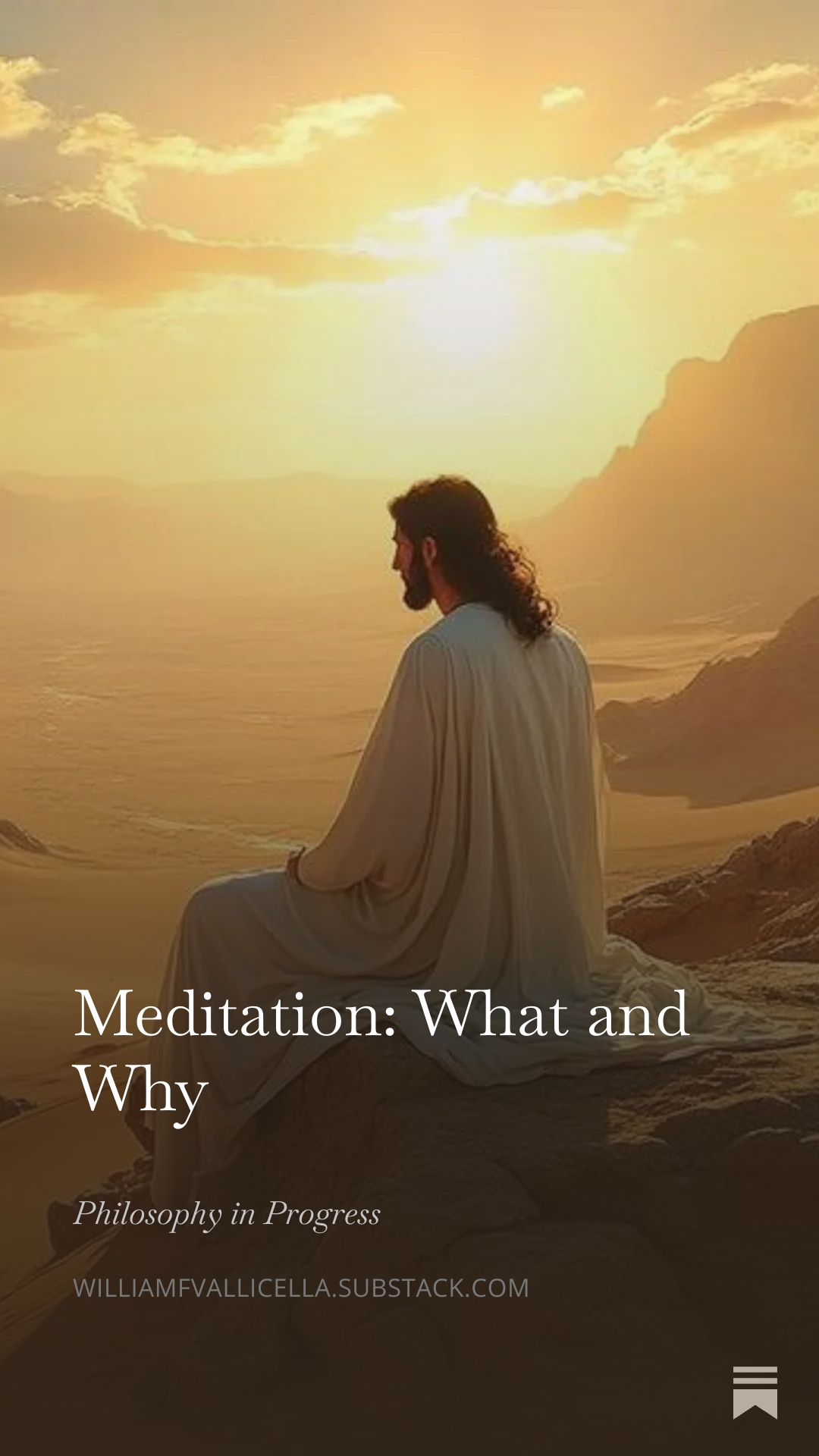
Suggestions on How to Meditate

A Substack follow-up to Meditation: What and Why in response to Tom Carroll’s query.  And then we’ll ‘swim the Ganges.’ But I might not get to the Ganges tomorrow since I’ll be heading to the shooting range.

The neo-Kantian German philosopher Eugen Herrigel wrote a book entitled Zen in the Art of Archery.  Tomorrow I will practice Zen and the Art of Handgunnery. Can you trigger an explosion a couple of inches from your face without flinching or moving the gun, with equanimity and detachment from the outcome, hitting a bulls-eye eleven yards off?

Meditation: What and Why

Tom Carroll asks,

When you say “meditation,” what do you mean? Is there a specific practice or set of practices you have in mind? I am genuinely curious. I am a 69-year-old Catholic, well-ensconced in Holy Mother Church with absolutely no desire to “swim the Ganges,” as one might say. Still, I have read a bit on Vedanta recently and it’s interesting. That’s part of what prompts my question, I suppose.

Here is part of my answer.  More later on specific practices and ‘swimming the Ganges.’ Feel free to ask me any question about it.

Can an AI System Meditate?

Resolute meditators on occasion experience a deep inner quiet. It is a definite state of consciousness. You will know it if you experience it, but destroy it if you try to analyze it.  If you have the good fortune to be vouchsafed such a state of awareness you must humbly accept it and not reflect upon it nor ask questions about it, such as: How did I arrive at this blissful state of mind? How can I repeat this experience?  You must simply rest in the experience. Become as a little child and accept the gift with gratitude. One-pointedness is destroyed by analysis. 

Mental quiet is a state in which the "mind works" have temporarily shut down in the sense that discursive operations (conceptualizing, judging, reasoning) have ceased, and there is no inner processing of data or computation.  You have achieved a deep level of conscious unity prior to and deeper than anything pieced together from parts. You are not asleep or dead but more fully alive. You are approaching the source of thoughts, which is not and cannot be a thought.  Crude analogy: the source of a stream is not itself a stream.  Less crude, but still an analogy: the unity of a proposition is not itself a proposition, or the proposition of which it is the unity, or a sub-proposititional constituent of the proposition.

Can a computing machine achieve the blissful state of inner quiet? You can 'pull the plug' on it in which case it would 'go dark.'  The machine is either on or off (if it is 'asleep' it is still on).   But when the meditator touches upon inner quiet, he has not gone dark, but entered a light transcendentally prior to the objects of ordinary (discursive) mind.

I would replace the lyric, "Turn off your mind, relax, and float downstream; it is not dying, it is not dying" with "Turn off your discursive mind and swim upstream; it is not dying; it is not dying." "That you may see the meaning of Within."

Can an AI system achieve mental quiet, the first step on the mystical ascent? Cognate questions: Could such a system realize the identity of Atman and Brahman or enjoy the ultimate felicity of the Beatific Vision?  Is ultimate enlightenment reachable by an increase is processing speed? You are aware, aren't you, that processing speed is increasing exponentially

The answer to these questions, of course, is No.  When a computer stops computing it ceases to function as it must function to be what it is.  But when we halt our discursive operations, however, we touch upon our true selves.

Taming the Wild Horse of the Mind on the Road to Benares

This morning's meditation session ran from 3:10 ante meridiem to 4:00. Before that I was sketching six blog posts in my journal. My mind was on fire with ideas fueled in part by  some entries from Volume Five of Tom Merton's journal.  As flabby a liberal as he is, both politically and theologically, he is engaged in the seven volumes of his journal in a wholly admirable project of relentless self-examination. I love this argonaut of interiority with all his inner conflicts.

He fled the world but was drawn back to her. The contemplative of contemptus mundi  became a peace activist. He who preached The Silent Life (the tile of one of the best of his books) was an inveterate scribbler of journal entries, articles, poems, letters — how many volumes of correspondence? Five? –  not to mention too many books some of them good many of them not so good.

His journals are a treasure trove of ideas, references, self-criticism, culture-critical observations, weather reports, whimsical vignettes, extrapolations, autodidactic and amateurish, from his reading of Nietzsche, Heidegger, Sartre, Jaspers, Camus and plenty of people you've never heard of, Isaac of Stella, Evdokimov, Julien Green . . . I could go on.

Anyway, my mind was racing when I hit the black mat of meditation. Now you can pull in the reins brutally on the wild horse, or let him run. Best to let him run and tire himself out while you observe his antics. After 20 minutes he settled down, leaving 30 minutes for a peaceful dive toward Silence or Mental Quiet, the first stage on the mystical descent. The German Versenkung taken mystically* as opposed to nautically well captures the sinking below the  waves of discursivity into the depths.

Now it can happen that you sink so deep that you fear that you will never come up again. The terror of ego loss grips you. At this point you need a great faith and a great trust, lest you miss the opportunity of a lifetime: to penetrate the veil while enwrapped in the mortal coil. I was offered this opportunity many years ago but the fear of ego death  sent me to the surface again when the whole point is to transcend the ego, to let it go, to give up control.  The ego must die for the soul to live. I am alluding to what may be the deep meaning of Matthew 18:3: "Verily I say unto you, Except ye be converted, and become as little children, ye shall not enter into the kingdom of heaven." The little child trusts. Plato: "To philosophize is to learn how to die."

_______________

* (KONZENTRATION) Zustand tiefer KonzentrationMeditation absorption contemplation
die Verbindung zum Göttlichen durch die sitzende, stille Versenkung: connecting with the divine by means of seated, quiet contemplation.

Two Worries about Meditation

One Christian friend worries that his meditation practice might lead him in a Buddhist direction, in particular toward an acceptance of the three marks of phenomenal existence: anicca, anatta, dukkha.  He shouldn't worry. Those doctrines in their full-strength Pali  form are dubious if not demonstrably untenable. As such, they cannot be veridical deliverances of any meditation practice. 

For example, the doctrine of anicca, impermanence, is not a mere recording of the Moorean fact that there is change; it is a radical theory of change along Heraclitean lines.  As a theory it is dialectically driven and not a summary of phenomenology. One could read it into the phenomenology of meditational experience, but one cannot derive it from the phenomenology. The claim I just made is highly contentious; I will leave it to the first friend to see if he can verify it to his own satisfaction.

Since he is a Christian I recommend to him an approach to meditation more in consonance with Christianity, an approach  as inner listening.  In one sentence: Quiet the mind, then listen and wait.  Open yourself to intimations and vouchsafings from the Unseen Order. Psalm 46:10: "Be still and know that I am God . . . ." But be aware that the requisite receptivity exposes one to attack from demonic agents whose power exceeds our own. So discernment is needed.

This brings me to a second Christian friend who asks, "Do you think the mind clearing function of meditation might be akin to the person Jesus taught us of, the person with a clean and emptied soul that was attractive to the demons as a place to occupy?"  

Yes, there is that danger. A mind cluttered and distracted by  petty thoughts and concerns is, from the point of view of the demons, safe against any irruption of divine light. This is why demons are more likely to be encountered in monasteries than in fleshpots. But once the mind is cleared of mundane detritus, once it returns from the diaspora of the sense world and rests quietly in it itself in its quest for the Unchanging Light, the demons have an opening.  But these facts of the spiritual life are no argument against meditation; they are an argument for caution. One would be well-advised to preface every meditation session with a discursive prayer along these lines: "Lord, I confess my spiritual infirmity and humbly ask to be protected from any and all demonic agents. Lord help me, guardians guard me." Sancti Angeli, custodes nostri, defendite nos in proelio, ut non pereamus in tremendo iudicio.  

My second friend is a Protestant, and among other faults, they fail to appreciate the mystical element in Christianity.

Finally:

The East no more owns meditation than the Left owns dissent.  Here is a quick little bloggity-blog schema.

Buddhist Nihilism: the ultimate goal is nibbana, cessation, and the final defeat of the 'self' illusion.

Hindu Monism: the ultimate goal is for the little self (jivatman) to merge with the Big Self, Atman = Brahman.

Christian Dualism: the ultimate goal is neither extinction nor merger but a participation in the divine life in which the participant, transfigured and transformed as he undoubtedly would have to be, nevertheless maintains his identity as a unique self.  Dualism is retained in a sublimated form.

I warned you that my schema would be quick. But I think it is worth ruminating on and filling in.  The true philosopher tacks between close analysis and overview, analytic squinting and syn-opsis and pan-opsis.

You say you want details?

Related

A 'No' to 'No Self' 

Can the Chariot Take Us to the Land of No Self? 

Buber on Buddhism and Other Forms of Mysticism