
A Substack article from a couple of years ago.
A Substack article from a couple of years ago.
Examined and rejected. Top o’ the Stack.
Facebook advertisement: “Mercifully brief, perfectly rigorous, and indisputably sound.” I wouldn’t promote it that way here, of course.
Contemplating suicide? Look before you leap.
Julian Green, Diary 1928-1957, p. 230:
The yearning to leave the world is so strong at times that I don’t know how to resist it, but am nearly sure that this is the great temptation that must at all costs be warded off.
First a positive note: A Dylan biopic is coming, A Complete Unknown.
…………………………
Del Shannon (Charles Weedon Westover), December 30, 1934 – February 8, 1990, known prmarily for his Billboard Hot 100 #1 hit, Runaway, 1961. "Suffering from depression, Shannon committed suicide on February 8, 1990, with a .22-caliber rifle at his home in Santa Clarita, California, while on a prescription dose of the anti-depressant drug Prozac. Following his death, The Traveling Wilburys honored him by recording a version of "Runaway"." (Wikipedia)
Dalida, O Sole Mio. I think I'm in love. "Dalida (17 January 1933 – 3 May 1987), birth name Iolanda Cristina Gigliotti, was a singer and actress who performed and recorded in more than 10 languages including: French, Arabic, Italian, Greek, German, English, Japanese, Hebrew, Dutch and Spanish." [. . .]On Saturday, 2 May 1987, Dalida committed suicide by overdosing on barbiturates.[7][8] She left behind a note which read, "La vie m'est insupportable… Pardonnez-moi." ("Life has become unbearable for me… Forgive me.")" (Wikipedia)
The Singing Nun, Dominique, 1963. "Jeanine Deckers (17 October 1933 – 29 March 1985) was a Belgian singer-songwriter and initially a member of the Dominican Order in Belgium (as Sister Luc Gabrielle). She acquired world fame in 1963 as Sœur Sourire (Sister Smile) when she scored a hit with the her French-language song "Dominique". She is sometimes credited as "The Singing Nun". [. . .]
Citing their financial difficulties in a note, she and her companion of ten years[8][9][10], Annie Pécher, both committed suicide by an overdose of barbiturates and alcohol on 29 March 1985.[11][12] In their suicide note, Decker and Pécher stated they had not given up their faith and wished to be buried together after a church funeral.[7] They were buried together in Cheremont Cemetery in Wavre, Walloon Brabant, the town where they died.[13] The inscription on their tombstone reads "I saw her soul fly across the clouds", a line from Deckers' song "Sister Smile is dead". (Wikipedia)
Phil Ochs, Small Circle of Friends. There but for Fortune. "Philip David Ochs (/ˈoʊks/; December 19, 1940 – April 9, 1976) was an American protest singer (or, as he preferred, a topical singer) and songwriter who was known for his sharp wit, sardonic humor, earnest humanism, political activism, insightful and alliterative lyrics, and distinctive voice. He wrote hundreds of songs in the 1960s and released eight albums in his lifetime." [. . .] "On April 9, 1976, Ochs hanged himself.[110]" (Wikipedia)
My favorite suicide song is Shiver Me Timbers by Tom Waits. James Taylor offers a beautiful interpretation. Is it really about suicide at sea? The reference to Martin Eden suggests to me that it is. But you might reasonably disagree.
Look before you make the leap of faith in ultimate nonentity. There may be no exit.
Top o' the Stack.
Girlfriend dumped you? Give it six months, and you may wonder what you ever saw in her.
The Stoic method of division may help you over the hump, the slump, the slough of despond.
Substack latest, with quotations from the forgotten Paul Ludwig Landsberg.
Are you quite sure that there is a way out? It may be that there is no exit. You can of course destroy your body, and that might do the trick. But then again it might not. Or is it perfectly obvious that you are either identical to your body or necessarily dependent for your existence on its existence? You might want to think about this before making the leap of faith in ultimate nonentity.
It would be fairly easy to give strong arguments why TO BE is not the same as TO BE PHYSICAL. Think of so-called 'abstract objects.' It is much more difficult to argue persuasively that the identity fails in the case of persons. And yet persons are rather remarkable. The ones we are regularly acquainted with are also animals. Sunk in animality as we are, it is easy to think that we are are just highly evolved animals. It is easy to miss the wonder of personhood. But the abyss that separates man from the animal should give one pause.
Bishop James A. Pike's son Jim committed suicide. He supposedly communicated the following message to his father from the Other Side:
I thought there was a way out; I wanted out; I've found there is no way out. I wish I had stayed to work out my problems in more familiar surroundings. (James A. Pike, The Other Side: An Account of My Experiences with Psychic Phenomena, Doubleday, 1968, p. 118.)
If you were around in the '60s and hip to what was happening you will recall Bishop Pike. He was a theological liberal who made quite a splash the ripples of which have long since subsided. The book I have cited is worth reading but best consumed with a mind both open and critical.
Dwight Green writes,
I had forgotten about your focus on the Beats in October (more of a remembrance of Kerouac, if I remember right) until I saw your recent post introducing it for this year.A couple of years ago I drove to the Big Sur area and was unable to do much hiking due to recent fire and weather wiping out many trails in the parks. On one of my stops I witnessed what helped push Kerouac mentally over the edge, as he published in Big Sur. The incredible power that defines the area is truly awesome (despite the overuse of that word). It's been a long time since I really connected with Kerouac but I did that weekend. See here. (I'm in the process of moving this to a new site but I don't have all the links working yet, so this is the old site.)The incident is more than a little macabre and I don't mean to "profit" from it in any way, but I had not understood his feelings in Big Sur until that moment. Just wanted to pass it on in case it's of interest.
So that when later I heard people say “Oh Big Sur must be beautiful!” I gulp to wonder why it has the reputation of being beautiful above and beyond its fearfulness, its Blakean groaning roughrock Creation throes, those vistas when you drive the coast highway on a sunny day opening up the eye for miles of horrible washing sawing. Jack Kerouac, Big Sur (1962)
. . . Big Sur follows Kerouac a few years after On the Road had been published (and fourteen years after the events in the book) as he's trying to handle the fame of his book as well as his inability to control himself, especially with alcohol. Kerouac's mental deterioration coincides with his visits to Lawrence Ferlinghetti's cabin in Big Sur. His isolation, exacerbated by the insignificance he feels in comparison to nature's power brings on a mental and physical breakdown. The poem he wrote while in Big Sur, "Sea: Sounds of the Pacific Ocean at Big Sur," echoes the parts of the novel comparing man's transience to nature's permanence, one of the many tensions in the book such as image vs. reality and beauty vs. hazard.
Happiness eluded this student of happiness despite his career success and the admiration of his peers. So at age 38 he jumped off a tall building.
Man up, and serve your time in the penal colony of the world. You'll die soon enough.
I detect a cri du coeur in the following question to me from a reader:
Do you believe it is morally permissible for an unmarried person who is now middle-aged (late 40's) and who has no children to care for and who has battled clinical depression and anxiety for many years to commit suicide?
Since this is an 'existential' and not merely a theoretical question, and because I want to treat it with the proper respect, I should say that while I have read about clinical depression, I would not call any of my bouts with anxiety and depression 'clinical.' I have successfully dealt with all of them on my own through prayer, meditation, Stoic and other spiritual disciplines, journal writing, vigorous physical exercise (running), and just toughing it out. The classically American virtue of self-reliance, too little practiced these days, can sometimes see you through much better than drugs and hand-holding. But I have been spared the hell I have read about in William Styron's Darkness Visible, and more recently in the philosopher J. P. Moreland's Finding Quiet: My Story of Overcoming Anxiety and the Practices that Brought Me Peace.
I recommend Moreland's book to the reader and this interview as an introduction thereto.
To come directly at the question: any philosopher who proffers a confident answer to the question is either a fool or a blowhard. Being neither, I will say that I don't know. I further believe that no one knows despite their asseverations to the contrary. I will say that I have never seen a rationally compelling argument against the moral permissibility of suicide when the going gets unbearably tough. That life is hell for some people is better known than any doctrine that forbids escape.
I now refer the reader to some entries of mine that I hope are of some use to him.
Benatar on Suicide: Is Suicide Murder?
Is it Always Wrong to Take One's Own Life?
Suicide, Drafts, and Street Corners
Addendum (1/28). It seems to me that each of us who has the time and soundness of mind to pursue the question should should decide now what he will do if calamity strikes.
Today is the Feast of St. Augustine.
At Confessions, Bk. VI, Ch. 11, Augustine speaks of "a greed for enjoying present things that both fled me and debased me."
A paradox of pleasure. Certain pleasures madly striven after prove fleeting and unreal, yet not so fleeting and unreal that they cannot degrade and debase their pursuers destroying both their souls and their bodies.
At the apogee of this mad trajectory, the pleasure pursued issues in death as in the case of David Carradine's death by auto-erotic asphyxiation in a Bangkok hotel room. Is there any more extreme case of the insane abuse of the body as a pleasure factory?
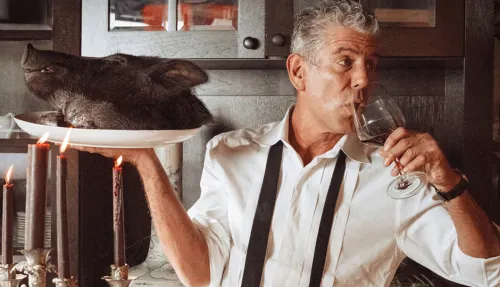
As I noted earlier, the celebrity chef, 'foodie,' and gastro-tourist, Anthony Bourdain, hanged himself in his hotel room. I speculated that the man was spiritually adrift. "If Bourdain had a spiritual anchor, would he have so frivolously offed himself, as he apparently did?"
Then I found the graphic below. Now I know the man was spiritually adrift. The view he gives vent to is utter nihilism. If the summum bonum lies in the gratification of the lusts of the flesh, why didn't Bourdain find his solace in further such indulgence?
Enjoy the ride and then commit suicide. And then there is Jeffrey Epstein whose ride to the bottom ended miserably.
I cannot erase a truth by erasing the sentence that expresses it; can I erase my self by erasing the body that is its worldly vehicle and expression?
Filed under: Questions
One problem with suicide is that it is a permanent solution to what is often a merely temporary problem.
My knowledge of my ignorance regarding the ultimate disposition of things keeps me from viewing suicide as a live option should the going get tough. I lack the complacent assurance of those atheists and mortalists who are quite sure that there is no afterlife. I also lack the complacent assurance of those theists and immortalists who feel sure that God will forgive them. And it seems to me that I have good grounds for both lacks of assurance.
"You may be fooling yourself. It may be that what keeps you from viewing suicide as a live option is your having been brought up to believe that it is a mortal sin. The priests and nuns got hold of your credulousness before you could erect your critical defenses."
To which my reply will be that others, brought up in the same way, went on to commit suicide and to commit without qualm other sins that they were taught were mortal. They were brought up the same way and taught the same things at a time when the Catholic Church was taken seriously as a source of theological and moral authority. Those others were not receptive to the religious teaching. They received it, but they were not receptive to it, and so they did not really receive it. A doctrine can be taught but not the receptivity thereto. Seeds can be sown, but if the soil is inhospitable, nothing will grow.
My innate receptivity to the message that something is ultimately at stake in life and that it matters absolutely how we live does not prove that the message is true. But the innateness of the receptivity to the message shows that it was not a matter of indoctrination but a matter of maieutic.
The recent suicide of Anthony Bourdain, celebrity chef and 'foodie,' offers food for thought. Why would so apparently successful and well-liked a man suddenly hang himself in his hotel room? One can only speculate on the basis of slender evidence, and it is perhaps morally dubious to do so.
On the other hand, not to wonder about a culture in which apparently sane and mature individuals throw away their lives on impulse is also dubious. But the problem lies deeper than culture. It lies in man's fallen nature.
It is clear to me that we are, all of us, morally sick and most of us spiritually adrift. If Bourdain had a spiritual anchor, would he have so frivolously offed himself, as he apparently did?
His 1999 New Yorker essay Don't Eat Before Reading This opens as follows:
Good food, good eating, is all about blood and organs, cruelty and decay. It’s about sodium-loaded pork fat, stinky triple-cream cheeses, the tender thymus glands and distended livers of young animals. It’s about danger—risking the dark, bacterial forces of beef, chicken, cheese, and shellfish. Your first two hundred and seven Wellfleet oysters may transport you to a state of rapture, but your two hundred and eighth may send you to bed with the sweats, chills, and vomits.
This is what good eating is all about? Seriously?
Bourdain displays the requisite decadent New Yorker cleverness, but he also betrays a failure to grasp the moral side of eating and drinking. There is first of all his moral obliviousness to the questions that divide carnivores from vegetarians, an obliviousness in evidence farther down:
Even more despised than the Brunch People are the vegetarians. Serious cooks regard these members of the dining public—and their Hezbollah-like splinter faction, the vegans—as enemies of everything that’s good and decent in the human spirit. To live life without veal or chicken stock, fish cheeks, sausages, cheese, or organ meats is treasonous.
I am taking no position at the moment on the morality of meat-eating. I am merely pointing out that there is a moral question here that cannot be dismissed — especially not with the cavalier stupidity of the quotation's final sentence.
But much more important is the moral question of gluttony.
D1. Gluttony is either the habitual, quantitatively excessive consumption of food or drink, or the habitual pursuit for their own sakes of the pleasures of eating or drinking, or indeed any habitual over-concern with food, its preparation, its enjoyment, etc.
In his Summa Theologica (Part 2-2, Question 148, Article 4), St. Thomas Aquinas reiterated the list of five ways to commit gluttony: