Faith and Prayer: The Case of Ron Franz

Top o’ the Stack.  Explores the difference between puerile and mature faith.  Topics include: idolatry, superstition, grades of prayer, mysticism, Simone Weil.

It starts out:

One of the minor characters of Jon Krakauer’s Into the Wild is the old man to whom Krakauer gave the name ‘Ron Franz.’ He was 80 years old when his and Christopher McCandless’s paths crossed. McCandless made indelible impressions on the people he met, but he affected Franz more than anyone else, so much so that the old man with no surviving kin wanted to adopt the 24-year-old as his grandson. The story of their encounter is recounted in the chapter entitled ‘Anza-Borrego’ and is also well told in the movie version of Krakauer’s book. Franz came to pin his hopes on the remarkable young man and longed for his return from Alaska. When he heard from a hitchhiker that McCandless had died, he and his faith were shattered:


If God Created the World, Who Created the Creator?

Thomas Merton claims that the title question is a good koan. I maintain that it isn’t.  I then give two examples of what I consider to be good Christian koans. Substack latest.

This article is relevant to my ongoing discussion with Tom Carroll. I thank him once again for engaging, as opposed to opposing, my ideas.  Those who think oppositionally in philosophy are not philosophers but ideologues.

Meditation as Reduction to the Root of Ordinary Mind

I said earlier that  one aim of meditation is to “to dis-cover the root of all thinking, that which is transcendentally-ontologically prior to all thinking.”  Tom Carroll asked me about this and what, if anything, it has to to with what Kant and Husserl mean by ‘transcendental.’

1) The basic idea is that, below the surface of ordinary mind, with its chaos of thoughts, images, good and evil feelings, useful and useless memories, and other detritus, there lies a ‘depth dimension’ that some of us have experienced. It is ‘prior’ in some sense to ordinary mind  and its discursive operations. The experience of this depth dimension cannot be brought about by one’s own effort. It occurs on its own initiative.  Phenomenologically, the experience has a gift-character.  It is as if one has been granted this experience by a Power external to oneself.  Whether one has in reality been granted this experience by an external Power is a  metaphysical question that goes beyond the phenomenology of the situation.  But it is reasonable to take the experience as evidence of an external power that is prior to and deeper than anything on the phenomenal plane.

One can have this experience, or gain this glimpse,  without any preparatory spiritual exercises whatsoever.  Or one can make preparations.  The preparations at most prepare the soul; they cannot of themselves initiate the growth. If one prepares with discursive prayer, one first touches upon this depth dimension in the transition from what Augustin Poulain calls the “prayer of simplicity” to the non-discursive “prayer of quiet.” If one experiences this transition, then one has reached the initial and lowest level of mystical experience, properly so-called.  See here.

In addition to the planting metaphor, there is a metaphor for this preparation from al-Ghazali that I like very much. A desert-dweller  is more likely to catch a cooling breeze at the top of a minaret than at its base. So he climbs to the top of the minaret. But whether he is granted a cooling breeze is not in his power.  So  the first step into the mystical cannot be achieved by own-power alone.  It is not just that own-power is insufficient; own-power is neither necessary nor sufficient. Other-Power, however,  is both necessary and sufficient. Preparations are merely ancillary or auxiliary.

2) By ‘thinking’ I mean discursive thinking.  So a meditator qua meditator is not a thinker. Discipline thinking is at best a springboard beyond discursion toward the transdiscursive.

3) I said earlier that the root of all thinking is transcendentally-ontologically prior to all thinking. What sort of priority is this?

‘Prior’ has several senses, among them: temporal, logical,  transcendental, ontological.  If one event occurs before another in time, then the first is temporally prior to the second. The priority of the parts of a whole to the whole is in many cases logical but not temporal.  This is especially clear in cases in which neither the whole nor its parts are in time. The numbers 2, 7, and 9 are logically but not temporally prior to the set, {2, 7, 9}.   In this example there cannot be temporal priority because neither the parts (the elements) not the whole (the set) are in time.

In the case of a wall made of stacked stones, both whole (the wall) and the parts (the constituent stones) are in time. Moreover, the wall came to be at a time and will cease to be at a later time. Nonetheless, at any given time t in the wall’s career, the stones at t are logically, not temporally, prior to the wall at t.

A third example. The definitions and axioms in an axiomatic system are logically, not temporally, prior to the theorems that follow from the axioms. And note that ‘follow’ here does not have a temporal sense, despite the fact that the writing of a proof on a blackboard involves a temporally sequential series of steps.

A fourth example.  Trump and the true sentence ‘Trump exists’ uttered or written by someone both exist in time.  Does the man exist because the sentence is true, or is the sentence true because the man exists? The latter. The existing man, as the truth-maker of the true sentence,  is logically prior to the true sentence.

4) Transcendental  priority  is different from both temporal and logical priority. It refers to the priority of consciousness over every object of consciousness, where ‘object’ is taken in a maximally broad way  to cover concrete particulars, abstract particulars (tropes), events, event-sequences, abstracta (ideallia) of all sorts including Fregean propositions, mathematical sets of every cardinality,  functions, series, finite and infinite, relations  of consistency, inconsistency, and entailment, introspectible mental items whether intentional or non-intentional, Meinongian nonentities, concepts in minds, exemplified and unexemplified universals,  all distinctions and differences between and among anything and anything else . . . , in short, everything that can be brought before consciousness  as an object for consciousness.

Transcendental consciousness is thus the ultimate Other to every actual and possible object in the maximally broad sense of the term.  It is the ultimate condition of the  possibility of anything’s appearing.  You can think of it as the transcendental Light of mind without which nothing would appear, including physically illuminated things such as yonder mesa, or physical sources of physical light such as the Sun, or the lambent spaces between them.

5) Ontologically prior to this transcendental Light stands its onto-theological Source.  Augustine claims to have glimpsed this eternal Source of Transcendental Light upon entering into his “inmost being.” Entering there, he saw with his soul’s eye, “above that same eye of my soul, above my mind, an unchangeable light.” He continues:

It was not this common light, plain to all flesh, nor a greater
light of the same kind . . . Not such was that light, but
different, far different from all other lights. Nor was it above my
mind, as oil is above water, or sky above earth. It was above my
mind, because it made me, and I was beneath it, because I was made
by it. He who knows the truth, knows that light, and he who knows
it knows eternity. (Confessions, Book VII, Chapter 10)

6) I didn’t get around to Kant and Husserl. Tomorrow’s another day.

Suggestions on How to Meditate

A Substack follow-up to Meditation: What and Why in response to Tom Carroll’s query.  And then we’ll ‘swim the Ganges.’ But I might not get to the Ganges tomorrow since I’ll be heading to the shooting range.

The neo-Kantian German philosopher Eugen Herrigel wrote a book entitled Zen in the Art of Archery.  Tomorrow I will practice Zen and the Art of Handgunnery. Can you trigger an explosion a couple of inches from your face without flinching or moving the gun, with equanimity and detachment from the outcome, hitting a bulls-eye eleven yards off?

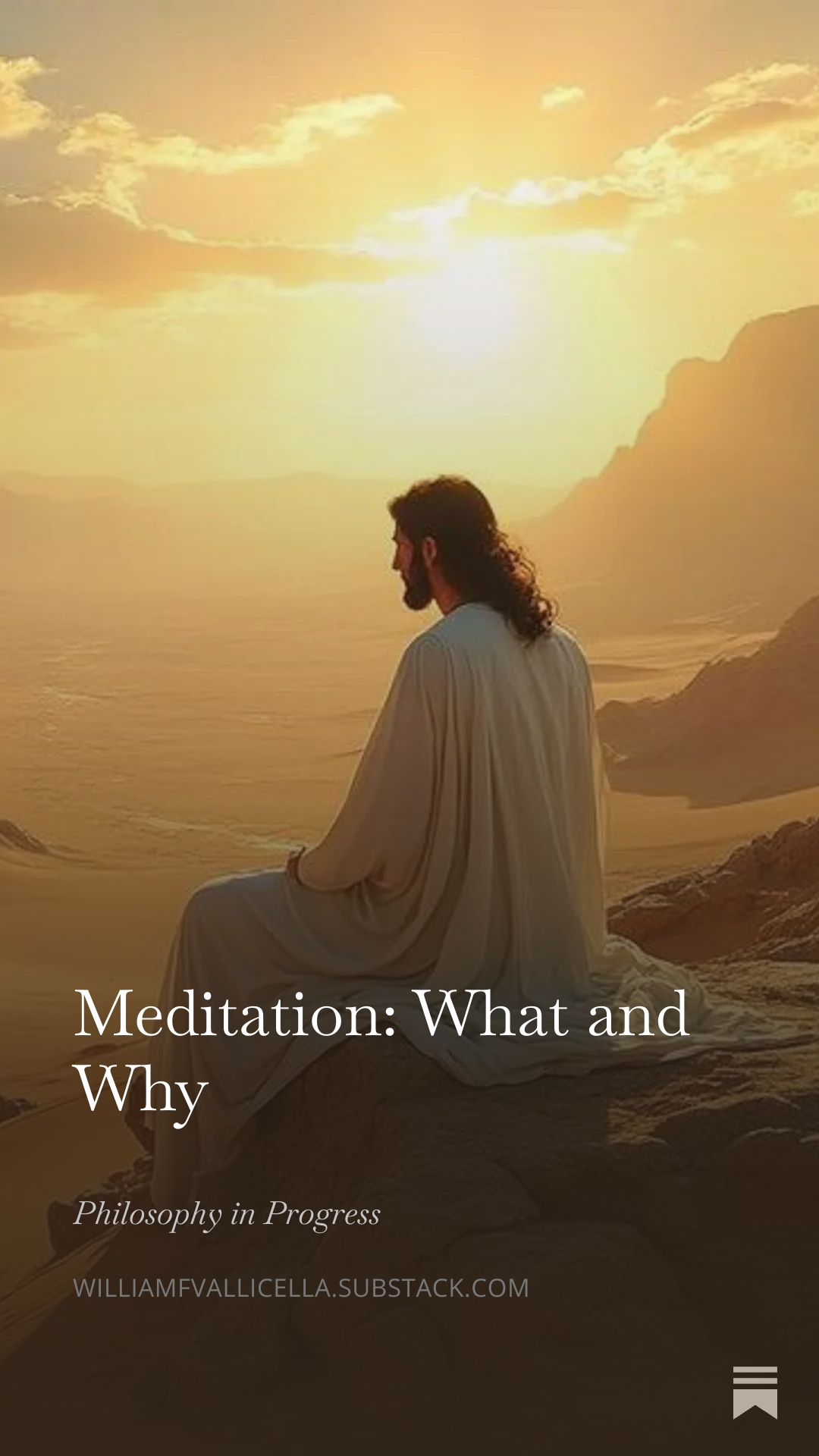
Meditation: What and Why

Tom Carroll asks,

When you say “meditation,” what do you mean? Is there a specific practice or set of practices you have in mind? I am genuinely curious. I am a 69-year-old Catholic, well-ensconced in Holy Mother Church with absolutely no desire to “swim the Ganges,” as one might say. Still, I have read a bit on Vedanta recently and it’s interesting. That’s part of what prompts my question, I suppose.

Here is part of my answer.  More later on specific practices and ‘swimming the Ganges.’ Feel free to ask me any question about it.

Can an AI System Meditate?

Resolute meditators on occasion experience a deep inner quiet. It is a definite state of consciousness. You will know it if you experience it, but destroy it if you try to analyze it.  If you have the good fortune to be vouchsafed such a state of awareness you must humbly accept it and not reflect upon it nor ask questions about it, such as: How did I arrive at this blissful state of mind? How can I repeat this experience?  You must simply rest in the experience. Become as a little child and accept the gift with gratitude. One-pointedness is destroyed by analysis. 

Mental quiet is a state in which the "mind works" have temporarily shut down in the sense that discursive operations (conceptualizing, judging, reasoning) have ceased, and there is no inner processing of data or computation.  You have achieved a deep level of conscious unity prior to and deeper than anything pieced together from parts. You are not asleep or dead but more fully alive. You are approaching the source of thoughts, which is not and cannot be a thought.  Crude analogy: the source of a stream is not itself a stream.  Less crude, but still an analogy: the unity of a proposition is not itself a proposition, or the proposition of which it is the unity, or a sub-proposititional constituent of the proposition.

Can a computing machine achieve the blissful state of inner quiet? You can 'pull the plug' on it in which case it would 'go dark.'  The machine is either on or off (if it is 'asleep' it is still on).   But when the meditator touches upon inner quiet, he has not gone dark, but entered a light transcendentally prior to the objects of ordinary (discursive) mind.

I would replace the lyric, "Turn off your mind, relax, and float downstream; it is not dying, it is not dying" with "Turn off your discursive mind and swim upstream; it is not dying; it is not dying." "That you may see the meaning of Within."

Can an AI system achieve mental quiet, the first step on the mystical ascent? Cognate questions: Could such a system realize the identity of Atman and Brahman or enjoy the ultimate felicity of the Beatific Vision?  Is ultimate enlightenment reachable by an increase is processing speed? You are aware, aren't you, that processing speed is increasing exponentially

The answer to these questions, of course, is No.  When a computer stops computing it ceases to function as it must function to be what it is.  But when we halt our discursive operations, however, we touch upon our true selves.

Play to Win . . .

. . . but with complete detachment from the outcome.  So I tell myself, while playing chess, for example, but not only in such competitions, but in all the affairs of life. Be like the lotus leaf that floats on the water but does not become wet! (Bhagavad Gita 5:10) But does the self-admonition refer to an achievable ideal? Is it psychologically possible for a human being freely to strive to accomplish some end he values but remain completely indifferent as to whether or not he achieves his end?

If it is not psychologically possible, then it cannot be an ideal let alone a moral obligation. Ought implies can, and what I ought to do I am morally obliged to do.  Surely I am not morally obliged to remain wholly indifferent to whether I achieve what I set out to achieve in all the pursuits of life if such detachment is psychologically impossible. 

What's more, such detachment is not even an ideal if my generalized 'ought' implies 'can' principle holds water.

Heaven and Hell: the Looming of the Last Things at the End of the Trail

A friend of mine, nearing the end of the trail, afflicted in body and soul, writes:
 
A question, my friend. Can you imagine someone on his deathbed saying, "Well I never really believed I'd meet Jesus, but the possible reward (eternal salvation) was so great that I was persuaded to be a believer so long as the probability of salvation was not effectively zero. I can't say I really believe in Jesus, but the possible rewards of believing are so great I had to buy the ticket." A decision-theoretic argument for belief that some think can made stronger by also postulating Hell (eternal damnation). If I don't believe, I risk Hell, even if I think the probability of that is very small.
 
Well, the Hell branch of the argument has the problem that eternal damnation is incompatible with a just and benevolent deity. Way too many people are sent to Hell for merely not believing (especially children). So what about Heaven? Can a just and benevolent God reward me with eternal happiness just for believing in (and maybe worshipping) him? Just as the threatened punishment seems totally disproportionate, so the promised reward seems "too good to be true" (in other words, a scam).
 
Not necessarily MY view of Heaven, but one that I hear often.
 
As for hell, I tend to agree with my friend.
 
Suppose God exists and there is an afterlife the quality of which depends on how one behaves here below.  Suppose that the justice which is largely absent here will be meted out there.  And suppose we take as a moral axiom that the punishment must fit the crime.  The question then arises: what crime or series of crimes by any human being could merit everlasting post-mortem punishment?  I would say that no crime or series of crimes would merit such punishment.  Thus it is offensive to my moral sense that a just God would punish everlastingly a human evildoer. 
 
Two qualifications. (1) It is reasonably presumed to be  otherwise with angelic evildoers such as Lucifer, so let's leave them out of the discussion.   (2) It is also reasonably presumed to be otherwise if a human, whether evildoer or not, wanted to maintain himself in a state of rebellion against God, after coming face-to-face with God, in which case my moral sense would have no problem with God's granting the rebel his wish and maintaining him in a state of everlasting exclusion from the divine light and succor.  Candidate rebels: Christopher Hitchens, Bertrand Russell, Jean-Paul Sartre, Josef Stalin.

Suppose that, after death, Stalin sees the errors of his ways and desires to come into right relation with God.  He must still be punished for his horrendous crimes. Surely justice demands that much.  What I fail to grasp, however, is how justice could demand that Stalin be punished everlastingly or eternally (if you care to distinguish eternity from everlastingness) for a finite series of finite crimes. 

Thomas Aquinas disagrees:

The magnitude of the punishment matches the magnitude of the sin. Now a sin that is against God is infinite; the higher the person against whom it is committed, the graver the sin—it is more criminal to strike a head of state than a private citizen—and God is of infinite greatness. Therefore an infinite punishment is deserved for a sin committed against Him. (Summa Theologica, Ia2ae. 87, 4.)

Some years back, my friend floated the suggestion that we are in hell right now. This can't be right, for reasons I won't go into. But it is reasonably held that we are right now in purgatory. The case is made brilliantly and with vast erudition by Geddes MacGregor in Reincarnation in Christianity (Quest Books, 1978,  see in particular, ch. 10. "Reincarnation as Purgatory.")

As for heaven, my friend asks,

Can a just and benevolent God reward me with eternal happiness just for believing in . . . him? Just as the threatened punishment seems totally disproportionate, so the promised reward seems "too good to be true" . . . .

The question is essentially this:  If justice rules out everlasting, 'infinite,' punishment for finite crimes committed by miserably limited humans, does it also rule out everlasting reward for finite good deeds? If the threatened punishment is totally disproportionate, is the promised reward also totally disproportionate?

To sharpen it a bit further, let's translate the interrogative into a declarative:  If no everlasting punishment is justified, then no everlasting reward is either.  If that is the claim, then I would respond by saying that the Beatific Vision is not a reward  for good things we do here below, but the state intended for us all along.  It is something like a birthright or an inheritance.  One doesn't earn one's inheritance; it is a gift, not a reward.   But one can lose it.  Similarly with the Beatific Vision.  One cannot earn it, and one does not deserve it.  But one can lose it.

It is also worth noting that 'totally disproportionate' and 'too good to be true' differ in sense.  The visio beata is admittedly totally disproportionate as a reward  for the good things that we wretched mortals do, but that is not to say that it is too good to be true.  If it is true that our ultimate felicity is participation in the divine life, and true that this participation is open to us, as a  real possibility and a divine gift, then that is the way things are. How could it be too good to be true?  Whatever good thing exists, precisely because it exists ,cannot be too good to exist.

Concluding Existential-Practical  Postscript

What I really want to say to my friend is that, while these philosophical and theological problems are genuine and important, they cannot be resolved on the theoretical plane.  In the end, after canvassing all the problems and all the arguments for and against, one simply has to decide what one will believe and how one will live. In the end, the will comes into it.  The will must come into it, since nothing in this area can be proven, strictly speaking. The 'presuppers' are out to lunch, to mention one bunch of those who fabricate a fake certainty for themselves to assuage their overwhelming doxastic security needs. And the same goes for the Biblical inerrantists.  The will comes into it, as I like to say, because the discursive intellect entangles itself in problems it cannot unravel.  

In my own case, I have had enough mystical, religious, aesthetic, moral, and paranormal experiences to convince me to take the Unseen Order with utmost seriousness — and I do. And so that's the way I live, devoting most of my time to prayer, meditation-contemplation, lectio divina, study of the great classics of philosophy and theology, moderate ascesis, such good works as befit my means and station, and writing philosophy, which I view as itself a spiritual practice.  I mean: what could be a better use of a life than to try to ascend to the Absolute by all possible routes?  But this won't make any sense to you unless you perceive this world, the Seen Order, to be a vanishing quantity devoid of ultimate reality and value, and our fleeting lives in it unsatisfactory and ultimately meaningless, if they end in annihilation.  

So I say to my friend: you are on your own. Going to a church and participating in external rites and rituals won't do you much if any good, nor will confessing your sins to a pedophile priest. (Ex opere operato is on my list of topics to discuss.) There is no need to go outside yourself; truth dwells in the inner man. Noli foras ire, in te ipsum redi. In interiore homine habitat veritas. (Augustine) Review your life and try to recall those moments and those experiences which seemed most revelatory of the Real, and live and then die in accordance with them. 

In the face of temptation, ask yourself: How do I want death to find me? In what state?  The lures of this world are alluring indeed, and it is well-nigh impossible to resist them, as witness the corruption of (some of) the cardinals who voted on the new pope. You have a sense of the Unseen Order if you sense that temptation ought to be resisted.  Whence the bindingness of that Ought? Whence the vocation to a Higher Life?  Are they just illusions of brain chemistry? Could be! You decide!

I myself have decided that The Greatest Temptation must be resisted.

One more point about church-going. It may be necessary for those excessively social animals lacking inner directedness, but I'd say that Matthew 6:6 hits the mark: "But thou, when thou prayest, enter into thy closet, and when thou hast shut thy door, pray to thy Father which is in secret; and thy Father which seeth in secret shall reward thee openly." (KJV)

But I don't want to deny that special places, some of them churches, have an aura that aids and may even induce contemplative repose.  I recall a time in Venice, Italy when I entered an ancient and nondescript little church and spent a few moments there alone. Upon exiting, I was unusually calm and collected.  My girlfriend at the time, noticing the transformation,  remarked, "You ought to go to church more often." The following, though AI-generated, is spot on. 

Aura of Places

An aura of a place can be described as a distinctive atmosphere or feeling that seems to surround and emanate from it. This term is often used metaphorically to convey the unique quality or vibe that a location gives off. For example, a place might have an aura of mystery, tranquility, or invincibility.

In spiritual contexts, auras are thought to be energy fields surrounding all living and non-living things, including places. These fields can be influenced by the emotions, thoughts, and experiences of those who frequent the location.


The Dangers of Psychic Phenomena on the Spiritual Quest

The thoughts of Paul Brunton well presented in a short video. I have been reading him for years. Like Thomas Merton, the man is at his best in his journals. I have read and re-read all sixteen volumes. For some extracts see my Brunton category

From the Mail Bag: Old-Time Reader Swims the Tiber

This just in from Russell B.:

Long time no talk.

I hope you’re doing well. I have been thinking about your work on existence over the past 3-4 years very seriously. So seriously, in fact, that it has made me swim the Tiber (well, I was born and raised Catholic so did I actually leave?). But I had to leave Protestantism; there was nothing left for me there. However, my biggest problem was divine simplicity. Long story short: I think your view (and Barry Miller’s view) is more or less the proper way to think about existence which in turn helps make DDS easier to swallow. And, if I might add, while the view is philosophically rich, I find the mystical and religious implications much richer. I have been obsessed with the mystics and in particular Teresa of Avila and Juan de la Cruz. I am unsure if you have felt similar ways in which their ideas deeply coincide with a God that just is Being itself. I don’t really know if I have words to describe how other than it just 'appears' to me that way.
 
Another way in which you helped me religiously was helping me decide between between Eastern Orthodoxy and Rome. They are essentially the same religion but I remember you saying that we need to approach truth from four different angles: philosophically, morally, religiously, and mystically. Well, I would say that Catholicism uses all four of these approaches while Orthodoxy ignores the first. This was huge for me. Now I know you have problems with the amount of dogma the Catholic Church has. This was also a stumbling block for me but I have tried to approach the matter like the parable where Jesus says only a child will enter the Kingdom of Heaven. It has been humbling to say the least. 
 
Very good to hear from you, Russell.  Here are a couple of questions and some comments that will interest you and perhaps others.
 
1) What were your reasons for becoming a Protestant in the first place and then leaving Protestantism, apart from acceptance of DDS? And what sect did you leave?
 
2) You ask whether I think  mysticism, particularly that of the two great Spanish mystics you mention, coheres with the notion of a God who is ipsum esse subsistens.  I do indeed. I am sure you are aware of Exodus 2:14: Ego sum qui sum . . . dic illis: QUI EST misit me ad vos. On Mount Sinai God reveals himself to Moses, and communicates to him the following message to be relayed to those at the foot of the mountain, a message presumably not couched in the words of  any human language: "I am who am . . . say this, 'He Who Is sent me to you.' "
 
To my mind, this passage from Exodus expresses the identity of the God of the Bible with the God of the philosophers. The God of the Bible, a being, reveals himself to man as Being itself.  The two upward paths, that of religion and that of philosophy, come together as one at the apex of the ascent in the divine simplicity.  The ascent to the Absolute is thus onto-theological.  And so, the two paths, neither of which in itself is a mystical path, culminate in a mystical unity, that of the simple God.  It is a mystical unity in that it defies discursive grasp.  We ineluctably think in opposites and naturally balk at talk of a thing identical to its attributes, its attributes identical to one another, its essence  identical to its existence, and so on.
 
You can come to understand how a God worth his salt must be ontologically simple without being able to understand how he could be ontologically simple. You can reason your way up to the simple God, but not into him or his life.  There will be no syllogizing in the Beatific Vision.  Discursivity must be dropped as it must also be dropped in the transition from ordinary, discursive prayer to the Prayer of Quiet, the first stage of infused contemplation, with several more beyond it.  These stages are well-described in Teresa's Interior Castle, and in all the manuals of mystical theology.  Poulain, about whom I say something over at Substack, is particularly good.
 
Mystics properly so called, such as Teresa de Avila and Juan de la Cruz, are able to jump immediately to the apex by mystical intuition.  And so there are three upward paths, although the mystical way is perhaps not well-described as a path inasmuch as it can be trod in an instant  without any preparatory ascesis if one receives an infusion of divine grace. (Grace is gratuitous and so cannot be brought about by any technique.)   The philosopher plods along, discursively, step by step. The religionist proceeds tediously with rites and rituals, petitions and penances and processions, fasting and almsgiving, kneeling and standing.  Mystics, properly so-called, do these things  as well, but not as well and not as much.  You may have noticed, Russell, that St. Teresa is a pretty sharp thinker who works out a criteriology for the evaluation of mystical experiences in The Interior Castle, a late work of hers, and the one I would recommend to people above her others.  It is short and easy to read.
 
As for Thomas Aquinas, the main exponent of DDS, he too is a mystic, a minor mystic if you will, not at the level of Teresa and Juan, not to mention Meister Eckhart, et al.   I believe the only experience of Thomas's we are aware of is the one at the end of his life which prompted him to give up writing. See my Substack article, Why Did Thomas Aquinas Leave his Summa Theologiae Unfinished? Aquinas is all three: philosopher, religionist, mystic.  Or it might be better to say he wears four hats: philosopher, religionist, theologian, mystic. 
 
This response is beginning to get lengthy, so I'll leave two more comments I have until later.  The Comments are enabled.
 
 
Ipsum esse tattoo

Idle Talk and Idle Thought

If you aim to avoid idle talk, then you ought also aim to avoid idle thought. A maxim to mind:

Avoid the near occasion of useless conversation.

This applies both to conversation with others and with oneself. The latter is avoided by internal situational awareness which is classically enjoined by:

Guard the mind.

Not easy. It is easy to avoid others, but not easy to avoid one's garrulous self.

Could a Jew Pray the “Our Father”?

I return an affirmative answer at Substack.

It dawned on me a while back that there is nothing specifically Christian about the content of the Pater Noster. Its origin of course is Christian. When his disciples asked him how they should pray, Jesus taught them the prayer. (Mt 6:9-13) If you carefully read the prayer below you will see that there is no mention in it of anything specifically Christian: no mention of Jesus as the Son of God, no mention of the Word becoming flesh and dwelling among us (the Incarnation), no mention of the Resurrection, nothing that could be construed as even implicitly Trinitarian. So I thought to myself: a believing (non-Christian) Jew could pray this prayer, and could do so in good faith. There is nothing at the strictly doctrinal level that could prevent him. Or is there?

Read the rest.