
Choice-Worthy, Achievable Goals: Responses to Vohanka

Vlastimil Vohanka put three questions to me:
1) Would you agree with the claim, suggested in my “Boredom of the Gods” rant  that we live at times when people (esp.  white men)  find it hard to find overarching, dominant life-goals that would seem to them both (a) (viscerally) attractive and (b) realistically achievable?

(Maybe you know Bolitho’s quite famous book Twelve Against the Godshttps://en.wikipedia.org/wiki/William_Bolitho_Ryall, which, among other things, comments on the same problem. )

BV: I wasn’t aware of Bolitho, but the following excerpt from the Wikipedia article is relevant, especially inasmuch as I am now an old man who will no longer take the risks he took as an adventurous young man.
He [Bolitho] sees human endeavour as a duality between conformity and non-conformity. “We are born adventurers, and the love of adventures never leaves us till we are very old; old, timid men, in whose interest it is that adventure should quite die out. This is why all the poets are on one side, and all the laws on the other; for laws are made by, and usually for, old men.”[9] He points out that their lives [the lives of adventurers] show the difficulties involved, and the scant reward to be expected from such adventuring.[9]
Before I try to answer your question, one better put to a sociologist, I will ask you why the extensive quotation from that morally obtuse Andrew Tate? Your title suggests that you consider him a god. Do you really want to imply that? He better resembles a demon. He says, “Fucking women sucks cuz women are bad people.” False twice-over.  The second half is on a par with Rosie O’Donnell’s recent claim that “Men suck.” Why quote this defective specimen?
This Tate guys seems to be the very poster boy for toxic masculinity. My line on this, which you may be aware of,  is the only reasonable one. Neither masculinity as such, nor femininity as such are toxic; but there are cases that are well-described as cases of toxic masculinity.  See my Substack article, Masculinity. I give examples of toxic and non-toxic masculinity. There are specifically male virtues and specifically female virtues, a difference based in biology and perhaps also in metaphysics.  Men and women need each other’s virtues.  Related: Decent Man, Manly Man, Otherworldly Man.
As for V’s question #1, I disagree with his presupposition that the problem of finding a life-goal that is both attractive and achievable is a recent one. It’s age-old. It is not just V’s and younger generations that face it.  “Most men live lives of quiet desperation,” wrote Thoreau in the 19th century.  Ever since Adam was kicked out of the Garden, life for the majority has been drudgery and servitude.  The great affluence we enjoy in the West makes things easier than they used to be. But this affluence has also had the opposite effect by fueling the dissatisfaction of many of the young.  The affluence makes possible the leisure that breeds  dissatisfaction. The self-esteem movement plays a role. People brought up to have an excessively high opinion of themselves despite actual accomplishments will naturally kvetch when they find that it is hard to live large and heroically.
Despite what I said, the problem remains of finding a life-goal that is noble and inspiring but also  achievable.
What’s my advice? First off, you need to make a list of choice-worthy goals. Empty celebrity and the adulation of know-nothings ought not be on the list.  Nor should food and sex. Man does not live by bread alone, nor by bed alone. To live is to live in a way befitting a human being.  There is nothing wrong with doing well so long as you do well by doing good.
Once you have your list of choice-worthy goals, you need to determine which are achievable by you . This requires self-knowledge.  Do you have what it takes to be a Navy SEAL, a firefighter, a medical doctor, an astronaut, an engineer?
You then must sacrifice to attain your goals. “You have to pay your dues if you want play the blues.”
2) In https://otherlife.co/every-angel-is-terrifying-by-riva-tez-and-praxis-society, philosopher Riva Tez says:

“Nietzsche’s concept of the last man is a prophetic description of the world as it is today. You are basking in a fake glory. You are entertained and satiated. You are seemingly productive, but you are not great. If you feel this and aren’t bothered by it, look away. If you feel this and it bothers you, listen on.”
BV: Nietzsches Last Man “who has his little pleasure for the day and his little pleasure for the night” is no role model. But then Nietzsche himself has nothing better to offer.
3) I am an elitist: most people can’t be great. And, relatedly, most people can’t do philosophy well. See https://blackbeardphilosopher.substack.com/p/the-abyss-and-the-soy-latte

Q: Would you agree with both?
BV: Yes, I would agree to both, as long as you mean by ‘elitism’ the elitism of spirit and not that of social privilege and position.  Life is hierarchical.  Indeed, life is many hierarchies, the hierarchy of the spirit being one of them. Few are great. There are only a few great philosophers. The vast majority of philosophers, even if they are sincere truth-seekers,  have a much more humble role, that of striving upwards to the level of the greats.
We should all aspire to be great, but few will make the cut. And when we
write our more serious writing we should write for the ages even though we know we will be lucky to end up footnotes in forgotten books and journals.
Seven Ways of Life

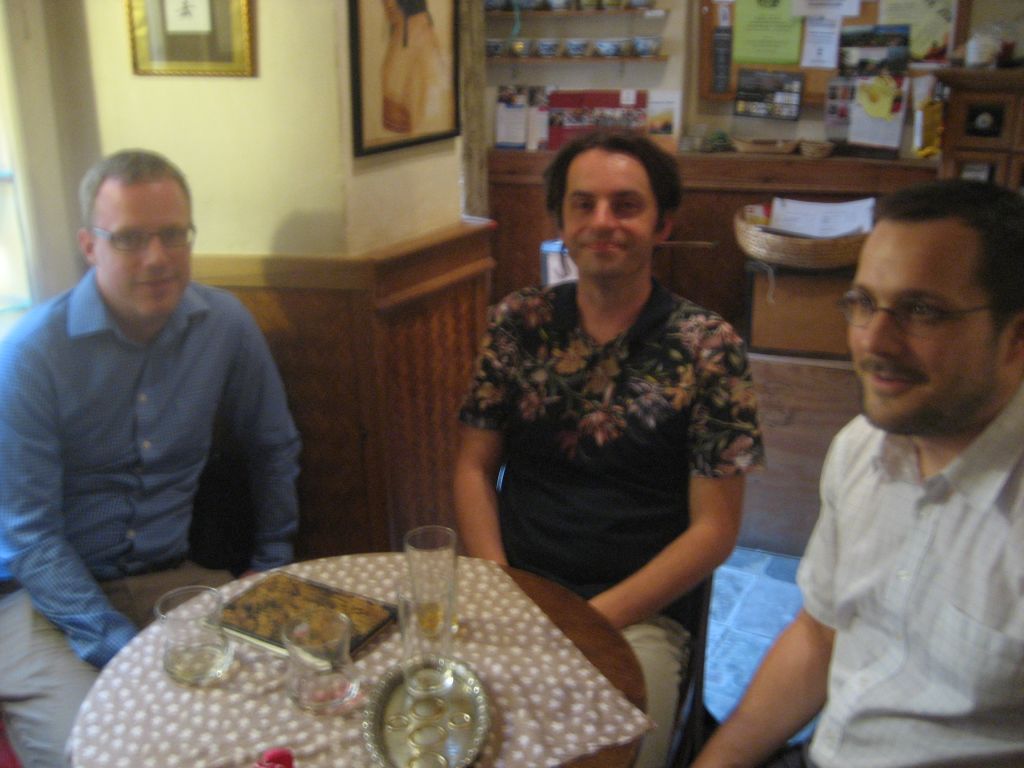
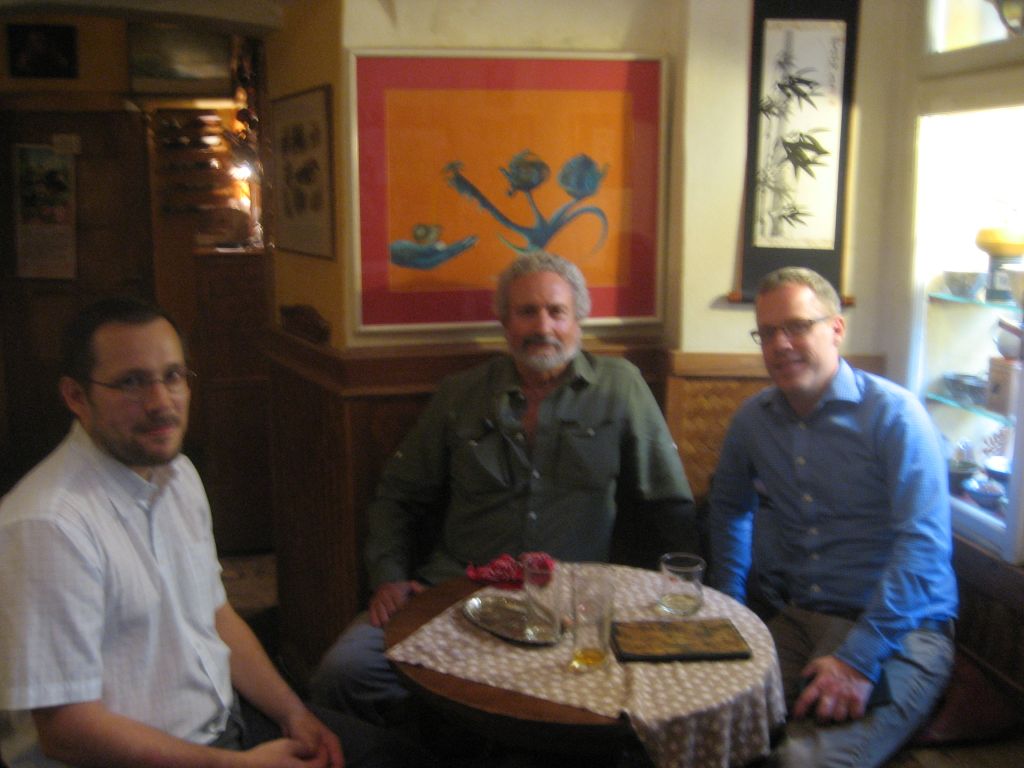
The following is the meat of a Substack post by our friend Vlastimil Vohanka.  He is the man in the middle. To his left is Lukas Novak, and to his right an American philosopher whose name I have forgotten. I took the picture in  a tea house in Prague in June of 2018.  Since then V’s views seem to have changed considerably.  I don’t know the whole story; he can add whatever details he likes.   He strikes me as in the grip of a midlife crisis.  If so, that may help explain the dark jag he is now on.  He converted to Catholicism around the time I met him, if I rightly recall, but has since, as it seems to me, performed a sort of theological epoché  with respect to the teachings of Rome.

To anyone in a midlife crisis my advice is to hunker down and ride it out. A Philosopher on the Midlife Crisis adds some details and tells my story.  When you come out on the other end you may ask yourself as I asked myself after a crisis that took about eight years fully to recover from: What was that all about?

Here is what V has to say in the post in question. Feel free to comment.

Claim: ordinary life is (a) okayish but (b) not worth living. Even Socrates and Schopenhauer agree on (b). So do many religious people. The strategies vary but go in several and at times compatible types: (1) martyr yourself or do something else heroic (the way of optimistic hazards of saints, missionaries, Don Quijote, Nietzsche, Juenger, Camus, conquerors, explorers, revolutionaries, guerrilas, adrenaline sportsmen, and psychopaths), (2) kill yourself (the way of desperates), (3) wait for death and have hope beyond it (the way of believers; most common, often most tame and inconspicuous, recall Kierkegaard’s Knight of Faith), (4) stop thinking (the way of Schopenhauer and some Eastern people), (5) think real deep (the way of Socrates and Einstein), (6) go intense raw hedonic (the way of rock stars and addicts), (7) go intense subtle hedonic (the way of dedicated artists, psychonauts, occultists, and some Eastern people). I respect most some variations on the 1st way.

I can relate to this. V and I agree that the unexamined life of the ordinary schlep is not worth living.  And yes, Socrates and Schopenhauer agree on this point despite their differences.  V and I both seek Something More than what is envisaged from the vantage point of bourgeois mediocrity.  We are both existentialists in a sense I won’t pause to define except to say that philosophy, the real thing, is not an arcane academic game from which  some manage to fill their bellies, but the  pursuit and appropriation of the ultimate truth about the ultimate matters.

As a young man, it was for me either suicide, mediocrity, or striving. And so I gave up electrical engineering and an assured path for the risks of the philosophical quest.  It was the ’60s, a time of great ferment socially, politically, religiously.  The Vietnam war had become a quagmire. Who was I to believe about it? I didn’t want to end up in the military-industrial complex working for Raytheon, say, designing  guidance systems for missiles.  I needed Perspective, the Big Picture, and you can’t get that from material science, fluid mechanics, or by struggling to solve ‘diffy q’s.’ (differential equations).

V  wants to live heroically, epically; he wants a great life.  Of the three people he mentions under (1) above,  my impression is that he is most attracted by the life-path of  Ernst Jünger.  V can tell us whether he has read Jünger’s recently translated and released Approaches: Drugs and Altered States (Telos Press, 2022).

(2) is out for both of us. Nothing is stupider than to kill yourself when life itself will perform that service soon enough.  Your girl friend dumped you? Give it six months and you will wonder what you ever saw in her in the first place.  I have elsewhere expressed my lack of sympathy for that gastro-tourist Anthony Bourdain who hanged himself. (By the way, this pedant reminds you that a man is hanged; his coat is hung.) You will call me ‘insensitive’ re: Bourdain, but I grant that suicide make sense and is forgivable  and even morally justifiable in some cases, extreme clinical depression being one of them.  A contemporary locus classicus on this topic is William Styron’s Darkness Visible.  I was mercifully spared clinical depression. My depressions were amenable to my own self-brewed logotherapy.  The worst year of my life was my 21st when I experienced what I called my Existential Malaise Crisis. Good old Emersonian self-reliance pulled me through. If you really need help that you cannot self-provide, however, don’t be afraid to ask for it!

And if you are tempted by suicide, are you quite sure what’s on The Other Side?  The link will take you to a book  by a well-known theological ‘quantity’ in the ’60s, Bishop James A. Pike, about his son who killed himself, and supposedly reports back.

The raw hedonism of (6) is out for me.  The search for the Real in intensity of experience was trademark ’60s  and many of us were beguiled by it to the point of dying from it. I dabbled with it and came close but pulled back in time.

I was never tempted by the subtle hedonism of (7).  An early familiarity with Kierkegaard and his Stages on Life’s Way (the aesthetic, the ethical, and the religious)  anesthetized me to  aestheticism. But it wouldn’t have had that effect had I not been antecedently predisposed, by my training in pre-Vatican II Roman Catholicism, to take seriously the moral and the related religious points of view.  That training and teaching fell, not on stones, but on fertile soil that was there innately.

I suppose the difference between me and Vlastimil is that, while he is drawn to some of the life-styles of (1), I am drawn to an amalgam of (3), (4), and (5) in that I hope beyond this life in the conviction that, if this is it, the game ain’t worth the candle; that the ability to silence at will the discursive mind (“stop thinking” as V puts it) is an ability that one ought to cultivate and practice; that the rational mind must be celebrated within its limits and taken as deep as one can take it.

Play to Win . . .

. . . but with complete detachment from the outcome.  So I tell myself, while playing chess, for example, but not only in such competitions, but in all the affairs of life. Be like the lotus leaf that floats on the water but does not become wet! (Bhagavad Gita 5:10) But does the self-admonition refer to an achievable ideal? Is it psychologically possible for a human being freely to strive to accomplish some end he values but remain completely indifferent as to whether or not he achieves his end?

If it is not psychologically possible, then it cannot be an ideal let alone a moral obligation. Ought implies can, and what I ought to do I am morally obliged to do.  Surely I am not morally obliged to remain wholly indifferent to whether I achieve what I set out to achieve in all the pursuits of life if such detachment is psychologically impossible. 

What's more, such detachment is not even an ideal if my generalized 'ought' implies 'can' principle holds water.

Ideals and Non-Attachment

Self-mastery, you say, is the highest mastery. You are attached to this ideal and you live for the most part in accordance with it. But on occasion you stumble and fall. You lose your temper, overeat, or succumb to lust. And then you feel disgust with yourself. The failure hurts your ego. It diminishes your sense of distinction, which is what the ego is. The pain of moral failure reveals attachment to an ideal and a self-image. Is it the ideal you honor or your self-image? The solution is not to abandon  the ideal,  but to pursue it with detachment from the outcome, the outcome being either your success or your failure in meeting its demand.

Non-attachment is an ideal too. You can identify with it and become attached to it to the detriment of your non-attachment. But if I am not my property, pelf, and productions, nor my body, nor my transient states of mind, how could I be my ideals? They too are external.  If I identify  with the ideal of non-attachment, then I am attached to it, and to that extent conflate my (true) self with my (worldly) ego. 'My' ideals are not me. I don't own them or control them. It would be truer to say that they own me and control me. They are not ex-pressions of any true self I may have. They are not my innermost identity; I acquire an objective, a worldly identity by identifying with them. 

So subtle are the dialectics of the self and the demands of the moral life.