Julian Green, Diary 1928-1957, an excerpt from the entry of 24 March 1951, p. 243:
Since my return to France in 1945, I never had an opportunity of seeing Gide without his attempting, one way or the other, to aim a blow at my [Roman Catholic] faith. [. . .] It would be understanding him very badly to say that he played the part of Satan. Quite the contrary, his purpose was to save me. He wanted to win me over to unbelief and exerted all the zeal of a Christian trying to convince an infidel. That is what perturbed me. Any means seemed good to him in order to make me doubt, because that was the price of salvation. And what was religious in him lent a particular form to his atheism, and to his nonbelief the aspect of a religion. On the other hand, his extraordinary intuition of human beings allowed him to sense how much I was upset by our talks on Catholicism, no matter what pains I took to hide my state of mind. I sometimes eluded this trying subject; he brought me back to it, gently, firmly, with the obstinacy of a missionary. Finally, he realized he was wasting his time (I could no more fall back than a man with a wall behind him), but he never quite gave up trying to convert me, and did so visibly for conscience’ sake and sometimes against his will.
I find Gide’s evangelically atheist attitude exceedingly strange. What was Gide trying to save Green from? Error? Being wrong? Surely not from perdition! Perhaps Gide was trying to save Green from anxiety in this life over whether he would end up in hell in the next. But I see no evidence of this in Gide.
And what was Gide trying to convert Green to? The truth? That would make Gide a proselyte for the truth when Gide was opposed to the proselytic mentality. He didn’t like it when Paul Claudel, who presumed to be in firm possession of the ultimate truth about the ultimate matters, tried to bring Gide into the Roman Catholic fold.
If Gide did not like people trying to convert him to what they took to be true for his own good, how could he, consistently with that dislike, aim to convert people like Green to what he, Gide, took to be true, namely, that there is no God, no soul, no higher purpose to human existence, no ultimate justice for the countless victims of injustice, no final succor or salvation from our earthly predicament? Claudel was sincerely concerned about Gide’s spiritual welfare. Given what Gide believed, could he be concerned with Green’s spiritual welfare?
And how could Gide be so cocksure that he had the truth? Giben that he was skeptical of Green’s belief, why wasn’t he also skeptical of his own disbelief?
The deepest issue here, it seems to me, is the question of the value of truth. Is it good for us to know the truth, or would it be better for us not to know the truth? You might respond that it depends on what the truth is. If the truth is that we will can look forward to a blissful eternity, then that is a truth it would be good to know. But if the truth is that we will shortly be worm fodder, then that is a truth it would not be good to know.
To respond in this way, however, would show a failure to understand the question. The question is whether truth, whatever it is, is a value. Value for whom? For us. So the question is whether the truth would be good for us know.
Truth is one thing, its value another. If you have the truth, then you are in touch with the way things are, whether partially or completely. One way of being in touch is by knowing how things stand in reality. Another is by believing truly how things stand in reality, where to believe truly is to have a true belief. Knowing and believing truly are not the same but they can be subsumed under the rubric reality-contact. Either way one is in contact with reality. But is it good for us to be in contact with the way things are? Will this contact contribute to our flourishing, our living well, our being happy on balance and in the long run? To say yes is to say that truth, or rather contact with reality whether via knowledge or belief, is a value, a good thing.
Gide’s attitude seems to be that the truth is the supreme value whether or not it is good for us to know it. The opposite attitude is that of William James who maintained that the true is the good by way of belief.
But now we are in deep. Time to rustle up some vittles for the evening’s repast before Mark Levin comes on. There’s more to life than philosophy. There’s politics!

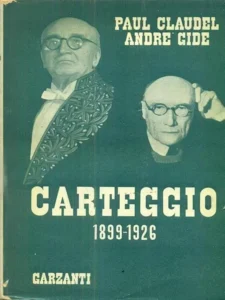 On occasion we encounter morally good people who are sincerely interested in our spiritual welfare, so much so that they fear that we will be lost if we differ from the views they cherish, even if our views are not so very different from theirs. Julian Green in his Diary 1928-1957, entry of 10 April 1929, p. 6, said to André Gide: