
Seven Ways of Life

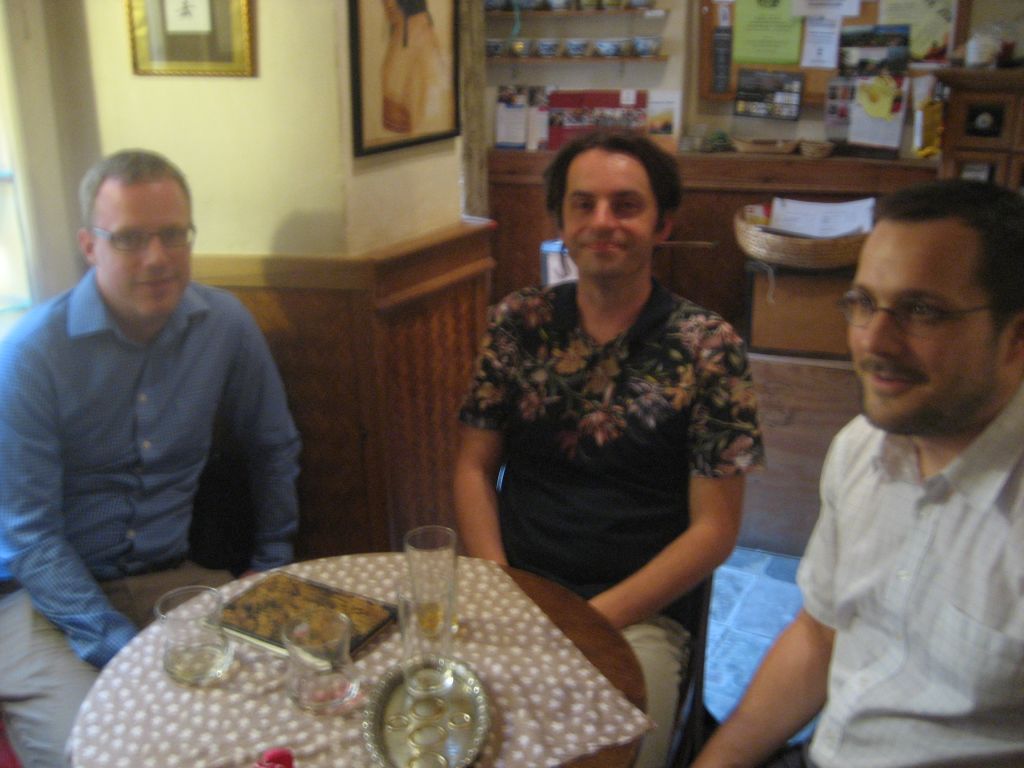
The following is the meat of a Substack post by our friend Vlastimil Vohanka.  He is the man in the middle. To his left is Lukas Novak, and to his right an American philosopher whose name I have forgotten. I took the picture in  a tea house in Prague in June of 2018.  Since then V’s views seem to have changed considerably.  I don’t know the whole story; he can add whatever details he likes.   He strikes me as in the grip of a midlife crisis.  If so, that may help explain the dark jag he is now on.  He converted to Catholicism around the time I met him, if I rightly recall, but has since, as it seems to me, performed a sort of theological epoché  with respect to the teachings of Rome.

To anyone in a midlife crisis my advice is to hunker down and ride it out. A Philosopher on the Midlife Crisis adds some details and tells my story.  When you come out on the other end you may ask yourself as I asked myself after a crisis that took about eight years fully to recover from: What was that all about?

Here is what V has to say in the post in question. Feel free to comment.

Claim: ordinary life is (a) okayish but (b) not worth living. Even Socrates and Schopenhauer agree on (b). So do many religious people. The strategies vary but go in several and at times compatible types: (1) martyr yourself or do something else heroic (the way of optimistic hazards of saints, missionaries, Don Quijote, Nietzsche, Juenger, Camus, conquerors, explorers, revolutionaries, guerrilas, adrenaline sportsmen, and psychopaths), (2) kill yourself (the way of desperates), (3) wait for death and have hope beyond it (the way of believers; most common, often most tame and inconspicuous, recall Kierkegaard’s Knight of Faith), (4) stop thinking (the way of Schopenhauer and some Eastern people), (5) think real deep (the way of Socrates and Einstein), (6) go intense raw hedonic (the way of rock stars and addicts), (7) go intense subtle hedonic (the way of dedicated artists, psychonauts, occultists, and some Eastern people). I respect most some variations on the 1st way.

I can relate to this. V and I agree that the unexamined life of the ordinary schlep is not worth living.  And yes, Socrates and Schopenhauer agree on this point despite their differences.  V and I both seek Something More than what is envisaged from the vantage point of bourgeois mediocrity.  We are both existentialists in a sense I won’t pause to define except to say that philosophy, the real thing, is not an arcane academic game from which  some manage to fill their bellies, but the  pursuit and appropriation of the ultimate truth about the ultimate matters.

As a young man, it was for me either suicide, mediocrity, or striving. And so I gave up electrical engineering and an assured path for the risks of the philosophical quest.  It was the ’60s, a time of great ferment socially, politically, religiously.  The Vietnam war had become a quagmire. Who was I to believe about it? I didn’t want to end up in the military-industrial complex working for Raytheon, say, designing  guidance systems for missiles.  I needed Perspective, the Big Picture, and you can’t get that from material science, fluid mechanics, or by struggling to solve ‘diffy q’s.’ (differential equations).

V  wants to live heroically, epically; he wants a great life.  Of the three people he mentions under (1) above,  my impression is that he is most attracted by the life-path of  Ernst Jünger.  V can tell us whether he has read Jünger’s recently translated and released Approaches: Drugs and Altered States (Telos Press, 2022).

(2) is out for both of us. Nothing is stupider than to kill yourself when life itself will perform that service soon enough.  Your girl friend dumped you? Give it six months and you will wonder what you ever saw in her in the first place.  I have elsewhere expressed my lack of sympathy for that gastro-tourist Anthony Bourdain who hanged himself. (By the way, this pedant reminds you that a man is hanged; his coat is hung.) You will call me ‘insensitive’ re: Bourdain, but I grant that suicide make sense and is forgivable  and even morally justifiable in some cases, extreme clinical depression being one of them.  A contemporary locus classicus on this topic is William Styron’s Darkness Visible.  I was mercifully spared clinical depression. My depressions were amenable to my own self-brewed logotherapy.  The worst year of my life was my 21st when I experienced what I called my Existential Malaise Crisis. Good old Emersonian self-reliance pulled me through. If you really need help that you cannot self-provide, however, don’t be afraid to ask for it!

And if you are tempted by suicide, are you quite sure what’s on The Other Side?  The link will take you to a book  by a well-known theological ‘quantity’ in the ’60s, Bishop James A. Pike, about his son who killed himself, and supposedly reports back.

The raw hedonism of (6) is out for me.  The search for the Real in intensity of experience was trademark ’60s  and many of us were beguiled by it to the point of dying from it. I dabbled with it and came close but pulled back in time.

I was never tempted by the subtle hedonism of (7).  An early familiarity with Kierkegaard and his Stages on Life’s Way (the aesthetic, the ethical, and the religious)  anesthetized me to  aestheticism. But it wouldn’t have had that effect had I not been antecedently predisposed, by my training in pre-Vatican II Roman Catholicism, to take seriously the moral and the related religious points of view.  That training and teaching fell, not on stones, but on fertile soil that was there innately.

I suppose the difference between me and Vlastimil is that, while he is drawn to some of the life-styles of (1), I am drawn to an amalgam of (3), (4), and (5) in that I hope beyond this life in the conviction that, if this is it, the game ain’t worth the candle; that the ability to silence at will the discursive mind (“stop thinking” as V puts it) is an ability that one ought to cultivate and practice; that the rational mind must be celebrated within its limits and taken as deep as one can take it.
Is Religion Escapist?

Escapist LadderEscapism is a form of reality-denial.   One seeks to escape from reality into a haven of illusion.  One who flees a burning building we do not call an escapist.  Why not?   Because his escape from the fire is not an escape into unreality, but into a different reality, one decidedly superior to that of being incinerated.  The prisoner in Plato's Cave who ascended to the outer world escaped, but was not an escapist. He was not escaping from, but to, reality.

Is religion escapist?  It is an escape from the 'reality' of time and change, sin and death.  But that does not suffice to make it escapist.  It is escapist only if this life of time and change, sin and death, is all there is.  And that is precisely the question, one not to be begged.

You tell me what reality is, and I'll tell you whether religion is an escape from it. 

You say that you know what reality is? You bluster!

There is a nuance I ought to mention.  In both Platonism and Buddhism, one who has made "the ascent to what is" (Republic 521 b) and sees aright, is enjoined to  return so as to help those who remain below.  This is the return to the Cave mentioned at Republic 519 d.  In Buddhism, the Boddhisattva ideal enjoins a return of the enlightened individual to the samsaric realm to assist in the enlightenment of the sentient beings remaining there.

To return to the image of the burning building.  He who flees a burning building is no escapist: he flees an unsatisfactory predicament, one dripping with dukkha, to a more satisfactory condition.  Once there, if he is granted the courage, he reconnoiters the situation, dons fire-protective gear, and returns to save the trapped.

Both the Cave and the samsaric realm are not wholly unreal, else there would be no point to a return to them.  But they are, shall we say, ontologically and axiologically deficient.

I pity the poor secularist who believes in nothing beyond them.

Image credit

What is Man?

Engel noch tastendHe is an animal, but also a spirit — and thus a riddle to himself. He reasons and speaks, he objectifies, he says 'I' and he means it. He does not parrot the word 'I' in the manner of a parrot or a voice synthesizer; uttering 'I' he expresses self-awareness.  Man has a world (Welt), not merely an environment (Umwelt).  Man envisages a higher life, a higher destiny, whether within history or beyond it.  And then he puzzles himself over whether this envisagement is a mere fancy, a delusion, or whether it presages the genuine possibility of a higher life. 

More than an animal, he can yet sink lower than any animal, which fact is a reverse index of his spiritual status.  He can as easily devote himself to scatology as to eschatology.  The antics of a Marquis de Sade are as revelatory of man's status as the life of a St. Augustine.  It takes a spiritual being both to willingly empty oneself into the flesh and to transcend it. 

Kierkegaard writes that "every higher conception of life . . . takes the view that the task for men is to strive after kinship with the Deity . . . ."  (Attack Upon Christendom, p. 265)  We face the danger of "minimizing our own significance" as S. K. puts it, of selling ourselves short.  And yet how difficult it is to believe in one's own significance!  The problem is compounded by not knowing what one's significance is, assuming that one has significance.  Not knowing what it is, one can question whether it is. 

Kierkegaard solves the problem by way of his dogmatic and fideistic adherence to Christian anthropology and soteriology.  Undiluted Christianity is his answer.  My answer:   live so as to deserve immortality.  Live as if you have a higher destiny.  It cannot be proven, but the arguments against it can all be neutralized.  Man's whence and whither are shrouded in darkness and will remain so in this life.  Ignorabimus. In the final analysis you must decide what to believe and how to live.

You could be wrong, no doubt.  But if you are wrong, what have you lost?  Some baubles and trinkets.  If you say that truth will have been lost, I will ask you how you know that and why you think truth is a value in a meaningless universe.  I will further press you on the nature of truth and undermine your smug conceit that truth could exist in a meaningless wholly material universe.

The image is by Paul Klee, Engel noch tastend, angel still groping.   We perhaps are fallen angels, desolation angels, in the dark, but knowing that we are, and ever groping.

Running as Equalizer?

Kirk Johnson, To the Edge: A Man, Death Valley, and the Mystery of Endurance, Warner 2001, p. 179:

Runners, I believe, are the last great Calvinists.  We all believe, on some level, that success or failure in a race — and thus in life — is a measure of our moral fiber.  Part of that feeling is driven by the psychology of training, which says that success only comes from the hardest possible work output, and that failure is delivered unto those who didn't sweat that extra mile or that extra hour.  The basic core of truth in that harsh equation is also one of the more  appealing things about recreational racing: It really does equalize everyone out.  A rich man's wallet only weighs him down when he's running, and a poor man can beat him.  Hard work matters.

In one way running equalizes, in another it doesn't. 

It levels the disparities of class and status and income.  You may be a neurosurgeon or a shipping clerk.  You won't be asked and no one cares.  The road to Boston or Mt. Whitney is no cocktail party; masks fall away.  One does not run to shmooze.  This is not golf.  Indigent half-naked animal meets indigent half-naked animal in common pursuit of a common goal: to complete the self-assigned task with honor, to battle the hebetude of the flesh, to find the best that is in one, the 'personal best.'  

But in quest of one's personal best the hierarchy of nature reasserts herself.  We are not equal in empirical fact and the road race makes this plain.  In running as in chess there is no bullshit: result and rank are clear for all to see.  Patzer and plodder cannot hide who they are and where they stand — or fall.

So although running flattens the socio-economic distinctions, it does so only to throw into relief the differences of animal prowess and the differences in spiritual commitment to its development.

Life is hierarchical.