
I dust off, revise, and expand this old entry in connection with discussions with Malcolm Pollack, Dmitri D. et al. about artificial intelligence. One of the questions is whether AI systems are subjects of intrinsic intentional states. I incline to the view that they are not. Since intentional states are meaning-laden, I further incline to the view that no AI system, not even the most advanced LLMs, understand language or anything else. They are merely syntactic engines.
………………………….
1. Intentionality: Original and Derived
All will agree that there is a distinction to be made between original (intrinsic) and derived intentionality. Intentionality is aboutness. For example, a map is not the terrain it maps; the map is about the terrain. What makes the map about the terrain? A map is not about a chunk of terrain and its geological features just in virtue of the map’s physical and geometrical properties. Consider the contour lines on a topographical map. The closer together, the steeper the terrain. Closer together means steeper. But surely the lines and their arrangement have no representational power in themselves. That closer together should mean steeper is a meaning assigned by map-makers and agreed to by map-users.
The point is that a map’s meaning is not intrinsic to the map qua physical object. The meaning derives from us. There has to be one or more meaning-assigners and meaning-apprehenders external to the map to give the map a meaning and determine what that meaning is. The map’s intentionality is derivative: it derives, or has it source in, our intentionality, which is original.
So some things, maps for example, derive their semantic properties from other things, map-makers and map-users, for example. Semantics has to do with sense and reference. ‘Meaning’ covers both. Setting sense aside for now, the reference or referent of a map is that to which it purports to refer.
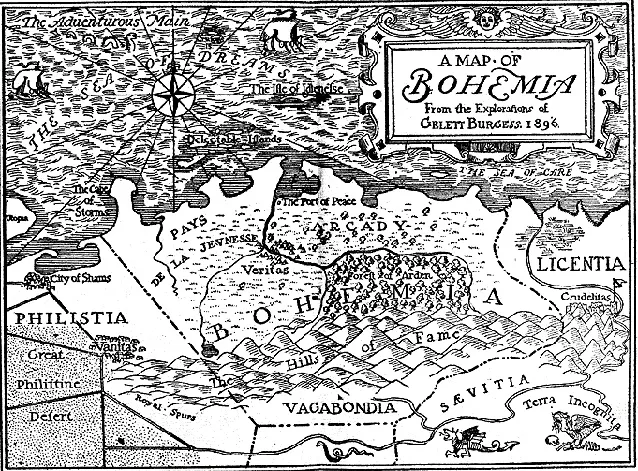
But note that a map needn’t actually refer to anything to be map. It need only purport to refer. This is a well-known characteristic feature of intentionality or aboutness or object-directedness: the existence in reality of the intentional object does not follow from the fact that something intends it. Thus the existence in reality of a chunk of terrain does not follow from the existence of a map of it. The map directly below purports to refer to something extra-cartographically real, but fails in its purport. It is no less a map for all that.
Suppose I draw you a map so that you can find my camp in the extra-cartographically real Superstition Wilderness. I use the Greek uppercase Φ to mark my camp and the Greek uppercase Ψ to mark the camp of a heavily-armed crazy man that you are well advised to avoid. I intend that Φ designate my camp, and Ψ his. That intending (narrow sense) is a case of intentionality (broad sense). I am the meaning-assigner. I assign a referent to the Greek symbols, thereby making those inscriptions mean (refer to) something, symbolize something.
A symbol may be viewed for certain purposes as a purely syntactic unit. To view it this way is to abstract from its semantic properties. A symbol in use, however a symbol that symbolizes, a symbol that exercises its symbolic function, is a syntactic unit that means something other than it, and is therefore more than a merely syntactic. A syntactic engine is a machine that manipulates symbols qua syntactic units, ‘tokens’ is what the AI guys call them. A computer is just a syntactic engine. The same is true of the most advanced AI systems. The manipulation of symbols as mere syntactic units cannot confer meaning upon them. Such ‘manipulation’ is neither constitutive of nor sufficient for meaning.
Or at least this is a question we need to consider. I incline to the view that, just as you cannot squeeze blood from a stone, you cannot squeeze semantics from syntactics. No AI system, not even the most advanced LLM, can by itself, mean anything or understand anything.
It is also important to note that the very distinction between syntax and semantics presupposes languages and understanding, and thus presupposes the antecedent ‘marriage’ of the syntactic and semantic. How then can we reduce the latter to the former? I’ll spell this out in later posts.
I have said enough to make clear the difference between derived and original intentionality. The symbols on my map derive their intentionality or aboutness from my intentionality which, relative to theirs, is original. But if the origin of their intentionality is in me, and not in them, might it not be the case that my intentionality is itself derived? After all, it does not follow from the fact that I am the source of the intentionality of the symbols on my map that my intentionality does not itself have a source. But if so, then a regress threatens which appears to be both infinite and vicious. But before discussing this further, I need to bring in another point.
2. Ascriptivism Versus Realism
Daniel Dennett appears to hold an ascriptivist or projectivist or imputationalist or instrumentalist theory of intentionality: nothing is an intentional system intrinsically or an sich; a system is intentional only in virtue of someone’s assigning intentional states to it. Thus there is no intrinsic intentionality in my computer (when it is running a chess program or any program). But it may be nonetheless useful to take up the “intentional stance” vis-a-vis the computer and impute to it beliefs and desires (e.g., the desire to inflict mate) in order to explain its behavior. Given the computer’s complexity, the intentional stance promises an easier explanation that the physical and design stances do.
A realist about intentionality, on the other hand, is someone who holds that some systems really are intrinsically intentional: their having beliefs and desires and other object-directed states is not a matter of anyone’s viewing them as having such states. I am a realist: some systems are intrinsically intentional. But there are two ways to be a realist.
One way is by being a reductive realist. Such a person admits the reality of intentional states but identifies them with something believed to be more fundamental such as brain states. If you believe, with Fred Dretske, that intentionality does not need naturalizing, but already is a natural phenomenon in the natural world, then you are presumably a reductive realist about intentionality. You are saying this: there is intrinsic intentionality, but it is physical in nature.
I’m a realist too, but a nonreductive one: I hold that intentionality is irreducibly real: it cannot be reduced to, or identified with, anything else. It is what it is and not some other thing. It is what it is and it is spiritual in nature. Part of the reason I believe this is because the alternatives are quite hopeless. But what on earth or in heaven does ‘spiritual’ mean? This is a challenge I face.
3. The Ascriptivist Regress
Back to Dennett. Suppose one takes the ascriptivist line. Then an infinite regress appears unavoidable. Suppose I ascribe intentionality to my chess playing computer. Quite obviously, my ascribing, projecting, imputing, is itself an intentional state or a series of such states. So if ascriptivism is true, then my acts of ascribing must themselves be ascribed — otherwise they are intrinsic and Danny’s game is over. This launches us on a regress that is obviously infinite since at each level, one can “kick it up a notch.” It is also clear that this regress (unlike the truth regress) is vicious since at no level is the explanation of intentionality complete.
One might think to avoid the regress by embracing a circle: I ascribe intentional states to the computer and it ascribes intentional states to me. But surely this is even more of an absurdity for reasons that needn’t be belabored.
The upshot is that pure ascriptivism is incoherent, an utter non-starter. Dennett’s actual view is a bit different.
4. Adulterated Ascriptivism : Homunculism
Perhaps the solution is to mix some realism in with the ascriptivism. Maybe it goes like this. I have a head full of homunculi. These little men and women, working together, ascribe intentionality to me. But each homunculus has its intentionality ascribed to it by other, stupider, homunculi which are constituents of it. The stupider homunculi, in turn, are composed of even stupider ones, and so on until we get to the level of individual neurons which aren’t ‘about’ anything. The base level homunculli are so stupid that one could say that they don’t even rise to the level of being either stupid or intelligent.
Does this avoid the dilemma of having to choose between a vicious infinite regress and a vicious circle? What Dennett is proposing is a finite regress that terminates with something naturalistically acceptable, namely entities that lack intrinsic or original intentionality.
Admittedly, this proposal gets rid of the infinity of the regress, but not its viciousness: we still have no explanation of intentionality. Consider the base-level homunculi. They are so primitive as to lack all intentionality. How then can they ascribe intentionality to their colleagues one level up? Surely it is obvious that the ascribing of intentionality is itself an intentional act or series thereof.
The point is quite simple. If the regress terminates with base entities utterly devoid of intentionality, then no higher level entities will be intentional. For the higher-ups get their intentionality only from the ones lower down in the hierarchy. If the ones at the very bottom have no intentionality, then they can’t transmit it up. But if, on the other hand, the ones at the very bottom possess intentionality, then it is false that all intentionality is derived.
In the final analysis, Dennett is an eliminativist about intentionality. His position amounts in the end to the denial of intentionality. To see this, you just have to think clearly. Dennett is saying that all intentionality is derivative, none is intrinsic or original. But that makes sense only if one embraces an infinite regress. But in this case an infinite regress must be vicious. On the other hand, a regress that terminates either terminates with entities that are intrinsically intentional or entities that are not. If the former, the game is over. If the latter, no intentionality gets transmitted up and Dennett is an eliminativist about intentionality just as he is an eliminativist about consciousness and qualia.