
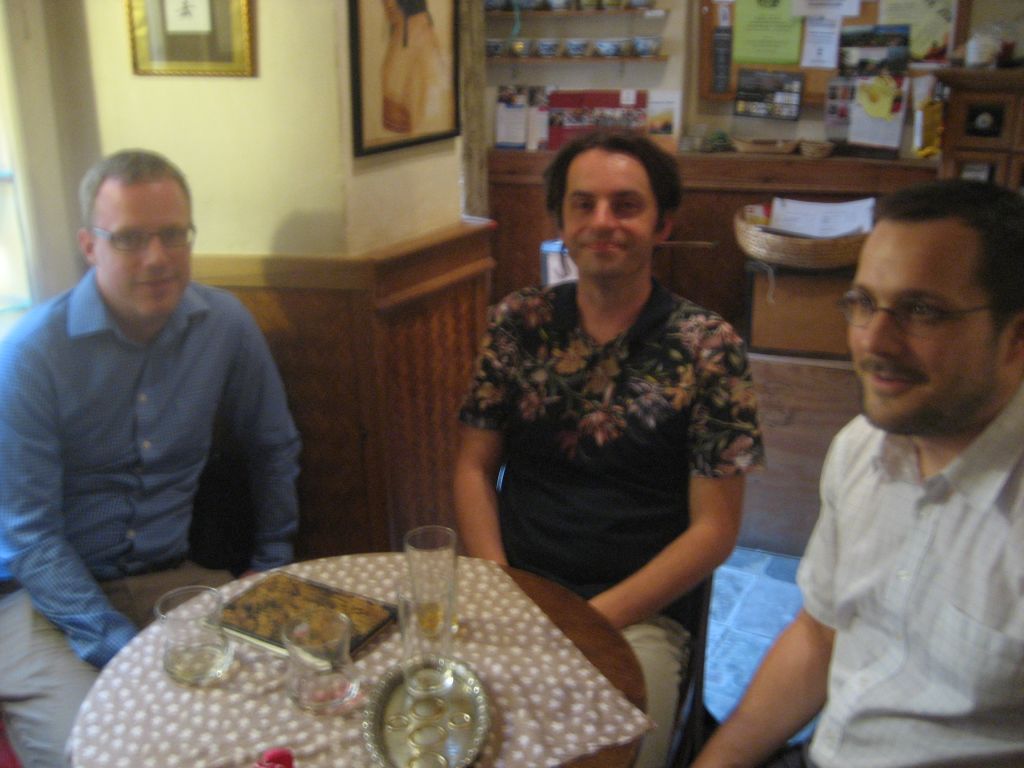
The following is the meat of a Substack post by our friend Vlastimil Vohanka. He is the man in the middle. To his left is Lukas Novak, and to his right an American philosopher whose name I have forgotten. I took the picture in a tea house in Prague in June of 2018. Since then V’s views seem to have changed considerably. I don’t know the whole story; he can add whatever details he likes. He strikes me as in the grip of a midlife crisis. If so, that may help explain the dark jag he is now on. He converted to Catholicism around the time I met him, if I rightly recall, but has since, as it seems to me, performed a sort of theological epoché with respect to the teachings of Rome.
To anyone in a midlife crisis my advice is to hunker down and ride it out. A Philosopher on the Midlife Crisis adds some details and tells my story. When you come out on the other end you may ask yourself as I asked myself after a crisis that took about eight years fully to recover from: What was that all about?
Here is what V has to say in the post in question. Feel free to comment.
Claim: ordinary life is (a) okayish but (b) not worth living. Even Socrates and Schopenhauer agree on (b). So do many religious people. The strategies vary but go in several and at times compatible types: (1) martyr yourself or do something else heroic (the way of optimistic hazards of saints, missionaries, Don Quijote, Nietzsche, Juenger, Camus, conquerors, explorers, revolutionaries, guerrilas, adrenaline sportsmen, and psychopaths), (2) kill yourself (the way of desperates), (3) wait for death and have hope beyond it (the way of believers; most common, often most tame and inconspicuous, recall Kierkegaard’s Knight of Faith), (4) stop thinking (the way of Schopenhauer and some Eastern people), (5) think real deep (the way of Socrates and Einstein), (6) go intense raw hedonic (the way of rock stars and addicts), (7) go intense subtle hedonic (the way of dedicated artists, psychonauts, occultists, and some Eastern people). I respect most some variations on the 1st way.
I can relate to this. V and I agree that the unexamined life of the ordinary schlep is not worth living. And yes, Socrates and Schopenhauer agree on this point despite their differences. V and I both seek Something More than what is envisaged from the vantage point of bourgeois mediocrity. We are both existentialists in a sense I won’t pause to define except to say that philosophy, the real thing, is not an arcane academic game from which some manage to fill their bellies, but the pursuit and appropriation of the ultimate truth about the ultimate matters.
As a young man, it was for me either suicide, mediocrity, or striving. And so I gave up electrical engineering and an assured path for the risks of the philosophical quest. It was the ’60s, a time of great ferment socially, politically, religiously. The Vietnam war had become a quagmire. Who was I to believe about it? I didn’t want to end up in the military-industrial complex working for Raytheon, say, designing guidance systems for missiles. I needed Perspective, the Big Picture, and you can’t get that from material science, fluid mechanics, or by struggling to solve ‘diffy q’s.’ (differential equations).
V wants to live heroically, epically; he wants a great life. Of the three people he mentions under (1) above, my impression is that he is most attracted by the life-path of Ernst Jünger. V can tell us whether he has read Jünger’s recently translated and released Approaches: Drugs and Altered States (Telos Press, 2022).
(2) is out for both of us. Nothing is stupider than to kill yourself when life itself will perform that service soon enough. Your girl friend dumped you? Give it six months and you will wonder what you ever saw in her in the first place. I have elsewhere expressed my lack of sympathy for that gastro-tourist Anthony Bourdain who hanged himself. (By the way, this pedant reminds you that a man is hanged; his coat is hung.) You will call me ‘insensitive’ re: Bourdain, but I grant that suicide make sense and is forgivable and even morally justifiable in some cases, extreme clinical depression being one of them. A contemporary locus classicus on this topic is William Styron’s Darkness Visible. I was mercifully spared clinical depression. My depressions were amenable to my own self-brewed logotherapy. The worst year of my life was my 21st when I experienced what I called my Existential Malaise Crisis. Good old Emersonian self-reliance pulled me through. If you really need help that you cannot self-provide, however, don’t be afraid to ask for it!
And if you are tempted by suicide, are you quite sure what’s on The Other Side? The link will take you to a book by a well-known theological ‘quantity’ in the ’60s, Bishop James A. Pike, about his son who killed himself, and supposedly reports back.
The raw hedonism of (6) is out for me. The search for the Real in intensity of experience was trademark ’60s and many of us were beguiled by it to the point of dying from it. I dabbled with it and came close but pulled back in time.
I was never tempted by the subtle hedonism of (7). An early familiarity with Kierkegaard and his Stages on Life’s Way (the aesthetic, the ethical, and the religious) anesthetized me to aestheticism. But it wouldn’t have had that effect had I not been antecedently predisposed, by my training in pre-Vatican II Roman Catholicism, to take seriously the moral and the related religious points of view. That training and teaching fell, not on stones, but on fertile soil that was there innately.
I suppose the difference between me and Vlastimil is that, while he is drawn to some of the life-styles of (1), I am drawn to an amalgam of (3), (4), and (5) in that I hope beyond this life in the conviction that, if this is it, the game ain’t worth the candle; that the ability to silence at will the discursive mind (“stop thinking” as V puts it) is an ability that one ought to cultivate and practice; that the rational mind must be celebrated within its limits and taken as deep as one can take it.
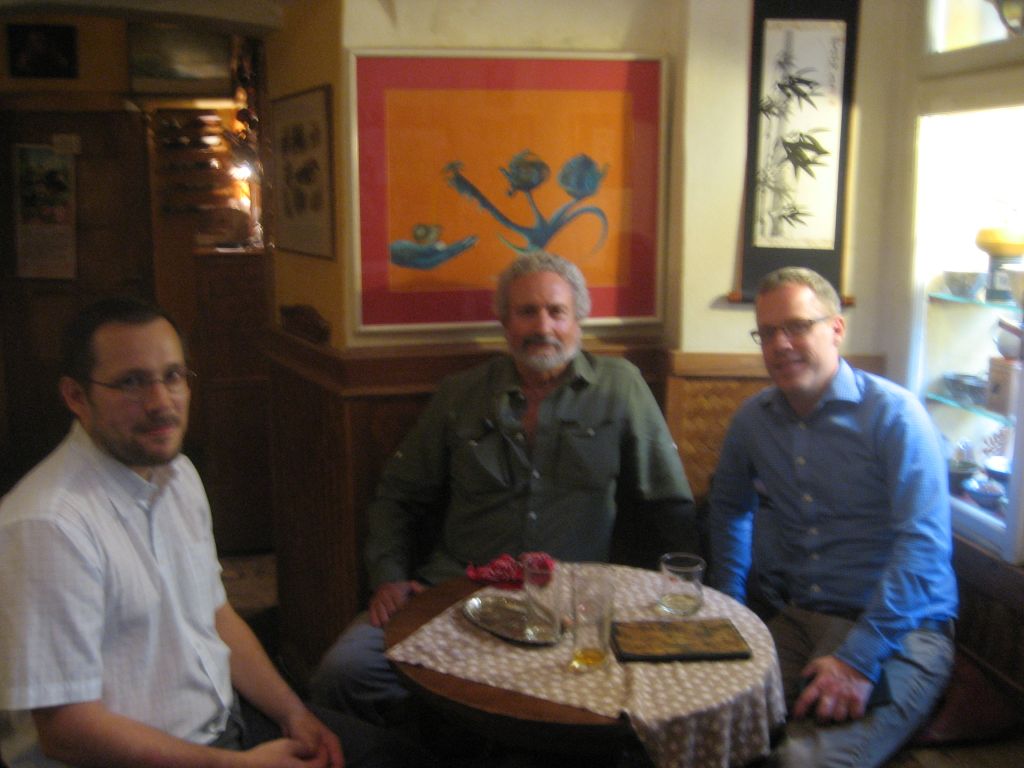
Thanks, Bill!
Just for now: I dislike that stupid soy face of mine in that pic above.
This is recent me, reading Céline.
https://drive.google.com/file/d/1LN2QqkUCpil8D8OUXEy998V-juQoMBoq/view?usp=sharing
More later.
The gentleman in blue shirt is Jason Marsh, a good philosopher.
You never struck me as ‘soy.’ What self-descriptive adjective would you use today, ‘paleo-carnivorous’?
Ah yes, Jason Marsh.
I’m dark but not depressed, though people don’t believe me.
Amor fati helps a lot.
Also sleep, coffee, good food, gym, meditation, great novels and movies, and the vague, opaque, surreal mystery of the world’s existence.
Related:
Depressed pessimists (like typical gnostics, Schopenhauer, Ligotti, Lovecraft) and manic vitalists (like Heraclitus, Nietzsche, BAP, or his friend Zero HP Lovecract, anon but excellent deep scifi horrorist) see the world similarly, they just differ in their emotional response to it.
Coincidentia oppositorum.
That’s why I say one can be dark but not depressed.
(Interestingly, to complicate things even further, David Benatar, if you recall, is close to Schopenhauer yet not depressed, it seems. You and me met him.)
Anyway, I often think of this passage from BAP’s aphoristic book Bronze Age Mindset (highly recommended).
“Some talk about this “madness behind things.” The real world is very different from the one that appears to us in waking life, but it’s not so different as to be entirely alien or abstract or “philosophical” in the way you might think. It’s not abstract, or made of perfect and eternal forms, it’s not somewhere else: it’s immanent, here, and within things, and it’s twisted. It doesn’t have any moral significance that can be understood by us. When Heraclitus speaks of all things being one, and all things being fire, he means this: when this actually shows itself to you, there is a demoniac and violent madness underlying things. The real world is similar to the apparent, but uncanny, devilish, disordered for us. Its hidden order, the fatal X behind things, reaches for things and aims beyond our scope as humans: it’s why Lovecraft knew it was true, our world is fashioned by a demiurge who is a blind, retarded schizophrenic. Its origin and happenings and its fate is in the play and war of the most gruesome factions, forgotten gods…to them we’re like stowaway rats on a ship. This shows itself most vividly in some dreams, which, if they had continuity, we couldn’t distinguish from waking life. Some but not all of the insane are able to see parts of this world, but they’re all unheard prophets, and ever more so in our time…psychiatry, a fraud, has weakened all faith in them, and of them in themselves. Everywhere the signal is jammed.”
Like Nietzsche, I suspect the cause of the difference (depressed vs vitalist response to darkness; silent despair vs genuine amor fati) is mostly physiological: inborn factors + food and climate and exercise. But I don’t deny that the worldview, meditation, childhood, romantic life, culture, economy, or chance might matter over and above that all.
Now, Bill,
How do you define midlife crisis and why do you think I am in it? Afaik, I’ve always felt held back and somewhat frustrated by what this (modern) world offers. Even as a Catholic of course.
In that regard, I’m very much with BAP a.k.a. Bronze Age Pervert, a Nietzschean philosopher with Bc. in math from MIT and PhD in philosophy from Yale:
https://blackbeardphilosopher.substack.com/p/the-boredom-of-the-gods
I don’t see how your Substack on midlife crisis addresses that exact kind of frustration with life.
I converted to Catholicism much earlier than 2018; it was in 1998, I think.
Yes, as of now, I am quite agnostic about the Christian metaphysics, but I respect it a lot, as I explain in https://blackbeardphilosopher.substack.com/p/the-goid
As for the standard Christian ethics (and political philosophy), I’ve been spoiled by Nietzscheans, so I think it’s mostly slavish and/or ineffectual: the standard dating, sex and marriage advice fails (esp. men), and the political results of Christians after, say, WWII have been super lame. They just keep losing. Here I recommend https://mansworldmag.online/towards-an-understanding-with-ned-flanders
Now, I don’t think Juenger’s is my way. I wouldn’t be a great soldier, though I don’t know for sure. I think, rather, I have some talent for being a Nietzchean philosopher or scholar: intense, keen yet not nerdy, courageous. I know how boastful it sounds, and I don’t care. I know my strengths, I’m 47.
Btw, the bottom line frame questions of lasting interest, to me, are these:
What is and how to live an epic life? (not necessarily heroic in military or similar ways)
How to avoid hell (understood broadly, as intense long-term misery) and attain heaven (intense long-term happiness)?
How to best help others in doing so?
In those contexts, how big difference does it make whether one sees oneself either as Aristotle or as Buddha suggested: i.e., either as a substance or as a process? Or also, either as predominantly free or as predominantly determined?
How to decide whether there is an afterlife and what is it like?
Are there parallel or otherwise discontinuous or separated dimensions, realms, worlds, or universes? Can and should we access them? Can and should we generate new ones?
How to decide whether there is a God? In what ways is he perfect? And what, if anything, does he want from us?
How to explore those: consult the very best relevant experts, read the very best sources; write good notes; organize meetings, research and expeditions. That would be epic enough, to me.
But there’s a hedonist strain in me, too, yes.
So, overall, for me it’s a combination of (1) (expeditions) and (5)-(7).
As for (4), to me things like meditations are tools that help in everything else; as well as back-up tools to not be very unhappy if everything fails, since they cultivate non-attachment etc.
V,
>>As the philosopher Francis Bacon puts it, “He that hath wife and children hath given hostages to fortune; for they are impediments to great enterprises, either of virtue or mischief.” << That is the only thing of value I found in that article about Ned Flanders. By the way, I had no idea who this Ned Flanders was. I was aware of "The Simpsons" but never watched even one episode. I assumed it was some stupid cartoon BS. So part of the problem is that I am 29 years older than you are, and can't take seriously a lot of the stuff you take seriously. I want to read Gad Saad's Suicidal Empathy, but BAP's book not so much. Apparently Ross Douthat got into some argument with that BAP guy. Do you have a reference for me? I poked around but couldn't find anything. Might your concern for the 'epic' be a reaction against the early childhood feminization of boys by female teachers? This seems to be a concern of a lot of you young and not-so-young guys. The author of the Ned Flanders piece mocks the uxoriousness of men like Ned Flanders, though that is not a word he uses or perhaps even knows.
Bill, I will reply by email, not here.
Later we can issue an edited version of our correspondence.
Please don’t post so much about my personal details.
V,
I apologize if I have revealed too much. Will be more circumspect in future.
Bill,
Though irrelevant to the rest of the topic I must interject a defence of The Simpsons. I can’t stand most TV shows, indeed I’ve never owned a TV as an adult, but The Simpsons at its best (Seasons 2-9) is brilliant, witty, extremely funny, endlessly quotable, a masterpiece of American popular culture. I own the DVDs and rewatch them often (on a projector). Unfortunately, it became very poor after its 9th season (though there are still a few good episodes in seasons 10 and 11) – unlike Seinfeld it didn’t know when to quit. I think if you like Seinfeld you’d probably like the best of The Simpsons – it’s less cynical and wry, more absurdist and satirical. I love both.
Hi Hector,
Your comment has weight coming from a man as erudite and well-read as you are. But as I said, I have not watched even one episode. In part, it is a generational thing. But I will try to watch an episode. As for Seinfeld, I have watched all the episodes more than once, but now some of them seem not worth wasting time on, like “Three Stooges” re-runs.
Who are these Stooges you speak of?
The Three Stooges, like the Marx Brothers, I find rather baffling. Strange how fashions in comedy change, a phenomenon for which I’ve never seen a satisfactory explanation!
You might need to watch more than one episode to get a feel for the characters and world. My favourite is probably ‘A Fish Called Selma’ from Season 7, a brilliant satire of washed-up ‘Hollyweird’ actors with an exceptional parody of the corny idiocy of (most) musicals.
As for generational tastes, my father is in his seventies and loves The Simpsons, but it probably does have more of a Gen X/Millennial appeal.
Hi, Bill. I hope you are doing well.
I agree with you about the amalgam of (3), (4), and (5).
What interests me at the moment is the compatibility of these options. One can’t do (4) and (5) simultaneously, but one can do them at different times. It seems each can provide support for (3). If one practices the rational life, taking the discursive mind as deep as one can go, one should find support for (3) — both the waiting and the hoping. Regarding the latter, the rational way should provide support for the afterlife, but also evidence against it. If one practices the way of silence, one might discover a separate stream of support for (3).
About (1), (6), and (7):
Each rests on assumptions that seem to require (5) if held rationally. (1) presupposes that the way of heroism is worth taking, raises questions about the nature of heroism, greatness, etc. (6) and (7) seem to presuppose hedonism, i.e., the axiological thesis that pleasure is the only intrinsic value and the normative thesis that one ought to do what generates pleasure.
Good to hear from you, Elliot.
I agree that (4) and (5) cannot be done simultaneously, but they can and I would say should be done at different times. While there must be no denigration of the discursive intellect or rational mind, it entangles itself in contradictions when it tries to penetrate to the Source. It then becomes ‘dialectical’ in Kant’s specific sense. He had a great insight here, one that repeats themes from the Madhyamika system of Buddhism. See T R V Murti, The Central Philosophy of Buddhism. But Kant had no sympathy for anything mystical. It was left to Schopenhauer to bring in the ‘stop thinking’ theme.
And I agree that (4) and (5) each in their own way support (3), the quest for God or the Absolute or the One, etc. One can reason to God, as in Aquinas, e.g., although in my opinion none of the theistic arguments are conclusive. Or one can go the inner route of Versenkung and try to access Transcendence at the root of the self, e.g. Augustine, by silencing the discursive intellect.
I like what you say in your final paragraph, and would challenge Vlastimil to explain what he means by greatness, heroism, and an epic life. When he quotes at great length that Andrew Tate guy it seems like he is giving the green light to sheer brutality. But I see no point in rejecting the effete and epicene soy-latte sipping milquetoast in favor of an Islamist or Nazi savage.
As for hedonism, an aphorism of Nietzsche (in Twilight, I think) is apropos: “Man does not seek pleasure, only the Englishman does.” Brilliant!
Vlastimil came up with a good phrase, “adrenaline sportsmen.”
Bill, that line from Nietzsche is good. About Kant: I was also thinking about him, but with respect to his view on rationally permissible hope and his postulates of God, freedom, and immortality.