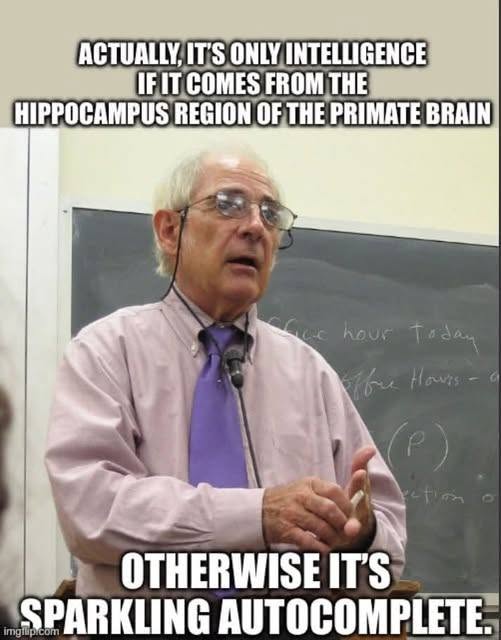
Below, a Searle-y observation which I suspect is on target. “Next token prediction,” which is the ‘magic’ that drives Claude & Co, is just super-sophisticated and super-fast auto-completion. But I’ll go Searle one better: it’s not the brain that thinks or any part thereof, but a spiritual substance ‘metaphysically behind’ it. I wish I could prove that, but I doubt that anyone can. It is, however, reasonable to believe, or so say I.
I don’t buy the idea that “automatic formal systems” (John Haugeland) are semantic engines. They are syntactic engines only. “Computers are defined in terms of symbol manipulation, and symbol manipulation by itself is neither constitutive of nor sufficient for meaning.” (John Searle, MIND: A Brief Introduction, Oxford UP 2004, p. 101.)
Vlastimil asked over at Facebook:
If many many mutually incompatible, substantive, philosophical views are reasonable, what makes you prefer a given one over the other?
I replied:
That’s a fair question. Obviously there is no algorithm (decision procedure, ‘effective procedure’) that we can apply. Suppose the question is whether we as individuals have a higher destiny beyond the grave. Nobody KNOWS the answer to that, and anyone who thinks he can PROVE it one way or another is engaged in what I call metaphysical bluster. (G. K. Chesterton is an example of a blusterer.) So in the end it all comes down to a free personal decision based on many factors including religious and mystical experiences, hints, intimations, glimpses, not to mention careful examination of all the arguments pro and con of all the philosophers, sages, mystics, religionists, and theologians East and West throughout the ages. Even if no argument or set of arguments is rationally COERCIVE, some arguments or sets thereof are better than others. For example, the arguments of the doctor angelicus count for more than those of a hack like Ayn Rand. I’ll send you a copy of my book if I can finish it before “shuffling off the mortal coil.” In the end you must ‘cut off’ yap and scribble and DE-CIDE (you know Latin) what you will believe and how you will live, and then live according to what you decide where belief and action are mutually reinforcing and limiting.