Trope Troubles: An Exercise in Aporetics

Elliot C. asked me about tropes. What follows is a re-post from 30 March 2016, slightly emended, which stands up well under current scrutiny.  Perhaps Elliot will find the time to tell me whether he finds it clear and convincing and whether it answers his questions.

…………………………..

A reader  has been much exercised of late by trope theory and other questions in ontology.  He has been sharing his enthusiasm with me.   He espies 

. . . an apparent antinomy at the heart of trope theory. On the one hand, tropes are logically prior to objects. But on the other hand, objects (or, more precisely, the trope-bundles constituting objects) are logically prior to tropes, because without objects tropes have nowhere to be – without objects (or the trope-bundles constituting objects) tropes cannot be. Moreover, as has I hope been shown, a trope cannot be in (or constitute) any object or trope-bundle other than that in which it already is.

How might a trope theorist plausibly respond to this?  Can she? [My use of the feminine third-person singular pronoun does not signal my nonexistent political correctness, but is an anticipatory reference to Anna-Sofia Maurin whom I will discuss below.  'Anna-Sofia'! What a beautiful name, so aptronymic. Nomen est omen.)

What are tropes?

It is a 'Moorean fact,' a pre-analytic datum, that things have properties.  This is a pre-philosophical observation.  In making it we are not yet doing philosophy.  If things have properties, then there are properties.  This is a related pre-philosophical observation.  We begin  to do philosophy when we ask: given that there are properties, what exactly are they?  What is their nature?  How are we to understand them?  This is not the question, what properties are there, but the question, what are properties?  The philosophical question, then, is not whether there are properties, nor is it the question what properties there are, but the question what properties are.

On trope theory, properties are assayed not as universals but as particulars: the redness of a tomato is as particular, as unrepeatable, as the tomato. Thus a tomato is red, not in virtue of exemplifying a universal, but by having a redness trope as one of its constituents (on the standard  bundle version of trope theory) or by being a substratum in which a redness trope inheres (on a nonstandard theory championed by C. B. Martin which I will not further discuss). A trope is a simple entity in that there is no distinction between it and the property it ‘has.’ 'Has' and cognates are words of ordinary English: they do not commit us to ontological theories of what the having consists in.  So don't confuse 'a has F-ness' with 'a instantiates F-ness.'  Instantiation is a term of art, a terminus technicus in ontology.  Or at least that is what it is in my book.  More on instantiation in a moment.

Thus a redness trope is red, but it is not red by instantiating redness, or by having redness as a constituent, but by being (a bit of) redness. So a trope is what it has. It has redness by being identical to (a bit of) redness.

It is therefore inaccurate to speak of tropes as property instances.  A trope is not a property instance on one clear understanding of the latter.  First-order instantiation is a dyadic asymmetrical relation: if a instantiates F-ness, then it is not the case that F-ness instantiates a.  (Higher order instantiation is not asymmetrical but  nonsymmetrical.  Exercise for the reader: prove it!)  Suppose the instantiation relation connects the individual Socrates here below to the universal wisdom in the realm of platonica.  Then a further item comes into consideration, namely, the wisdom of Socrates. This is a property instance.  It is a particular, an unrepeatable, since it is the wisdom of Socrates and of no one else. This distinguishes it from the universal, wisdom, which is repeated in each wise individual.  On the other side, the wisdom of Socrates is distinct from Socrates since there is more to Socrates that his being wise.  There is his being snub-nosed, etc.  Now why do I maintain that a trope is not a property instance? Two arguments. 

Tropes are simple, not complex.  (See Maurin, here.)  They are not further analyzable.  Property instances, however, are complex, not simple.   'The F-ness of a'  –  'the wisdom of Socrates,' e.g. — picks out a complex item that is analyzable into F-ness, a, and the referent of 'of.'  Therefore, tropes are not property instances.

A second, related,  argument.  Tropes are in no way proposition-like.  Property instances are proposition-like as can be gathered from the phrases we use to refer to them.  Ergo, tropes are not property instances. 

One can see from this that tropes on standard trope theory, as ably presented by Maurin in her Stanford Encyclopedia of Philosophy entry, are very strange items, so strange indeed that one can wonder whether they are coherently conceivable at all by minds of our discursive constitution.  Here is one problem.

How could anything be both predicable and impredicable?

Properties are predicable items.  So if tropes are properties, then tropes are predicable items.  If the redness of my tomato, call it 'Tom,'  is a trope, then this trope is predicable of Tom. Suppose I assertively utter a token of 'Tom is red.'  On one way of parsing this we have a subject term 'Tom' and a predicate term '___ is red.'  Thus the parsing: Tom/is red.  But then the trope would appear to have a proposition-like structure, the structure of what Russell calls a propositional function.  Clearly, '___ is red' does not pick out a proposition, but it does pick out something proposition-like and thus something complex.  But now we have trouble since tropes are supposed to be simple.  Expressed as an aporetic triad or antilogism:

a. Tropes are simple.
b. Tropes are predicable.
c.  Predicable items are complex.

The limbs of the antilogism are each of them rationally supportable, but they cannot all be true. Individually plausible, collectively inconsistent. The conjunction of any two limbs entails the negation of the remaining one.  Thus the conjunction of (b) and (c) entails ~(a).

We might try to get around this difficulty by parsing 'Tom is red' differently, as: Tom/is/red.  On this scheme, 'Tom' and 'red' are both names.  'Tom' names a concrete particular whereas 'red' names an abstract particular.  ('Abstract' is here being used in the classical, not the Quinean, sense.)   As Maurin relates, D. C. Williams, who introduced the term 'trope' in its present usage back in the '50s, thinks of the designators of tropes as akin to names and demonstratives, not as definite descriptions. But then it becomes difficult to see how tropes could be predicable entities. 

A tomato is not a predicable entity.  One cannot predicate a tomato of anything.  The same goes for the parts of a tomato; the seeds, e.g., are not predicable of anything.  Now if a tomato is a bundle of tropes, then it is a whole of ontological parts, these latter being tropes.  If we think of the tomato as a (full-fledged) substance, then the tropes constituting it are "junior substances." (See D. M. Armstrong, 1989, 115) But now the problem is: how can one and the same item — a trope –  be both a substance and a property, both an object and a concept (in Fregean jargon), both impredicable and predicable?  Expressed as an aporetic dyad or antinomy:

d. Tropes are predicable items.
e. Tropes are not predicable items.

Maurin seems to think that the limbs of the dyad can both be true:  ". . . tropes are by their nature such that they can be adequately categorized both as a kind of property and as a kind of substance."  If the limbs can both be true, then they are not contradictory despite appearances.

How can we defuse the apparent contradiction in the d-e dyad?  Consider again Tom and the redness trope R.  To say that R is predicable of Tom  is to say that Tom is a trope bundle having R as an ontological (proper) part.  To say that R is impredicable or  a substance is to say that R is capable of independent existence.  Recall that Armstrong plausibly defines a substance as anything logically capable of independent existence.

It looks as if we have just rid ourselves of the contradiction.  The sense in which tropes are predicable is not the sense in which they are impredicable.  They are predicable as constituents of trope bundles; they are impredicable in themselves. Equivalently, tropes are properties when they are compresent with sufficiently many other tropes to form trope bundles (concrete particulars); but they are substances in themselves apart from trope bundles as the 'building blocks' out of which such bundles are (logically or rather ontologically) constructed.

Which came first: the whole or the parts?

But wait!  This solution appears to have all the advantages of jumping from the frying pan into the fire.   For now we bang up against the above Antinomy, or something like it, to wit:

f. Tropes as substances, as ontological building blocks, are logically prior to concrete particulars.
g. Tropes as properties, as predicable items, are not logically prior to concrete particulars.

This looks like an aporia in the strict and narrow sense: an insoluble problem.  The limbs cannot both be true.  And yet each is an entailment of standard (bundle) trope theory.  If tropes are the "alphabet of being" in a phrase from Williams, then they are logically prior to what they spell out.  But if tropes are unrepeatable properties, properties as particulars, then a trope cannot exist except as a proper ontological part of a trope bundle, the very one of which it is a part.  For if a trope were not tied to the very bundle of which it is a part, it would be a universal, perhaps only an immanent universal, but a universal all the same. 

Furthermore, what makes a trope abstract in the classical (as opposed to Quinean) sense of the term is that it is abstracted from a concretum.  But then the concretum comes first, ontologically speaking, and (g) is true.

Interim conclusion: Trope theory, pace Anna-Sofia Maurin, is incoherent. But of course we have only scratched the surface. 

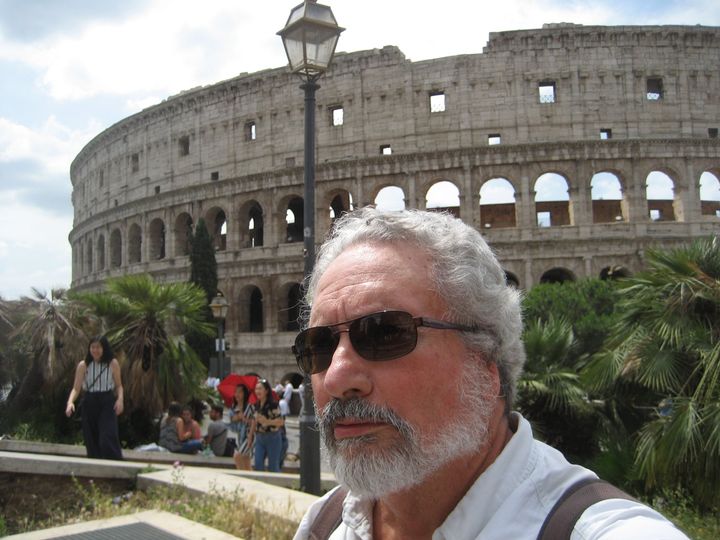
Pictured below, left-to-right:  Anna-Sofia Maurin, your humble correspondent, Arianna Betti, Jan Willem Wieland. Geneva, Switzerland, December 2008.  It was a cold night.

Maurin, Vallicella, Betti, et al.

Our Knowledge of Existence: How Do I Know that a Thing Exists?

The following incomplete draft has been languishing on my hard drive, on a memory stick, and in 'the cloud' since late November 202o.  So I will post it now to see what comments Elliot C. (and anyone else) has to offer. In other threads he has shown a burning interest in this question.

………………………..

1) I see a tree, a palo verde.  Conditions are normal both inside and outside of me, the perceiver. My eyesight is 20/20, the lighting is good, etc. I see that the tree is green, blooming, swaying slightly in the breeze, and so on. I know (directly, i.e., in the temporal present, without reliance on memory or testimony or inference) that the tree has these and other properties, and I know this by sense perception, in this instance by seeing them, and indeed by seeing them without the aid of such instruments as binoculars or closed-circuit television.  I know that the tree is green by seeing that the tree is green.  But  I cannot see that the tree is green without seeing green at the tree.  So I know (directly) that the tree is green by seeing green at the tree. It follows that the property green is sense-perceivable. It is a sensible or observable property. 

2) I presumably also know that the tree exists by seeing it.  That is, my seeing the tree suffices for my knowing that it exists. And the birds in the branches? Likewise: I know that they exist by seeing them.  But while I cannot know (directly) that the tree is green without seeing green at the tree, I can presumably know that the tree exists without seeing existence at the tree. For whatever existence is, it is not a sensible or observable property.  I see the green of the tree, but not the existence of the tree. Green is observable; existence is not. If I do know that the tree exists by seeing it, how do I know this given that existence is not  a sensible or empirically observable property or feature of the thing that exists?

3) And so we have a puzzle that arises naturally just by reflecting on some obvious data.  The problem is expressible as an inconsistent pentad. The  following propositions are individually plausible, and yet they are collectively inconsistent. Something's got to give.  To solve the problem, we either reject or reformulate one or more of the propositions, or we argue that, despite appearances, the propositions are consistent.

a) I know that the tree exists.

b) I know that the tree exists by seeing  that it exists.

c) An individual exists by instantiating the property of existence.

d) If I see that a thing has a property, then I see the property at the thing.

e) One cannot see or otherwise sense-perceive the property of existence.

The five  propositions are (collectively) inconsistent. Any four of them, taken together, entails the negation of the remaining one.  For example, the conjunction of the first four entails the negation of (e).  So the only way to solve the problem is by rejecting/revising one or more of the limbs. But which one?  Given the high plausibility of (a), (b), and (e), the natural candidates for rejection are (c) and (d).

Response 1: The existence of an individual is  not a property it instantiates, but the individual itself.

Given that the pentad is inconsistent, one response to it is by rejecting (c) by rejecting a presupposition on which (c) rests, namely, that  existence is a property of individuals.  Suppose it is maintained instead that the existence of an individual is just that individual.  Thus the existence of the tree is just the tree; it is not a property of the tree. If so,  then there is no real, non-verbal, difference between the tree and its existence. A tree and an existent/existing tree are one and the same.  To see the tree would be to see its existence.  Equivalently, to see the tree would be to see an existing tree. If this is right, then the solution to the puzzle is straightforward: I know that the tree is green by seeing  green at the tree, and I know that the tree exists simply by seeing the tree.  Seeing a sense-perceptible thing suffices for knowing that it exists.  

Rebuttal of Response 1

To see what is wrong with this response, consider a different example. I am looking at the Sun. While I am looking at it, it ceases to exist. Since it takes about eight minutes for the light of the Sun to reach the Earth, the following could happen: the object-directedness of the perceptual act undergoes no modification despite the fact that the object, the Sun, has ceased to exist.  I continue for a few minutes to see something  — no seeing without seeing something — but the something I see no longer exists. This shows that one cannot infer the real or extra-mental existence of the accusative of an act from the accusative's givenness.  By the accusative of a mental act I mean that which appears to the mind in  the act. In my first example, the accusative is the tree precisely as seen.  The back side of the tree is not seen by me, and so it is not part of the accusative. And the same goes for the ant on the front side of the tree which I cannot see because of my distance from the tree. Of course, the tree in reality either has an ant on its front side or it does not.  The tree in reality cannot be indeterminate in this regard, or in any regard.  But the accusative, as such, is indeterminate in this regard. This is the fate of intentional objects generally qua intentional objects: they are incomplete. This incompleteness reflects the finitude of our minds.

In the second example the accusative is the Sun precisely  as seen by me here and now. Therefore, if by 'existence' we mean existence in reality or existence in itself or extra-mental existence — these being equivalent terms — then I cannot know that a perceptible thing exists simply by seeing it.  For it could be that the accusative does not exist at the time it appears. I see the Sun at a time when there is no Sun to be seen. Appearing and being (existing) fall asunder.

One can arrive at the same conclusion via the Cartesian dream argument. I see things in dreams  that don't exist or that no longer exist.  My use of 'see' here is obviously a phenomenological use.  On this use, 'see' is not a verb of success: 'S sees x' does not entail 'S exists.'  Phenomenologically, one can see and otherwise sense-perceive what does not exist. I  had an extremely  vivid lucid dream once in which I saw, heard, and touched a beloved cat that I knew was dead.  I SAW the cat (in the phenomenological sense of 'see') despite its nonexistence in reality.  I didn't remember the cat or imagine it:  I saw it. I had a visual experience as of a cat even though my eyes were closed.

Or suppose a mad neuroscientist so stimulates a brain in a vat that the brain gives rise to a visual perception as of a tree just like the one in my opening example.  (The brain is eyeless and is not connected to any optical transducers.) The accusative of the act is given but it does not exist in reality.  You could say that in a case like this the accusative enjoys esse intentionale but not esse reale.

The upshot is that one cannot know that a perceptible item such as tree exists by seeing it. So response 1 fails.

Response 2: One can know that a visually-perceptible thing exists without seeing that the thing instantiates the putative property of existence and without seeing a thing that is identical to its existence.  The existence of an individual does not belong to the individual.  

On this response, a presupposition of all five limbs of the pentad is called into question, namely, the notion that existence belongs to existing things as it would belong to them if it were either a property of them, or identical to them, or hidden within them, or in some other way 'at' them or 'in' them.  One way to deny this presupposition is by holding that the existence of a tree, say, is really a property of something else.  One might say that the existence of trees is a property of the world-whole, the property of containing trees.  To say that trees exist would then be to say that the world contains trees.  Existence would then be a mondial attribute: it would be a property of the world.  The existence of Fs is then just the world's having the property of containing Fs.   The existence of Socrates is just the world's containing Socrates.

Rebuttal of Response 2

The theory is explanatorily  circular and worthless for that reason. The world cannot contain Socrates unless Socrates exists.  Before (logically speaking) the world can contain Socrates, Socrates must exist. To explain the existence of Socrates by saying that the world has him as a member is to presuppose the very thing that needs explaining, namely, the existence of Socrates.  The circular is of embarrassingly short diameter.

Saturday Night at the Oldies: Fools and Useful Idiots

These go out this April Fool's Day to all those who voted for Joey B and Kamala the Clown.  WTF were you thinking? You weren't. But most of you are 'nice people.'  Useful idiots are often very nice people. Would that being 'nice' were enough! 

The Who, Won't Get Fooled Again

Sam Cooke, Fool's Paradise

Ray Charles, I'm a Fool to Care

Johnny Winter, Be Careful with a Fool. Cultural appropriation by an albino!  White supremacy on stilts!

Beatles, The Fool on the Hill

Elvis Presley, A Fool Such as I

Ricky Nelson, Poor Little Fool.  Those "carefree devil eyes" will do it every time. 

Brenda Lee, Fool #1

The Shirelles, Foolish Little Girl

Ricky Nelson, Fools Rush In.  "Fools rush in/Where wise men never go/But wise men never fall in love/So how are they to know?" 

"Wise men say/Only fools rush in/ But I can't help/ Falling in love with you. Andrea Bocelli's live in Las Vegas version.

Elvin Bishop, Fooled Around and Fell in Love

Kingston Trio, Some Fool Made a Soldier of Me

Quicksilver Messenger Service, The Fool

Bill Evans, Foolish Heart

Connie Francis, Everybody's Somebody's Fool

Grateful Dead, Ship of Fools

"The fool who persists in his folly becomes wise" (William Blake)

Civility is for the Civil

A reader sent me a graphic to accompany one of my aphorisms:

Civility is no virtue if a cover for cowardice.

The meme is crude, but I see little point these days in being polite to our enemies. As another of my aphorisms has it, 

Be kind, but be prepared to reply in kind.

But don't be misled by what I am about to post.  You must heed Glenn Beck's GRAVE WARNING

Civility Return


Wokeassery Update

Alex Berenson on mRNAs

Black Female DEI Director Cancelled by DEI. De Anza College, Cupertino, California.  Not 'woke' enough, not 'diverse' enough to be 'included.' No 'equity' for her! Insufficient 'wokeness' = white supremacy.

From the beginning, efforts to obstruct my work were framed in terms that might seem bizarre to those outside certain academic spaces. For instance, simply attempting to set an agenda for meetings caused my colleagues to  accuse me of “whitespeaking,” “whitesplaining,” and reinforcing “white supremacy”—accusations I had never faced before. I was initially baffled, but as I attended workshops led by my officemates and promoted by my supervising dean, I repeatedly encountered a presentation slide titled “Characteristics of White-Supremacy Culture” that denounced qualities like “sense of urgency” and “worship of the written word.” Written meeting agendas apparently checked both boxes.

Maybe she should move to Florida where DEI goes to die.

Berkeley’s Unperceived Table

Ed writes,

A question: if Berkeley is out of his study, and says ‘My table is in my study’, is he speaking truly or falsely? If truly, then ‘my table’ and ‘my study’ must have referents, and the referents must stand in the relation ‘in’. But neither referent is perceived, so neither exists, according to B’s first definition of ‘exist’, and so ‘My table is in my study’ is false. According to B’s second (counterfactual) definition of ‘exist’, the statement can be true, but then we have to drop the first definition. Then what else do we lose of B’s philosophical system?

For example, is the statement ‘the table in my study is brown’ true or false, given that if B were seeing the table, he would perceive it to have the sensible quality of brown, and given that B is now outside his study? If true, then he must concede that the referent of ‘the table in my study’ is bearing the visible quality signified by ‘brown’, and so concede that everything he says about the impossibility of material substance is wrong, e.g. in §9 of the Treatise.

Indeed the whole project of Idealism collapses once we allow the possibility of language, and thence the possibility of successfully referring to objects and states of affairs that are not perceived.

My valued interlocutor is being a bit quick here. Let's sift through this carefully starting with definitions of 'exist(s)' either found in or suggested by a charitable reading of Berkeley's writings.

D1. X exists =df x is being perceived. (Esse est percipi.)

D2. X exists =df x is such that, were a perceiver P on the scene, P would perceive x.

D3. X exists =df either x is being perceived or x is such that, were a perceiver P on the scene, P would perceive x.

(D3) is the disjunction of (D1) and (D2). It is suggested by this passage:

The table I write on, I say, exists, that is, I see and feel it; and if I were out of my study I should say it existed, meaning thereby that if I was in my study I might perceive it, or that some other spirit actually does perceive it. (PHK 3, quoted here

God would be the best candidate for 'some other spirit.'  The author of the SEP entry, Lisa Downing, writes,

If the other spirit in question is God, an omnipresent being, then perhaps his perception can be used to guarantee a completely continuous existence to every physical object. In the Three Dialogues, Berkeley very clearly invokes God in this context. Interestingly, whereas in the Principles, as we have seen above, he argued that God must exist in order to cause our ideas of sense, in the Dialogues (212, 214–5) he argues that our ideas must exist in God when not perceived by us.[20] If our ideas exist in God, then they presumably exist continuously. Indeed, they must exist continuously, since standard Christian doctrine dictates that God is unchanging.

There is much more to it than this, of course, but what I have said suffices to neutralize Ed's objection.  He thinks he has refuted Berkeleyan idealism. He has done no such thing. He ignores (D3).

I must also object to Ed's apparent identification of idealism with Berkeleyan idealism. Ed is being unduly insular. A little to the East of where he lives there is this land mass called The Continent where other forms of idealism have been known to thrive.

I am also puzzled by Ed's talk of phrases like 'my table' needing referents when he himself denies (in his book) that there is extra-linguistic reference and affirms that all reference is intra-linguistic.  As I read him, Ed is a linguistic idealist. Linguistic idealism, however, is by my lights much less credible than Berkeleyan idealism.

The Double Denial by the ‘Woke’

It is not unreasonable to maintain that there is no God and that nature alone exists. But suppose you take it a step further and deny nature as well. Then you are in the precincts of 'woke' lunacy.  Call it the Double Denial.

One way to deny nature is by denying that the biotic underpins the social and that as a consequence the difference between men and women is a matter of social construction and not a matter of biology.  But any sane person will grasp instantly that one cannot change one's sex by merely thinking of oneself as belonging to the opposite sex. It is also obvious that sartorial and cosmetic modifications will not turn the trick.

Less obvious, but equally true, is that chemical and surgical alteration of one's body cannot change one's sex even if the surgical alteration is of a deeply structural sort:  reduction of muscle mass, heart and lung volume,  bone density, size of hands, and length of limbs even unto the removal of portions of bones to make the altered person shorter.

Procrustes' BedBut of course the 'transgendered' biological men who compete in, and win, women's sporting events do not and would not submit to the modern-day equivalent of the Bed of Procrustes: they are not about to be modified in the drastic ways just mentioned.  And yet such men are allowed to pass themselves off as women.  To add insult to injury, some of these impostors are then awarded 'woman of the year' titles.

What is going on here? It is one thing to condemn the injustice to women and overall idiocy of this, quite another to understand how it could arise and be taken seriously by otherwise sane people.

One thing that needs explaining is how leftists, who are supposedly for women and against their oppression by men and 'the patriarchy,' could embrace something so antifeminist as the allowance of male interference with women's sports. I suggest that what we are witnessing here is a collision of motifs on the Left. One such is the oppressor-oppressed motif. Another is the hyper-constructivist denial-of-reality motif. These motifs are in tension with each other. If men oppress women, then women need their 'safe spaces' where they can feel secure against real or merely perceived micro- and macro-aggression. Accordingly, there is obvious need for  sexual segregation in certain areas such as sports competitions, locker rooms, restrooms, prisons, etc.  But if everything is a matter of social construction, as per the second motif, then so are sexual differences in which case they are not innate and immutable, but malleable. A man can 're-identify' as a woman with or without chemical and surgical alteration. Add in a third motif that of expressive individualism and for good measure throw in the 'my truth' meme.  If 'my truth' is that I am a woman, then I am a woman and can compete against women. (There is little or no chance that any woman will 're-identify' as a man so as to compete against them.)

The conflict of leftist motifs explains the utter absurdity of wokesters who tolerate the grotesquely unjust penetration of biological males into female spaces.

Can one see that one is not a brain-in-a-vat?

This is a repost from 21 December 2009, slightly emended. I've added a clarifying addendum.

…………………………..

John Greco, How to Reid Moore:

So how does one know that one is not a brain in a vat, or that one is not deceived by an evil demon? Moore and Reid are for the most part silent on this issue. But a natural extension of their view is that one knows it by perceiving it. In other words, I know that I am not a brain in a vat because I can see that I am not. [. . .] Just as I can perceive that some animal is not a dog, one might think, I can perceive that I am not a brain in a vat. (21)

Really?

A bobcat just walked past my study window. I see that the critter is a bobcat, and seeing that it is a bobcat, I see  that it is not a dog, or a deer or a javelina.  So far, so good. But then John Greco comes along and tells me that in the same sense of 'see' — the ordinary visual-perceptual sense — I can see that I am not a brain-in-a-vat, a BIV. But 'surely' one cannot see or otherwise perceive such a fact. Or so I will argue.

Argumentum ad Lapidem?

No way, I say.  Over at Substack.

Ed comments:

"He did not maintain that rocks and trees do not exist; he did not deny or even question whether they are; he offered an unusual ontological account of what they are, namely, ideas in minds, including the divine mind." (BV)

True, but careful examination of Berkeley’s argument shows that he provides no clear definition or explanation of what “ideas” are.

He opens the Treatise as follows:

It is evident to any one who takes a survey of the objects of human knowledge, that they are either ideas actually imprinted on the senses; or else such as are perceived by attending to the passions and operations of the mind; or lastly, ideas formed by help of memory and imagination — either compounding, dividing, or barely representing those originally perceived in the aforesaid ways.

But is it “evident”? I look at the brown and black colours of the surface of my desk. These appear to be qualities of the desk surface itself, and not “imprinted on the senses” at all. Is Berkeley saying that the desk surface itself is imprinted on my senses? But that strange claim has to be clarified. Later on he offers a critique of the idea of substance, arguing that ideas are mental items, therefore cannot be supported by an immaterial item, substance. But that begs the question. If ideas are sensible qualities like colours, what evidence is there for their being mental items?

As for Johnson’s argument, what is the quale corresponding to resistance? Resistance, i.e. Newtonian force, is the most material of qualities. How can there be a quale of resistance without resistance itself?

BV: Newton's First Law of Motion implies that a stone, say, will remain at rest unless acted upon by an external force such as Johnson's kick.  An object at rest thus resists being moved.  This resistance is a (dispositional) property of physical things.  The quale corresponding to this resistance could be called felt resistance.  It is a mental in nature and cannot exist without a perceiver who, for example, tries to move a rock with his foot.

"How can there be a quale of resistance without resistance itself?"  An idealist of the Berkeleyan sort could say that there can't be a quale of resistance without resistance itself but then go on to say that (i) physical things are nothing more than objects of the divine mind, and (ii) resistance qualia exist only in finite (creaturely) minds. In this way the distinction between resistance qualia and resistance itself could be upheld.

The point I was making in my Substack article was that the good bishop cannot be refuted by kicking a stone. This is because Berkeley is not denying that there are stones; he is making a claim about the mode of being of stones, namely that their being/existence is ideal: they are accusatives of divine awareness and nothing more.  As I read him, Berkeley is not an eliminativist about stones and trees in quads, etc.  You could call him an ontological reductionist about such and sundry.

Daniel Dennett, by comparison is an eliminativist about qualia.  He I can refute by kicking 'stones,' namely his cojones. If I kick him in the groin, he will be brought to understand that felt pain, phenomenal pain, lived pain, is the most real thing in the world, and cannot be denied. I am assuming, of course, that he is not a zombie (as philosophers use this term). But that leads us in a different direction.