Soriano Summarizes Dreher’s Take on the ‘Groyper’ Phenomenon

The following is by James Soriano who does an excellent job of summarizing important points made by Dreher who, though prolix, is turning out good content on this and related topics.

………………………………

I link below a rambling essay by Rod Dreher on his visit to Washington, where he had a long conversation with VP Vance in the company of Hungary’s Viktor Orban on the future of Christianity in Europe and other things.

It is a nightmare about the state of American conservatism.  Despite Trump’s victory, conservatives are being subverted by radical Generation Z newcomers.  Many are so-called Christians conservatives and impoverished policy activists.  As a group, they have clustered around a white-supremacist ideology in which anti-Semitism is in the foreground.  They look to Tucker and this gent, Nick Fuentes, for inspiration.  They’re called “Groypers.”

The essay goes into a long digression about the prevalence of Jews in certain walks of life, but at the end Dreher recapitulates the main points of his findings during his Washington visit. 

I’ve shortened them and I would like to pass them along because they summarize the state of the civil war now raging in the ranks of conservatives.  There is much to be pessimistic about.

1.  The Groyper thing is real. It is not a fringe movement.  It really has infiltrated young conservative networks.

2.  Irrational hatred of Jews (and other races, but especially Jews) is a central core of it.  

3.  It cannot be negotiated with, because it doesn’t have traditional demands. It wants to burn the whole system down.

4.  The gatekeepers of the Right can’t make it go away.  They have less power than ever.  Dealing with this is going to require great skill and subtlety, and courage.

5.  This malign movement didn’t just appear from nowhere. There are within it legitimate grievances.  It is primed to believe totalitarian things.

6.  The Left got there first.  Left-wing radicals have marched through institutions and imposed illiberal, race-based leftist policies.   You cannot understand the rise of the Groypers without understanding this first.

7.  Conservatives hoped Trump’s anti-woke pushback would restore the meritocratic status quo.  The Zoomercons don’t want that.  They want revenge.

8.  This has the potential to destroy conservatism politically. 

9.  It poses the risk of wrecking the new, post-MAGA conservatism, whose natural heir is JD Vance. 

10.  Anti-Semitism is spreading like a virus among religious conservatives of the Zoomer generation.  They’re getting it through online influencers.  Their pastors and parents are not fighting back; they have lost authority.  Some Zoomer trad Catholics are making antisemitism part of their spirituality — this, despite the fact that the Catholic Church explicitly condemns it.  The same phenomenon exists among Zoomercon Orthodox and Protestants.  This is spiritual poison.

11. The liberal media is going to have a field day with this to distract from the fact that antisemitism is triumphant among progressives.  The new face of the Democratic Party is Zohran Mamdani.

12.  Conservatives — Jewish, Christian, and agnostic — who support Israel are going to have to think very hard about how to proceed.  Support for Israel has collapsed among the young, and it’s not coming back anytime soon. 

13.  The intra-conservative fight is here, and we can’t avoid it.

What I Saw And Heard In Washington

Related:

Why Did Thomas Aquinas Leave his Summa Theologiae Unfinished?

Burnout or viso mystica? A Substack article.

Our frenetic and hyperkinetic way of life makes it difficult to take religion seriously and what is essential to it, namely, the belief in what William James calls an Unseen Order. Our communications technology in particular is binding us ever tighter within the human horizon so that the sense of Transcendence is becoming weaker and weaker. It therefore comes as no surprise that someone would point to ‘burnout’ as the explanation of Aquinas’ failure to finish his sum of theology when the traditional explanation was that he was vouchsafed mystical insight into the Unseen Order:

The Proselytic Mentality

On occasion we encounter morally good people who are sincerely interested in our spiritual welfare, so much so that they fear that we will be lost if we differ from the views they cherish, even if our views are not so very different from theirs.  Julian Green in his Diary 1928-1957, entry of 10 April 1929, p. 6, said to André Gide:

With the best will in the world, they never see you without a lurking idea of proselytism. They are worried about our salvation.  They visibly have it on their minds., even when you talk to them of quite different matters. . . .  “Yes indeed!” cries Gide. “They will use every means to draw you to them. When you are with them you find yourself in the situation of a woman faced with a man who would harbor intentions!”

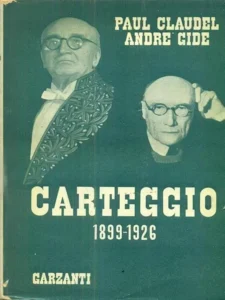
I’d guess the alacrity and enthusiasm of Gide’s response to Green had its origin in Gide’s relation to Paul Claudel, a committed Roman Catholic who never ceased trying to bring Gide around to the true faith. The Claudel-Gide correspondence 1899-1926 makes for fascinating reading.

What I find objectionable about the proselytic mentality is the cocksurety with which the proselytes hold their views.  They dogmatically affirm this and they dogmatically deny that, and are not in the least troubled by the fact that people as intellectually and morally virtuous as they are disagree. They ‘know’ what salvation is and the way to it.  The critical attitude is foreign to them. The fervor of their beliefs boils over into something they wrongly consider knowledge.

Their attitude is mostly harmless, but there are toxic forms of it, as history has taught us. The Founders of our great republic were well aware of the religious wars and of the blood shed by the dogmatists. These days it is the spikes of the Islamic trident that are a clear and present threat: conversion, dhimmitude, the sword. The ascension of a madman to the mayoralty in our greatest city is a troubling sign.

Could Qualia Terms and Neuroscience Terms have the Same Reference?

Could Frege’s sense-reference distinction be put to work? I think not.

Top o’ the Stack.

I made the point a while back that the vocabularies of phenomenology and neuroscience are radically disparate, such that nonsense arises when one says things like, ‘This burnt garlic smell is identical to a brain state of mine.’ To which a Vietnam veteran, altering the example, replied by e-mail:

. . . when a neuroscientist says your smelling this odor as napalm is nothing but a complex neural event activating several regions of the brain…, he isn’t claiming you can replace your talk about smells with talk about neural signals from the olfactory bulb. Different ways of talking have evolved for different purposes. But he is saying that beneath these different ways of talking & thinking there is just one underlying reality, namely, neural events in our brain.

The idea, then, that is that are are different ways of referring to the same underlying reality. And so if we deploy a simple distinction between sense and reference we can uphold the materialist/physicalist reduction of qualia to brain states. Well, I doubt it. In fact, I deny it.

Klima on Intellective Soul and Living Body in Aquinas and the Immortality of the Human Soul

Gyula Klima:

The composition from intellective soul and living body, and the natural immortality of the human soul (a section of a long paper)
. . . given the immateriality of the intellect, which I will not attempt to prove now, but let us just assume for the sake of the argument, the activity of the intellect cannot have as its subject the composite of body and soul, or as Aquinas would put it, this activity does not communicate with matter. What this means is that its acts are not acts of any parts of the body, in the way in which, say, my acts of sight are obviously the acts of my visual apparatus enformed [informed] by my sensitive soul.
BV:  The first sentence above strikes me as obviously true. For example, when I contemplate the theorem of Pythagoras, what in me thinks that thought?  No part of my living body, not even my brain or any part of my brain.  Nor is it the soul-body composite that thinks the thought. In the schema ego-cogito-cogitatum, where the cogitatum is the theorem in question, the ego cannot be any material thing, and thus no proper or improper part of my material body.  As for the act of thinking, the cogitatio, it cannot be any state of, or process in, any part of my material body.  In particular, it cannot be a brain state or process. So far, I agree with Klima and Thomas.  But suppose  I am having a coherent, ongoing, visual experience as of a tree. Is it obvious that this act of visual experiencing requires eyes, optic nerves, visual cortex, etc. , which is what I take Klima to be referring to with “visual apparatus”? No, it is not obvious, but to explain why would take us too far afield.
The point of agreement so far is that intellective acts do not “communicate with matter.” But if sensory acts do so communicate, then are there two souls involved in my cognitive life, an intellective soul and a sensitive soul?  Or is there only one soul? Only one according to Klima.
But the same sensitive soul also has intellective acts, which Aquinas argues cannot be the acts of any bodily organ, or to put it simply, I am not thinking with my brain (or any other organ for that matter): my brain merely provides, so to speak, “food for my thought”, in the form of phantasms, the singular representations of sensible singulars, which then my intellect further processes in its own acts of abstraction, concept formation, judgment formation and reasoning, all of which are acts of the intellect alone, which therefore cannot have the body and soul composite as their subject, but the soul alone.
BV: Right, we don’t think with our brains.  But we live in a world of concrete material particulars or singulars many of which are also sensible, i.e., able to be sensed.   My knowledge that the tree is green is sensory not intellective.  Phantasms are singular representations of singular sensibles. But it is quite unclear to me how the brain can “provide” or  “serve up” these representations for the intellect to “feast on” and intellectively process.  Are  the phantasms  located in the brain where the intellect gets hold of them for “processing”?  A representation is a representation of something (genitivus obiectivus) and it is is difficult to understand how any part of a hunk of meat can represent anything.  What gives bits of brain matter representational power?  But I won’t pursue this question further here. I pursue it elsewhere. We now come to the gravamen of my complaint against the hylomorphic attempt to explain personal survival of bodily death.
We are told that the soul-body composite cannot be the subject of sensory knowledge any more than it can be the subject of intellective knowledge. This, however, has the consequence that the intellective soul is not only a form, enforming [informing] the body, but is also a subject of its own power, the intellect, and its acts. But then, it exists not only as that by which the living body is, but also as that which is the underlying subject of its own acts which it does not communicate with the body. Therefore, upon the death of a human person, when the soul gets separated from the body, the soul ceases to be the form of the body, but that does not mean that it also has to cease to be. Since its own operations are not acts of the body, they can continue without its union with the body. But to operate, it must exist; so, it can naturally go on existing, as the underlying subject of its own intellectual operations. So, when a person dies, the person ceases to exist, but the person’s soul merely ceases to be a form of their body, which can persist in its being, naturally continuing the life that used to be the life of the person, as a separate soul, until the same person will be miraculously restituted in the resurrection, resuming the same life, now as a whole person again.
I agree with the first three sentences up to ‘therefore’ the bolding of which I have added.  Klima appreciates that the human soul for Aquinas has a dual function. It not only animates the body of which it is the soul, thereby making it a living body, but it is also that which thinks when a human being engages in intellective acts. The human soul is not only that by which the living body is alive; it is also “the underlying subject of its own [intellective] acts,” acts which do not “communicate with matter” and are therefore not the acts of the soul-body composite, the unitary psychophysical complex. So it is not Socrates qua soul-body composite who ponders whether virtue is teachable or whether there is more to knowledge than true belief; it is the intellect alone in Socrates that is the subject of these acts. That sounds right to me.
But we are then told, in the sentences  after therefore, that this individual (not universal) intellective soul will survive the death of its body.  But this is very hard to make sense of for several reasons.  Indeed, it smacks of a blatant non sequitur.  I will present only one reason in this entry. “Brevity is the soul of blog,” as some wit once observed.
 It is in virtue of forms that things are intelligible. If what thinks in a human being post-mortem is a form, however, then that form is not only intelligible but also intelligent.  It is not only intelligible, but intelligible to itself, which is to say that it is at once both intelligible and intelligent.  I find it hard to understand how a pure immaterial form, a form that does not inform anything, a form that is not a form of anything, can be both intelligible and intelligent. I find it hard to understand how  the subject and the object of acts of intellection could be one and the same.  I don’t intend this as a merely autobiographical comment. I am suggesting that anyone ought to find it hard to understand, indeed impossible to understand, and therefore intrinsically  unintelligible.  But in philosophy we are not allowed to make bare or gratuitous assertions. Quod gratis asseritur gratis negatur. So I need to argue this out. I will begin by giving two examples of intrinsically unintelligible notions.
a) The first example of intrinsic unintelligibility is the notion of a thing that causes its own existence. Since nothing can exercise causality unless it exists, nothing can cause its own existence. Not even God in his omnipotence could cause his own existence. For there cannot be an exercise of (efficient) causality unless there exists something or someone that/who exercises it. Necessarily, no action without an agent. But more than that: no action without an agent the being of which is not exhausted in its acting on a given occasion. What that means is that the agent cannot be identical to his action.  If Guido makes a meatball, there has to be more to Guido than that particular act of making that particular meatball, which is to say: no agent is identical to any of its actions, or the sum of them.   Suppose, as a matter of metaphysical necessity, that agent S performs action A. Even in a case like this the agent is not identical to any of his actions or the sum of them.
b) A second example of intrinsic unintelligibility is the notion of an open sentence that has a truth value. ‘___ is wise’ is an example of an open sentence. It can also be depicted using the free variable ‘x’ thusly: ‘x is wise.’ This open sentence, which picks out what Russell calls a propositional function, is neither true nor false: it lacks a truth value. A (closed) sentence results if we either substitute a name for the variable ‘x’ or bind the variable with a quantifier. Both ‘Socrates is wise’ and ‘For all x, x is wise’ are closed sentences which attract a truth value. That is a philosopher’s way of saying that they can be evaluated as either true or false. The first is true, the second false. The claim that ‘x is wise’ has a truth value, however, is intrinsically unintelligible: it makes no sense and cannot be understood, by me or anyone.
A pure immaterial form that is both intelligible and intelligent is like an open sentence that has a truth value.  Why? Well, consider the sentences ‘Socrates is wise’ and ‘Socrates is human.’  The first predicates an accidental form of a substance, the second a substantial form of a substance. Those sentences are both meaningful and true. What makes them meaningful is that they express complete thoughts or propositions: each has a subject-term, a copula, and a predicate-term. What makes them true is the inherence of the forms picked out by the predicates in what the subject-terms name,  something that is not a form.   Socrates is not a form.  He is a composite entity, a hylomorphic compound.  Just as it is unintelligible to suppose that there could be an action that was not the action of an agent distinct from the action, it is unintelligible to suppose that there could be a form that was not the form of something (genitivus subiectivus) that was not itself a form.
More  tomorrow.

The Ultimate Paradox of Divine Creation

Substack latest.

This entry continues the line of thought in Is Classical Theism a Type of Idealism?

God freely creates beings that are both (i) wholly dependent on God’s creative activity at every moment for their existence, and yet (ii) beings in their own own right, not merely intentional objects of the divine mind. The extreme case of this is God’s free creation of finite minds, finite subjects, finite unities of consciousness and self-consciousness, finite centers of inviolable inwardness, finite free agents, finite yet autonomous free agents with the power to refuse their own good, their own happiness, and to defy the nature of reality. God creates potential rebels. He creates Nietzsche, Sartre, and Camus. He creates Lucifer the light bearer who, blinded by his own light, refuses to acknowledge the source of his light, and would be that source himself even though the project of becoming the source of his own light is doomed to failure, and he knows it, but pursues it anyway. He creates Lucifer who became the father of all perversity. The “Father of lights” (James 1:17) creates the father of lies.

God creates and sustains, moment by moment, other minds, like unto his own, made in his image, who are yet radically other in their inwardness and freedom. He creates subjects who exist in their own right and not merely as objects of divine thought. How is this conceivable?

Aquinas on Angels and Human Souls: Examination of a Passage in De Ente et Essentia

I found a passage in De Ente et Essentia that is relevant to my claim that Thomas is not a hylomorphist with respect to  the human soul but a substance-dualist. Here is the passage in the Armand Maurer translation. The numbers in brackets are my interpolation. My commentary follows.

[1] This is why among these substances [created intellectual substances] we do not find a multitude of individuals in the same species . . . except in the case of the human soul because of the body to which it is united. [2] And even though the individuation of the soul depends on the body as for the occasion of its beginning, because it acquires its individuated  being only in the body of which it is the actuality, it is not necessary that the individuation cease when the body is removed.  [3] Because the soul has a separate being, once the soul has acquired its individuated being by having been made the form of a particular body, that being always remains individuated. [4]  That is why Avicenna says that the individuation and multiplication of souls depends on the body as regards its beginning but not as regards its end. (On Being and Essence, 2nd rev. ed, 1968, The Pontifical Institute of Medieval Studies, pp. 62-63.)

Commentary

Ad [1].  Created intellectual substances are either angels or human souls. Angels, of which there are many, are wholly immaterial. They are nonetheless composite beings in that they do not exist in virtue of their  essence (quiddity) but receive their existence from God.  Since there is no matter-form (hylomorphic) composition in them, what makes them many cannot be matter.  And so each is a species unto itself. Their numerical difference is a difference in species.

Human beings, by contrast, all belong to the same species where the genus is animal, the species is human, and the specific difference is rationality. “Man is a rational animal.” The numerical difference of human beings among themselves is therefore not a difference grounded in a difference of species but a difference grounded in a difference in designated matter (materia signata).

Ad [2]. We are then told that a human soul first begins to exist when it acquires a body.  Human souls do not pre-exist their embodiment. This is because the human soul is individuated — made to be an individual soul — by its acquisition of a body.  Before Socrates acquired a body, there was no individual Socrates. Socrates cannot exist in reality except as an individual human being  and he cannot exist as an individual human being without a material body. It is embodiment that brings about his individuation. So far, so good.

Now comes the crucial inference:  because the human soul acquires its individuated being (existence) in the material body of which the soul is the actuality, it is not necessary  that the individuation cease when the body is removed. Why not?

Ad [3]. The reason is because the soul’s individuation brings it about that the soul is  a separate being. Unfortunately, Aquinas appears to be equivocating on ‘separate.’ No doubt the individuation of  the soul of Socrates bring it about that his soul is separate from Plato’s soul in the sense of numerically different from Plato’s soul.  But that is not to say that the soul of either is separate in the sense of  existing without a body either before or after death.

I now explain the two senses of ‘separate.’

The cat is on the mat. The cat is separate from the mat, and the mat from the cat.  That is equivalent to saying that cat and mat are numerically different.  But neither is separate from designated matter. So ‘separate’ has these two different senses. Separation in the first sense is a symmetrical dyadic relation. It is existence-entailing on both ends: if x is separate from y, then x, y both exist.  Separation in the second sense is not a relation at all. A separate substance such as an angel is not separated from anything.  There is no parcel of designated matter that the angel Gabriel has to be separate from to be a separate substance.

So it looks as if Thomas is equivocating on ‘separate.’ One hesitates to tax such a great thinker with the fallacy of equivocation.  But even if  Thomas is not equivocating on ‘separate,’ his argument remains puzzling.  Angels are separate substances: although not self-subsistent like God, they subsist without matter.  They are individual in themselves, as forms.  They need no individuation ab extra. They are already, logically speaking, individuals.  Socrates does need individuation ab extra, and it comes from matter.  Before he began to exist, he was nothing in reality: he was not a subsistent individual form that acquired a body.  He became an individual only when a certain soul-body/ form-matter composite came to be. How then can the soul or form of that composite continue to exist when the composite is no more? This is impossible on Aristotelian hylomorphism, according to which the ‘principles’ of a hylomorphic compound substance are not themselves substances but non-independent ontological ‘parts’ or constituents of the substance of which they are the constituents.

Is Aquinas telling us that when Socrates died he became an angel? I reckon  not. (That would be quite the metabasis eis allo genos!) Not even the doctor angelicus became an angel at death. He is however telling us that when the philosopher  died he became a separate intellectual substance, and thus like an angel in that respect.   Bear in mind that for Thomas, an incomplete substance is a substance. An incomplete substance is logically capable of independent existence: it is not an accident of a substance nor a ‘principle’ of a substance.

So, while Socrates post-mortem is no angel, sensu stricto, he is a separate intellectual substance, a substance that exists in reality on its own without matter. How exactly, given that for humans, as opposed to angels, (designated) matter is the principium individuationis?

The Aquinate line seems to be that the individuation that human souls acquire from matter before death remains with those souls after death. But what is the argument for this surprising thesis?  The only argument I discern  in the above text is this:

a) Designated matter individuates human souls;
b) Such individuation by designated matter makes of the soul a separate substance;
c) A separate substance does not depend on matter for its subsistence; ergo,
d) A human soul once individuated is forever after a separate substance.

But what reason do we have to accept (b)?   No reason at all on a strictly hylomorphic approach.  In fact, such an approach rules out (b). The form or soul of a living substance such as Socrates is merely a ‘principle’ of this compound sublunary substance — as I have stated many times already.  These principles are not themselves substances. So they cannot exist on their own. Hence they cannot exist without matter. On strict hylomorphism, the soul of Socrates cannot continue to exist upon the dissolution of his body.

Everything falls into place, however, once you see that Aquinas is not a hylomorphic monist, but a substance-dualist.  He simply presupposes the truth of (b).  This presupposition is logical ‘fallout’ from  Christianity as he understands it.