
There is No Provision in Islam for Mosque-State Separation

John Hick, An Interpretation of Religion (Yale UP, 1989, pp. 48-49):

From the point of view of the understanding of this state of islam [submission to Allah] the Muslim sees no distinction between the religious and the secular.  The whole of life is to be lived in the presence of Allah and is the sphere of God's absolute claim and limitless compassion and mercy.  And so islam, God-centredness, is not only an inner submission to the sole Lord of the universe but also a pattern of corporate life in accordance with God's will.  It involves both salat, worship, and falah, the good embodied in behaviour.  Through the five appointed moments of prayer each day is linked to God. Indeed almost any activity may be begun with Bismillah ('in the name of Allah'); and plans and hopes for the future are qualified by Inshallah ('if Allah wills').  Thus life is constantly punctuated by the remembrance of God.  It is a symptom of this that almsgiving ranks with prayer, fasting, pilgrimage and confession of faith as one of the five 'pillars' of Islam.  Within this holistic conception the 'secular' spheres of politics, government, law, commerce, science and the arts all come within the scope of religious obedience.

What Hick calls a "holistic conception," I would call totalitarian.  Islam is totalitarian in a two-fold sense.  It aims to regulate every aspect and every moment of the individual believer's life. (And if you are not a believer, you must either convert or accept dhimmitude.)   But it is also totalitarian in a corporate sense in that it aims to control every aspect of society in all its spheres, just as Hick points out supra.

Islam, therefore, is profoundly at odds with the values of the West.  For we in the West, whether liberals or conservatives, accept church (mosque)-state separation.  We no doubt argue heatedly over what exactly it entails, but we are agreed on the main principle.  I regularly criticize the shysters of the ACLU for their extremist positions on this question; but I agree with them that "Congress shall make no law respecting an establishment of religion . . . ."

This raises a very serious question.  Is Islam — pure, unEnlightened, undiluted, fundamentalist, theocratic Islam — deserving of First Amendment protection?  We read in the First Amendment that Congress shall not prohibit the free exercise of religion.  Should that be understood to mean that the Federal government shall not prohibit the  establishment and  free exercise of a  totalitarian, fundamentalist  theocratic religion in a particular state, say Michigan? 

Note also that Islam is not a religion like Buddhism or Christianity.  It is as much a political ideology as a religion.  In this regard it is very similar to the totalitarian political  ideology, Communism.  Buddha and Jesus were not warriors; Muhammad was.

The USA is a nation with a secular government.  Suppose there was a religion whose aim was to subvert our secular government.  Does commitment to freedom of religion enjoin toleration of such a religion? As a religion, Islam is the worst of the great religions; as a political ideology, however, it is a formidable enemy.  If it prevails, we and our values lose.  Are we under some sort of obligation to tolerate that which would destroy us and our way of life?  Or does toleration have limits?

These are important questions and they need to be asked.  But so-called 'liberals' will scream in protest at my mere mention of them.  So what happened to the spirit of free and open inquiry?  I am inspired to a parody:

Where have all the liberals gone,long time passing?
Where have all the liberals gone, long time ago?
Where have all the liberals gone?
Gone to Pee Cee every one
When will they ever learn?
When will they e-v-e-r learn?
 

The No True Scotsman or No True Muslim Fallacy

This is a substantial revision, in the light of recent events, of an entry from about six years ago.  This post examines the fallacy that Antony Flew brought to our attention and suggests that 'No True Muslim' is an equally good name for it.

…………….

In logic, a fallacy is not a false belief but a pattern of reasoning that is both typical and in some way specious. Specious reasoning, by the very etymology of the term, appears correct but is not. Thus a fallacy is not just any old mistake in reasoning, but a typical or recurrent mistake that has some tendency to seduce or mislead our thinking. A taxonomy of fallacies is useful insofar as it helps prevent one from seducing oneself or being seduced by others.

Fallacies are either formal or informal.  An example of a formal fallacy is Affirming the Consequent.  An example of an informal fallacy is Petitio Principii.  Note than an argument that is formally valid can yet be informally fallacious.  Arguments that beg the question are examples.

Among the so-called informal fallacies is Antony Flew's No True Scotsman. Suppose A says, "No Scotsman puts sugar in his porridge." B replies, "But my uncle Angus puts sugar in his porridge." A responds, "Your Uncle Angus is no true Scotsman!"
 
Second Example.  Call it 'No True Muslim.'  A says, "Islam is a religion of peace; Muslims do not do things like murder cartoonists and journalists with whose ideas they disagree." B replies, "On 7 January 2015, two Muslim gunmen forced their way into the offices of Charlie Hebdo in Paris, France and killed Stéphane Charbonnier, the editor of the satirical weekly, and several others." A responds, "Those gunmen were not true Muslims."

Third Example. A: "Nowadays all chess players use algebraic notation." B: "Not so, Ed Yetman does not use algebraic notation. He uses descriptive notation exclusively." A: "Ed Yetman? You call him a chess player?!"

Fourth Example. A: "When a complete neuroscience is achieved, we will know everything about mind, brain, and consciousness." B: "I can't agree, even a completed neuroscience will not explain how consciousness arises from brain activity." A: "A neuroscience that can't explain consciousness would not be a completed neuroscience."

Clearly, something has gone wrong in these examples. Person A is making an illicit dialectical move of some kind. The general form of the mistake seems to be as follows. Person A makes a universal assertion, one featuring a quantifier such as 'all,' 'no,' 'everything' whether explicit or tacit. Person B then adduces a counterexample to the universal claim. Person A illicitly dismisses the counterexample by modifying his original assertion with the use of 'true' or 'real' some equivalent designed to exclude the counterexample.  Thus Uncle Angus is excluded as a counterexample by dismissing  him as not a true Scotman, and the Muslim gunmen are excluded by dismissing them as not true Muslims.

The fallacy is informal since the fallaciousness depends on the content or subject matter. So we need to ask: When is it not a fallacy? By my count, there are at least four classes of cases in which the No True Scotsman move is not fallacious.

1. When the original assertion is either a logical truth or an analytic truth. If I point out that all bachelors are male, and you reply that your sister Mary is a bachelor, then I am justified in dismissing your 'counterexample' by saying that Mary is not a true bachelor, or a bachelor in the strict sense of the term.

2. When the original assertion is synthetic but necessary. If Saul Kripke is right, 'Water is H2O' is synthetic but necessary. If I say that water is H2O, and you object that heavy water is not H2O but D2O, then I am entitled to respond that heavy water is not water.

3. When the original assertion involves stipulation. Suppose Smith defines a naturalist as one who denies the existence of God, and I respond that McTaggart is an atheist who is not a naturalist. Have I shown that Smith is wrong? Not all. Smith may respond that McTaggart is not a naturalist as he defines the term. Wholly or partially stipulative definitions cannot be said to be either true or false although they can be more or less useful for classificatory purposes.  Second example. Suppose Jack claims that libertarians favor open borders and Jill responds by adducing the case of libertarian John Jay Ray who does not favor open borders. Jack is within his epistemic rights in saying that Ray is not a full-fledged libertarian.

4. When the original assertion specifies the content of a belief-system or worldview.  Suppose I point out that Communists are anti-religion, believing as they do that it is the opiate of the masses, an impediment to social progress, the sigh of the oppressed, flowers on the chains that enslave, etc.  You say you know people who are Communists but are not against religion.  I am entitled to the retort that such 'Communists' are not Communists at all; they are not true or real or genuine Communists, that they are CINOs, Commies in Name Only, etc.  I have not committed the fallacy under discussion.

Back to the Muslims.  A Muslim is so-called because of his adherence to the religion, Islam.  There are certain core beliefs that are definitive of Islam, and thus essential to it,  and that a Muslim must accept if he is to count as a Muslim.  To take a blindingly  evident example, no Muslim can be an atheist.  Also: no Muslim can be a trinitarian, or a pantheist, or a polytheist, or believe in the Incarnation.  And of course there are more specific doctrines about the Koran, about the prophet Muhammad, etc., that are essential to the faith of Muslims.

Now suppose I point out that Muslims deny that Jesus is the son of God.  You reply that your Muslim friend Ali accepts that Jesus is the son of God.  Then I commit no fallacy if I retort that Ali is no true Muslim.

Saturday Night at the Oldies: Two Fortuitous Finds

Llewyn davis and catAfter a long and leisurely breakfast this morning with Peter Lupu, Mike Valle, and Richard Klaus, I stopped by Bookman's and got lucky.  I found a used copy of Milton Steinberg's 1939 novel, As a Driven Leaf.  The title is from Job 13: 24-25: "Wherefore hidest Thou Thy face. . . Wilt thou harass a driven leaf?" I learned about this novel from Joseph Epstein's recent WSJ piece, Balancing Faith and Reason.

And then I got lucky in the CD aisle, stumbling upon the soundtrack to Inside Llewyn Davis.  I listened to it on the drive home with raindrops on the windshield and tears in my eyes. Here are some tunes from it:

The Last Thing on My Mind

Five Hundred Miles

Fare Thee Well

Fare Well

The Roving Gambler

Green, Green Rocky Road

We Are All Bothered by Different Things

Brian Kennedy, A Passion to Oppose: John Anderson, Philosopher, Melbourne University Press, 1995, p. 141:

Melbourne intellectuals came to regard [John] Anderson 'as the man who had betrayed the Left, a man who had gone over to the other side.  Melburnians wanted Anderson to answer a simple question: was he or was he not interested in the fact that some were very rich and some were very poor?'  To this question Anderson replied that 'we are all bothered by different things.  That finished him with the Melburnians'. [Kennedy quotes Manning Clark, The Quest for Grace, Melbourne, 1991, p. 193]

"We are all bothered by different things."  And even when we are bothered by the same things, we prioritize the objects of botherment differently.  Now suppose you and I are bothered by exactly the same things in exactly the same order.  There is still room for disagreement and possibly even bitter contention: we are bothered to different degrees by the things that bother us.

"It angers me that that doesn't anger you!"  "It angers me that  you are insufficiently angered by what angers both of us."

Here then is one root of political disagreement.  It is a deep root, perhaps ineradicable.  And it is a root of other sorts of disagreement as well.  We are bothered by different things.

Are conservatives bothered by gun violence?  Yes, of course.  But they are bothered more by the violation of the Second Amendment rights of law-abiding citizens. Liberals, even if they are slightly bothered by the violation of these rights, assuming they admit them in the first place, are much more bothered by gun violence.  Now there are factual questions here concerning which agreement is in principle possible, though exceedingly unlikely.  For example there is the question whether more guns in the hands of citizens leads to less crime.   That is a factual question, but one that is not going to be resolved to the satisfaction of all.  Conservatives and liberals disagree about the facts.  Each side sees the other as having its own 'facts.'

But deeper than facts lie values.  Here the problem becomes truly intractable.  We are bothered by different things because we differ about values and their ordering.  Conservatives and presumably most liberals value self-reliance but conservatives locate it much higher up in the axiological hierarchy.  This probably explains why liberals are more inclined to rely on professional law enforcement for protection against the criminal element even while they bash cops as a bunch of racists eager to hunt down and murder "unarmed black teenagers" such as Michael Brown of Ferguson fame.

As for what finished Anderson with the Melburnians, he was apparently not sufficiently exercised by (material) inequality for the tastes of the latter despite his being a man of the Left, though not reliably so due to his iconoclasm.

Does it bother conservatives that there is wealth inequality?  To some extent.  But for a(n American) conservative liberty trumps equality in the scale of values.  With liberals it is the other way around.  Liberals of course cherish their brand of rights and liberties and will go to absurd extremes in defending them even when the right to free expression, a big deal with them, spills over into incitement to violence and includes the pollution of the culture with pornography.  Of course, this extremism in defense of free expression bangs up against the liberals' own self-imposed limit of political correctness.  The trashers of Christianity suddenly become chickenshits when it comes to the trashing of Islam.  That takes more courage than they command.  And they are easily cowed by events such as the recent terrorist attack on Charlie Hebdo in Paris.  Liberals are also absurdly eager to spread the right to vote even at the expense of making the polling places safe for voter fraud.  How else do you explain their mindless opposition to photo ID? But not a peep from liberals about 'real' liberties and rights such as gun rights, the right to private property, and the right to freedom from excessive and punitive taxation.

Is material inequality a problem?  Not as such.  Why should it be?  

As I recall John Rawls' Difference Principle, the gist of it is this: Social and economic inequality is justified ONLY IF the inequality makes the worse off better than they would have been without the inequality.  Why exactly?  If I'm smarter than you, work harder, practice the ancient virtues, avoid the vices, while you are a slacker and a screw-up who nevertheless has what he needs, why is my having more justified ONLY IF it makes you better off than you would have been without the inequality? (Yes, I know all about the Original Position and the Veil of Ignorance, but I don't consider that an argument.)

At the root of our difference are value differences and those, at bottom, are irreconcilable.

Leftist Enablers as Useful Idiots

Having lost their heads, they are in danger of losing their heads. 

…………..

Addendum 1/9. It is a nice literary question whether the above formulation is superior to

Having lost their minds, they are in danger of losing their heads.

I like both formulations but prefer the first because it exploits  an equivocation on 'lose one's head.' Logical heads shun equivocation like the plague, but it has its literary uses and charms.

By the way, the sentence immediately preceding features the figure of speech known as the synecdoche.

What Explains the Left’s Toleration of Militant Islam?

From 1789 on, a defining characteristic of the Left has been hostility to religion, especially in its institutionalized forms. This goes together with a commitment to such Enlightenment values as individual liberty, belief in reason, and equality, including equality among the races and between the sexes. Thus the last thing one would expect from the Left is an alignment with militant Islam given the latter’s philosophically unsophisticated religiosity bordering on rank superstition, its totalitarian moralism, and its opposition to gender equality.

So why is the radical Left soft on militant Islam?  The values of the progressive creed are antithetic to those of the Islamists, and it is quite clear that if the Islamists got everything they wanted, namely, the imposition of Islamic law on the entire world, our dear progressives would soon find themselves headless. I don’t imagine that they long to live under Sharia, where ‘getting stoned’ would have more than metaphorical meaning. So what explains this bizarre alignment?

1. One point of similarity between radical leftists and Islamists is that both are totalitarians. As David Horowitz writes in Unholy Alliance: Radical Islam and the American Left (Regnery, 2004) , "Both movements are totalitarian in their desire to extend the revolutionary law into the sphere of private life, and both are exacting in the justice they administer and the loyalty they demand." (p. 124)

2. Horowitz points to another similarity when he writes, "The radical Islamist believes that by conquering nations and instituting sharia, he can redeem the world for Allah. The socialist’s faith is in using state power and violent means to eliminate private property and thereby usher in the millenium." (129)

Perhaps we could say that the utopianism of the Left is a quasi-religion with a sort of secular eschatology. The leftist dreams of an eschaton ushered in by human effort alone, a millenial state that could be described as pie-in-the-future as opposed to pie-in-the-sky. When this millenial state is achieved, religion in its traditional form will disappear. Its narcotic satisfactions will no longer be in demand. Religion is the "sigh of the oppressed creature," (Marx) a sigh that arises within a contingent socioeconomic arrangement that can be overturned. When it is overturned, religion will disappear.

3. This allows us to explain why the secular radical does not take seriously the religious pathology of radical Islam. "The secular radical believes that religion itself is merely an expression of real-world misery, for which capitalist property is ultimately responsible." (129) The overthrow of capitalist America will eliminate the need for religion. This "will liberate Islamic fanatics from the need to be Islamic and fanatic." (130)

Building on Horowitz’s point, I would say the leftist in his naïveté  fails to grasp that religion, however we finally resolve the question of its validity or lack thereof, is deeply rooted in human nature. As Schopenhauer points out, man is a metaphysical animal, and religion is one expression of the metaphysical urge.  Every temple, church, and mosque is evidence of man's being an animal metaphysicum.   As such, religion is not a merely contingent expression of a contingent misery produced by a contingent state of society. On the contrary, as grounded in human nature, religion answers to a misery, sense of abandonment, and need for meaning essential to the human predicament as such, a predicament the amelioration of which cannot be brought about by any merely human effort, whether individual or collective. Whether or not religion can deliver what it promises, it answers to real and ineradicable human needs for meaning and purpose, needs that only a utopian could imagine being satisfied in a state of society brought about by human effort alone.

In their dangerous naïveté, leftists thinks that they can use radical Islam to help destroy the capitalist USA, and, once that is accomplished, radical Islam will ‘wither away.’ But they will ‘wither away’ before Islamo-fanaticism does. They think they can use genuine fascist theocracy to defeat the ‘fascist theocracy’ of the USA. They are deluding themselves.

Residing in their utopian Wolkenskukuheim — a wonderful word I found in Schopenhauer translatable as 'Cloud Cuckoo Land' — radical leftists are wrong about religion, wrong about human nature, wrong about the terrorist threat, wrong about the ‘fascist theocracy’ of conservatives, wrong about economics; in short, they are wrong about reality.

Leftists  are delusional reality-deniers.  Now that they are in our government, we are in grave danger.  I sincerely hope that people do not need a 'nuclear event' to wake them up.  Political Correctness can get you killed.

A Dog Named ‘Muhammad’


PillarsofWesternCivilisation There is a sleazy singer who calls herself 'Madonna.'  That moniker is offensive to many.  But we in the West are tolerant, perhaps excessively so, and we tolerate the singer, her name, and her antics.  Muslims need to understand the premium we place on toleration if they want to live among us. 

A San Juan Capistrano councilman named his dog 'Muhammad' and mentioned the fact in public.  Certain Muslim groups took offense and demanded an apology.  The councilman should stand firm.  One owes no apology to the hypersensitive and inappropriately sensitive.  We must exercise our free speech rights if we want to keep them.  Use 'em or lose 'em. 

The notion that dogs are 'unclean' is a silly one.  So if some Muslims are offended by some guy's naming his dog 'Muhammad,' their being offended is not something we should validate.  Their being offended is their problem.

Am I saying that we should act in ways that we know are offensive to others?  Of course not.  We should be kind to our fellow mortals whenever possible.  But sometimes principles are at stake and they must be defended.   Truth and principle trump feelings.  Free speech is one such principle. I exercised it when I wrote that the notion that dogs are 'unclean' is a silly one. 

Some will be offended by that.  I say their being offended is their problem.  What I said is true.  They are free to explain why dogs are 'unclean' and I wish them the best of luck.  But equally, I am free to label them fools.

With some people being conciliatory is a mistake. They interpret your conciliation and willingness to compromise as weakness.  These people need to be opposed vigorously.   For the councilman to apologize would be foolish.

Language and Reality

London Ed sends his thoughts on language and reality.  My comments are in blue.

Still mulling over the relation between language and reality.  Train of thought below. I tried to convert it to an aporetic polyad, but failed. The tension is between the idea that propositions are (1) mind-dependent and (2) have parts and so (3) have parts that are mind-dependent.  Yet (if direct reference is true) some of the parts (namely the parts corresponding to genuinely singular terms) cannot be mind-dependent.

How about this aporetic hexad:

1. Propositions are mind-dependent entities.
2. Atomic (molecular) propositions are composed of sub-propositional (propositional) parts.
3. If propositions are mind-dependent, then so are its parts.
4. In the case of genuine singular terms (paradigm examples of which are pure indexicals), reference is direct and not mediated by sense.
5. If reference is direct, then the meaning of the singular referring term is exhausted by the term's denotatum so that a proposition expressed by the tokening of a sentence containing the singular referring term (e.g, the sentence 'I am hungry') has the denotatum itself as a constituent.
6. In typical cases, the denotatum is a mind-independent item.

Note that (3) is not an instance of the Fallacy of Division since (3) is not a telescoped argument but merely a conditional statement.  London Ed, however, may have succumbed to the fallacy above. Or maybe not.

Our aporetic hexad is a nice little puzzle since each limb is plausible even apart from the arguments that can be given for each of them.

And yet the limbs of this hexad cannot all be true.  Consider the proposition BV expresses when he utters, thoughtfully and sincerely, a token of 'I am hungry' or 'Ich bin hungrig.'  By (4) in conjunction with (5), BV himself, all 190 lbs of him, is a proper part of the proposition.  By (6), BV is mind-independent.  But by (1) & (2) & (3), BV is not mind-independent.  Contradiction.

Which limb should we reject?  We could reject (1).  One way would be by maintaining that propositions are abstract (non-spatiotemporal) mind-independent objects (the Frege line).  A second way is by maintaining that propositions are concrete (non-abstract) mind-independent objects (the Russell line).  Both of these solutions are deeply problematic, however.

Or we could reject (3) and hold that propositions are mental constructions out of mind-independent elements.  Not promising! 

Or we could reject (4) and hold that reference is always sense-mediated.  Not promising either.  What on earth or in heaven is the sense that BV expresses when BV utters 'I'?  BV has no idea.  He may have an haecceity but he cannot grasp it!  So what good is it for purposes of reference?  BV does not pick himself out via a sense that his uses of 'I' have, that his uses alone have, and that no other uses could have.  His haecceity, if he has one, is ineffable.

So pick your poison.

By the way, I have just illustrated the utility of the aporetic style.  Whereas what Ed says above is somewhat mushy, what I have said is razor-sharp.  All of the cards are on the table and you can see what they are.  We seem to agree that there is a genuine problem here.

  • There is spoken and written language, and language has composition with varying degrees of granularity. Written language has books, chapters, paragraphs, sentences and words. The sentence is an important unit, which is used to express true and false statements. [The declarative sentence, leastways.]
  • Spoken and written language has meaning. Meaning is also compositional, and mirrors the composition of the language at least at the level of the sentence and above. There is no complete agreement about compositionality below the level of the sentence. E.g. Aristotelian logic analyses 'every man is mortal' differently from modern predicate logic. [Well, there is agreement that there is compositionality of meaning; but not what the parsing ought to be.]
  • The meaning of a sentence is sometimes called a 'proposition' or a 'statement'.  [Yes, except that 'statement' picks out either a speech act or the product of a speech act, not the meaning (Fregean Sinn) of a sentence.  Frege thought, bizarrely, that sentences have referents in addition to sense, and that these referents are the truth-values.]
  • There are also thoughts. It is generally agreed that the structure of the thought mirrors the structure of the proposition. The difference is that the thought is a mental item, and private, whereas the proposition is publicly accessible, and so can be used for communication. [It is true that acts of thinking are private: you have yours and I have mine.  But it doesn't follow that the thought is private.  We can think the same thought, e.g., that Sharia is incompatible with the values of the English.  You are blurring or eliding the distinction between act and accusative.] 
  • There is also reality. When a sentence expresses a true proposition, we say it corresponds to reality. Otherwise it corresponds to nothing.  So there are three things: language, propositions, reality.  The problem is to explain the relation between them.  [This is basically right. But you shouldnt say that a sentence expresses a proposition; you should say that a person, using a declarative sentence, in a definite context, expresses a proposition.  For example, the perfectly grammatical English sentence 'I am here now' expresses no proposition until (i) the contextual features have been fixed, which (ii) is accomplished by some person's producing in speech or writing or whatever a token of the sentence.]


  • In particular, what is it that language signifies or means? Is it the proposition? Or the reality?  If the latter, we have the problem of explaining propositions that are false. Nothing in reality corresponds to 'the moon is made of green cheese'.  So if the meaning of that sentence, i.e. the proposition it expresses, exists at all, then it cannot exist in mind-independent reality. [This is a non sequitur.  It can exist in mind-independent reality if it is a Fregean proposition! But you are right that if I say that the Moon is made of green cheese I am talking about the natural satellite of Earth and not about some abstract object.]
  • But if a false proposition suddenly becomes true, e.g. "Al is thin" after Al goes on a diet, and if when false it did not correspond to anything in external reality, how can it become identical with the reality?  And we say that such a proposition was false, but is now true, i.e. the same thing that was false, is true. But if the reality is identical with the proposition that is now true, and if the same proposition was once false, it follows that the proposition, whether true or false, is not identical with anything in external reality. [One issue here is whether a proposition can change its truth-value.  Suppose we say that a sentence like 'Al is fat' is elliptical for 'Al is fat on Jan 1, 2015.' The latter sentence expresses a Fregean proposition whose TV does not change.  Fregean propositions are context-free: free of indexical elements including tenses of verbs.  And who ever said that correspondence is identity?] 
  • It follows that the relation between language and reality is indirect, i.e. always mediated by a proposition. A sentence, to be meaningful at all, signifies or expresses a proposition, and a relation between the proposition and reality exists if the proposition is true, but not when the proposition is false. [I'll buy that.]
  • But what sort of thing is a proposition? It is a publicly available object, i.e. available to the common mind, not a single mind only, but not part of external mind-independent reality either. [You are asking a key question: What is a proposition?  It is a bitch for sure.  But look: both Fregean and Russellian propositions are parts of external mind-independent reality.  Do you think those gentlemen were completely out to lunch?  Can you refute them?  Will you maintain that propositions are intentional objects?]


  • We also have the problem of singular propositions, i.e. propositions expressed by sentences with an unquantified subject, e.g. a proper name. It is generally agreed that the composition of singular sentences mirrors the structure of the corresponding proposition. In particular the singular subject in language has a corresponding item in the proposition. Thus the proposition expressed by 'Socrates is bald' contains an item exactly corresponding to the word 'Socrates'.
  • But if propositions are always separate from external reality, i.e. if the propositional item corresponding to 'Socrates' is not identical with Socrates himself, what is it? [You could say that it is a Fregean sense.  But this is problematic indeed for reasons I already alluded to anent haecceity.]
  • Russell's answer was that singular sentences, where the subject is apparently unquantified, really express quantified propositions. If so, this easily explains how the proposition contains no components identical with some component of reality. [Right.]
  • But it is now generally agreed that Russell was wrong about proper name sentences.  Proper names are not descriptions in disguise, and so proper name propositions are not quantified. So there is some propositional item corresponding to the linguistic item 'Socrates'. [And that item is Socrates himself!  And that is very hard to swallow.]
  • But if the proper name is not descriptive, it seems to follow that the singular proposition cannot correspond to anything mental, either to a single mind or the group mind. Therefore it must be something non-mental, perhaps Socrates himself.  [Or rather, as some maintain, the ordered pair consisting of Socrates and the property of being bald.  You see the problem but you are not formulating it precisely enough.  When I think the thought: Socrates is bald, I cannot possibly have S. himself before my mind. My mind is finite whereas he is infintely propertied.] 


  • This means that sentences containing empty names cannot be meaningful, i.e. cannot express propositions capable of truth or falsity.  [I think so.]
  • This is counter-intuitive. It is intuitively true that the sentence "Frodo is a hobbit" expresses or means something, and that the meaning is composed of parts corresponding to 'Frodo' and 'is a hobbit'. But the part corresponding to 'Frodo' cannot correspond to or signify anything in external reality, i.e. mind-independent reality. [Yes]
  • So what does 'Frodo' mean?  [You could try an 'asymmetrical' theory: in the case of true singular sentences, the proposition expressed is Russellian, while in the case of false singular sentences the proposition expressed is Fregean.  Of course that is hopeless.]

Appeasement of Muslim Fanatics Did Not Begin with Barack Obama

It only got worse under his 'leadership.'  David Harsanyi:

. . . the gratuitous groveling we do to allay the sensitivities of violence-prone Muslims (because who else are we attempting to placate?) has become a cringe-worthy aspect of American policy long before Barack Obama ever showed up. When the Bush administration, in the middle of the Danish carton controversy, claimed that “Anti-Muslim images are as unacceptable as anti-Semitic images, as anti-Christian images or any other religious belief,” it was equally wrong. As far as the state goes, they’re all “acceptable.”

But only one of those can put you on kill lists.

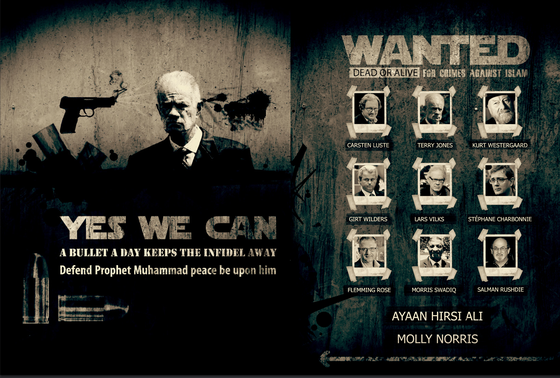
Screen Shot 2015-01-07 at 10.15.52 AM-thumb-560x378-5455

After the deadly terrorist attack on the Charlie Hebdo offices in Paris, France, it’s worth remembering that there is no amount of conciliating rhetoric that will stop attacks on our liberal values – even undermining them. Which is something we’ve done.

Remember Molly Norris whose name appears on the above poster?  I wrote about her on 16 September 2010:

Cartoonist Molly Norris Driven into Hiding by Muslim Extremism

Story here. 

Among the great religions of the world, where 'great' is to be taken descriptively not normatively, Islam appears uniquely intolerant and violent.  Or are there contemporary examples of Confucians, Taoists, Buddhists, Hindus, Jews, or Christians who, basing themselves on their doctrines, publically  issue and carry out credible death threats against those who mock the exemplars of their faiths?  For example, has any Christian, speaking as a Christian, publically  put out a credible murder contract on Andres Serrano for his despicable "Piss-Christ"?  By 'credible,' I mean one that would force its target, if he were rational, to go into  hiding and erase his identity?

UPDATE 9/19/2010.   Commentary by James Taranto here

Levels of Reality and the Essence of Religion

Reading John Anderson has enhanced my sense of the centrality of the question of levels of reality for those of us who view philosophy as a quest for the Absolute and a project of self-transformation.  Of course it was more or less obvious to me all along, Plato's Allegory of the Cave being the richest depiction we have of the two-world theme.

Essential to religion is the belief that there is what William James calls an "unseen order" (Varieties of Religious Experience, 53), a higher order, above or behind the phenomenal order of time and change, doubt and confusion, mendacity and evil.

The unseen order is to be affirmed without the phenomenal order being denied.  So there are two levels of reality.  How exactly they are related is the problem, or one problem.  We will pursue the problem in due course in connection with John Passmore's discussion of the "Two-Worlds Argument" in his Philosophical Reasoning.