Can Anyone Recommend a Good History of Philosophy?

A graduate student in philosophy asks about histories of philosophy:

Suppose I wanted, over time, to work through a text or series of texts. Which ones are worthy of consideration? I've heard good things about Copleston's 11 volumes. There's also Russell's history of western philosophy and Anthony Kenny has done a history as well. Do you recommend any of those (or perhaps another)? I should say that any history text will not supplant primary sources; it would be an addition to them.

While Bertrand Russell is entertaining, I can't recommend his history.  He wrote it for money, or rather he dictated it for money.  (When he was asked why he wrote a blurb for a certain book, he said that he had a hundred good reasons: the author paid him $100.)  For a taste, consider the following passage  from Bertrand Russell, A History of Western Philosophy (New York: Simon & Shuster, 1945), p. 427. I found it here, but without a link and without a reference. So, exploiting the resources of my well-stocked library, I located the passage, and verified that it had been properly transcribed. Whether Russell is being entirely fair to the Arabs is a further question.  In fact, I am pretty sure that he is not being fair to Avicenna (Ibn Sina) who played a key role in the development of the metaphysics of essence and existence.

Arabic philosophy is not important as original thought. Men like Avicenna and Averroes are essentially commentators. Speaking generally, the views of the more scientific philosophers come from Aristotle and the Neoplatonists in logic and metaphysics, from Galen in medicine, from Greek and Indian sources in mathematics and astronomy, and among mystics religious philosophy has also an admixture of old Persian beliefs. Writers in Arabic showed some originality in mathematics and in chemistry; in the latter case, as an incidental result of alchemical researches. Mohammedan civilization in its great days was admirable in the arts and in many technical ways, but it showed no capacity for independent speculation in theoretical matters. Its importance, which must not be underrated, is as a transmitter. Between ancient and modern European civilization, the dark ages intervened. The Mohammedans and the Byzantines, while lacking the intellectual energy required for innovation, preserved the apparatus of civilization, books, and learned leisure. Both stimulated the West when it emerged from barbarism; the Mohammedans chiefly in the thirteenth century, the Byzantines chiefly in the fifteenth. In each case the stimulus produced new thought better than that produced by the transmitters — in the one case scholasticism, in the other the Renaissance (which however had other causes also).

Copleston is good, and you might also consider Hegel.  He will broaden you and counteract the probably excessively analytic atmosphere which you now breathe.  But the Swabian genius is quirky and opinionated just like Lord Russell.  When he comes to the medieval period in his Lectures on the History of Philosophy, he puts on his “seven-league boots” the better to pass over this thousand year period without sullying his fine trousers. (Vol. III, 1)

Summing up the “General Standpoint of the Scholastics,” he has this to say: “…this Scholasticism on the whole is a barbarous philosophy of the finite understanding, without real content, which awakens no true interest in us, and to which we cannot return.” “Barren,” and “rubbishy” are other terms with which he describes it. (Vol. III, 94-95) The politically correct may wish to consider whether the descendants of Hegel should pay reparations to the descendants of Thomas Aquinas, et al.

ComBox open for anyone with recommendations.
Ross Douthat

Op-ed commentary at The New York Times is abominably bad.  But there are a couple or three exceptions, one of which is the work of Ross Douthat. This from For Poorer or Richer:

But the basic point is this: In a substantially poorer American past with a much thinner safety net, lower-income Americans found a way to cultivate monogamy, fidelity, sobriety and thrift to an extent that they have not in our richer, higher-spending present.

So however much money matters, something else is clearly going on.

The post-1960s cultural revolution isn’t the only possible “something else.” But when you have a cultural earthquake that makes society dramatically more permissive and you subsequently get dramatic social fragmentation among vulnerable populations, denying that there is any connection looks a lot like denying the nose in front of your face.

But recognizing that culture shapes behavior and that moral frameworks matter doesn’t require thundering denunciations of the moral choices of the poor. Instead, our upper class should be judged first — for being too solipsistic to recognize that its present ideal of “safe” permissiveness works (sort of) only for the privileged, and for failing to take any moral responsibility (in the schools it runs, the mass entertainments it produces, the social agenda it favors) for the effects of permissiveness on the less-savvy, the less protected, the kids who don’t have helicopter parents turning off the television or firewalling the porn.

This judgment would echo Leonard Cohen:

Now you can say that I’ve grown bitter but of this you may be sure /

The rich have got their channels in the bedrooms of the poor.

And without dismissing money’s impact on the social fabric, it would raise the possibility that what’s on those channels sometimes matters more.

Three Million Page Views

Yesterday, the Typepad version of Maverick Philosopher  shot past the three million page view mark.  This, the third main version of MavPhil, commenced operations on 31 October 2008.  The first main version took off on 4 May 2004.

To be exact, total page views at the moment are 3,003,886. That averages to 1,290.33 page views per day with recent averages well above that.  Total posts come to 5,749, total comments to 7,594.

The two million page view mark was reached on 19 July 2013.

I thank you one and all, man and bot, for your 'patronage.'

My pledge: You will never see advertising on this site.  You will never see anything that jumps around in your visual field.  You will not be assaulted by unwanted sounds.  You will never have to read anything against a black background. I will not beg for money with a 'tip jar.'  This is a labor of love and I prize my independence.

I also pledge to continue the fight, day by day, month by month, year by year, against the hate-America, race-baiting, religion-bashing, liberty-destroying, terror-appeasing fascists of the Left.  As long as health and eyesight hold out.

I will not pander to anyone, least of all the politically correct.

And I won't back down.  Are you with me?

Relative Truth?

If you are tempted by the thought that truth is relative you may want to consider whether it could be relatively true that there are beliefs, that different people have different beliefs about the same topic, that some hold that truth is non-relative, that others hold that being-true and being-believed-by-someone are one and the same property, and so on.

Two Mistakes

To reject moral equivalentism is not to embrace 'Manicheanism.'  To reject robust interventionism in foreign policy is not to subscribe to 'isolationism.'  To think otherwise in either case is to make a mistake.  Most leftists make the first mistake; many conservatives the second.

Vera Menchik

I am teaching chess to some women who  have joined our club, "The Lost Knights of the Superstitions."  Nice title, eh? At once both romantic and self-deprecatory with an allusion to the Lost Dutchman Gold Mine and Jacob Waltz, the 'Dutchman' himself who was not Dutch but Deutsch.

The following excerpt from an article by Lubomir Kavalek may help inspire the newly recruited distaff acolytes of the Royal Game.

Amazing Menchik

Vera Menchik (1906-1944) was the first women's world champion who could play successfully against the best male players. She almost stirred an international conflict. Three countries claimed her: she was born in Moscow, played chess mostly for Czechoslovakia, married an Englishman and died in London.

Menchik won the first official women's world championship in London in 1927 and defended the title six times in tournaments with an incredible overall score of 78 wins, four draws and one loss. She also defeated the German Sonja Graf in two world title matches in 1934 and 1937. Menchik played positionally most of the time, but she could deliver a nice tactical blow.

Menchik,Vera – Graf,Sonja
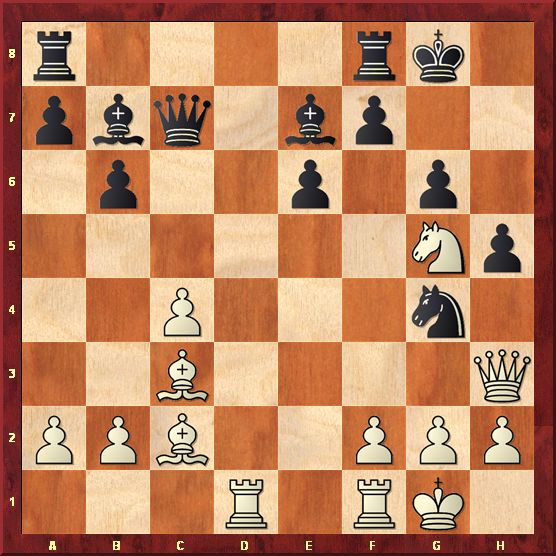
Wch (Women) Semmering (14), 13.07.1937

2012-04-23-Women2.jpg

Position after 20 moves

21.Rd7! (A beautiful decoy. The rook deflects the queen, allowing a spirited queen sacrifice: 21… Qxd7 22.Qxh5! gxh5 23.Bh7 mate.
White would have a decisive advantage after: 21…Qxh2+ 22.Qxh2 Nxh2 23.Rxe7 Nxf1 24.Bxg6! e5 25.Nxf7 Kg7 26.Nxe5+ Kf6 27.Rxb7.)
Graf resigned.

2012-04-22-Menchik2.jpg

2012-04-22-Menchik1.jpg

2012-04-22-Znamka_Mencikova.jpg

2012-04-22-Menchik3.jpg

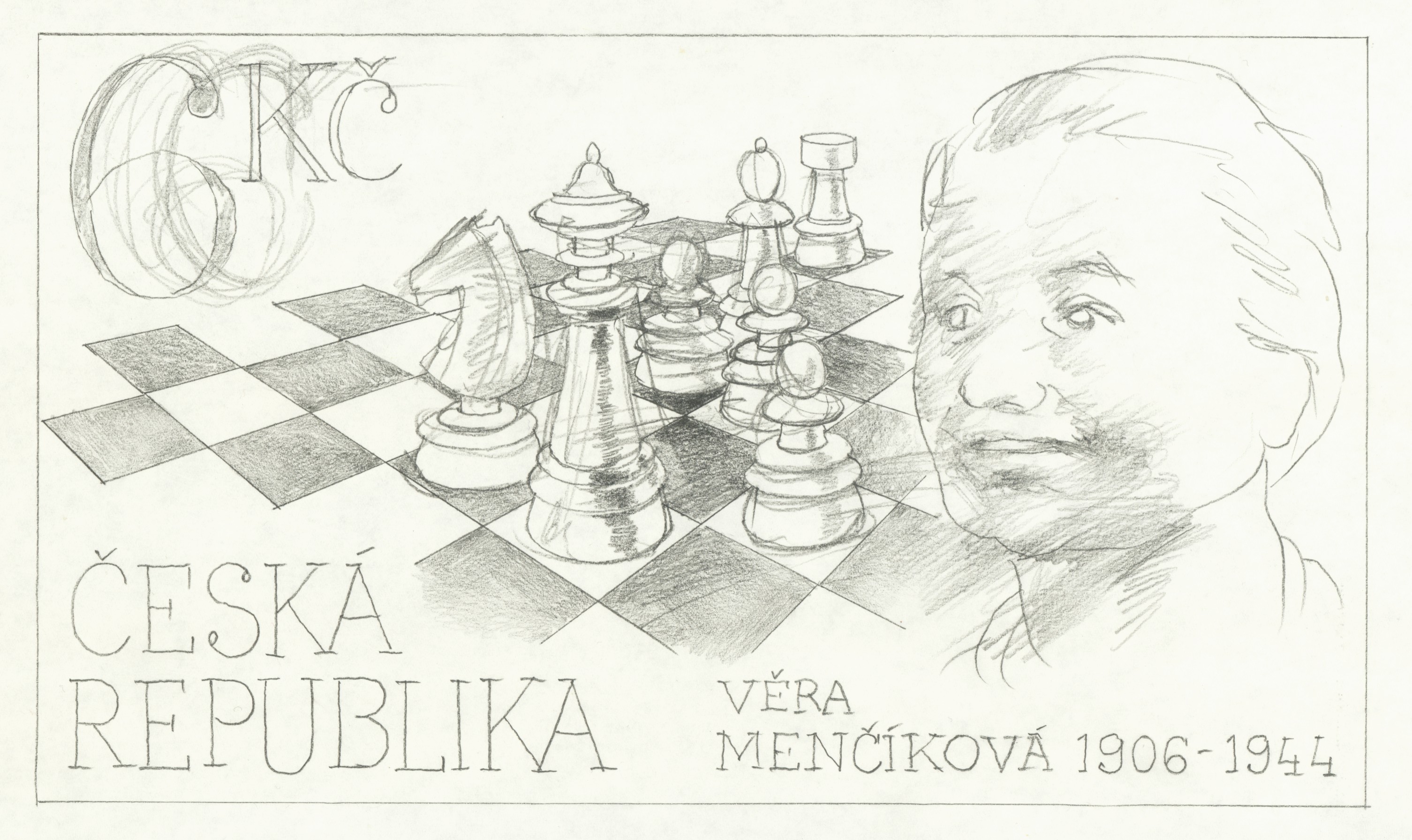
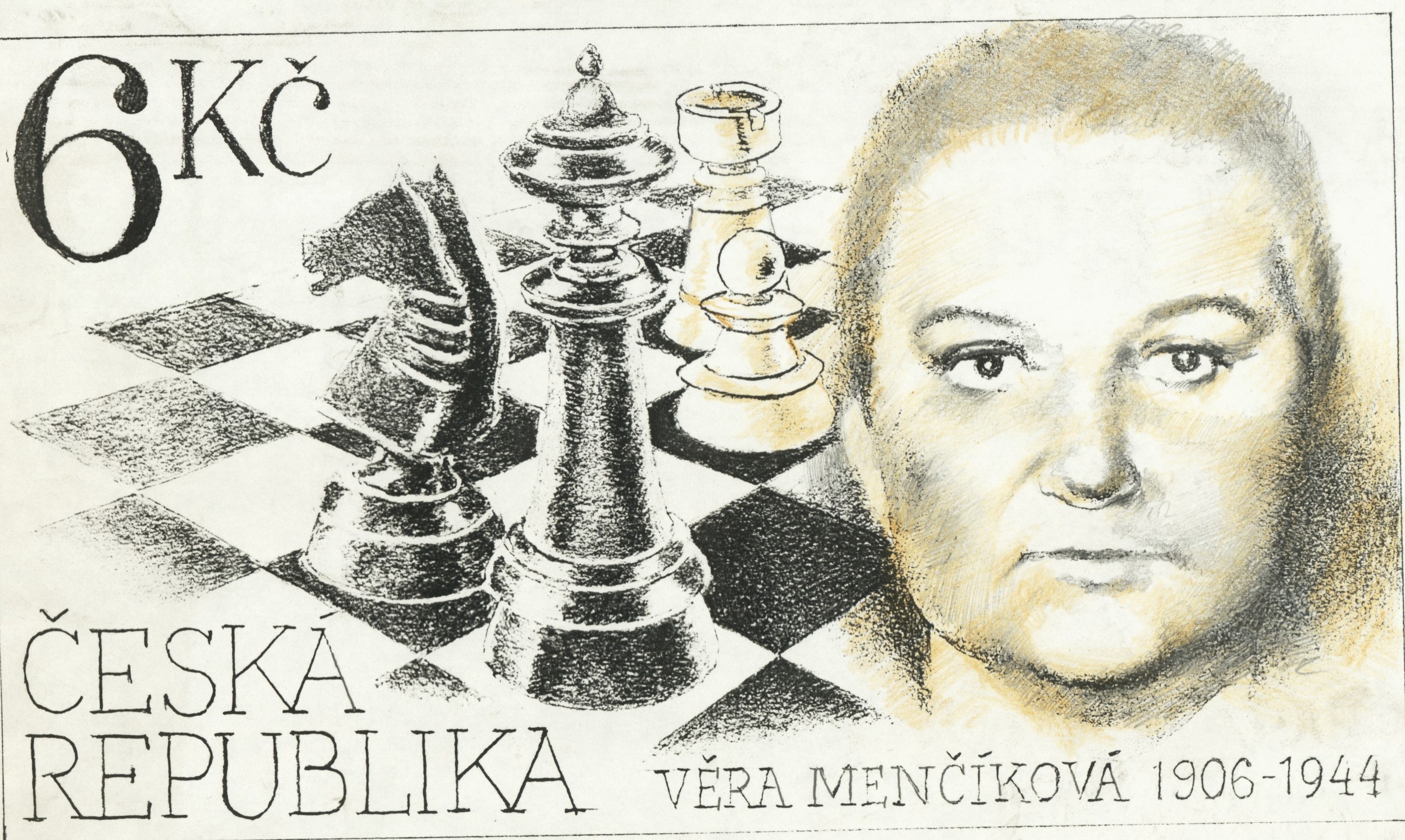
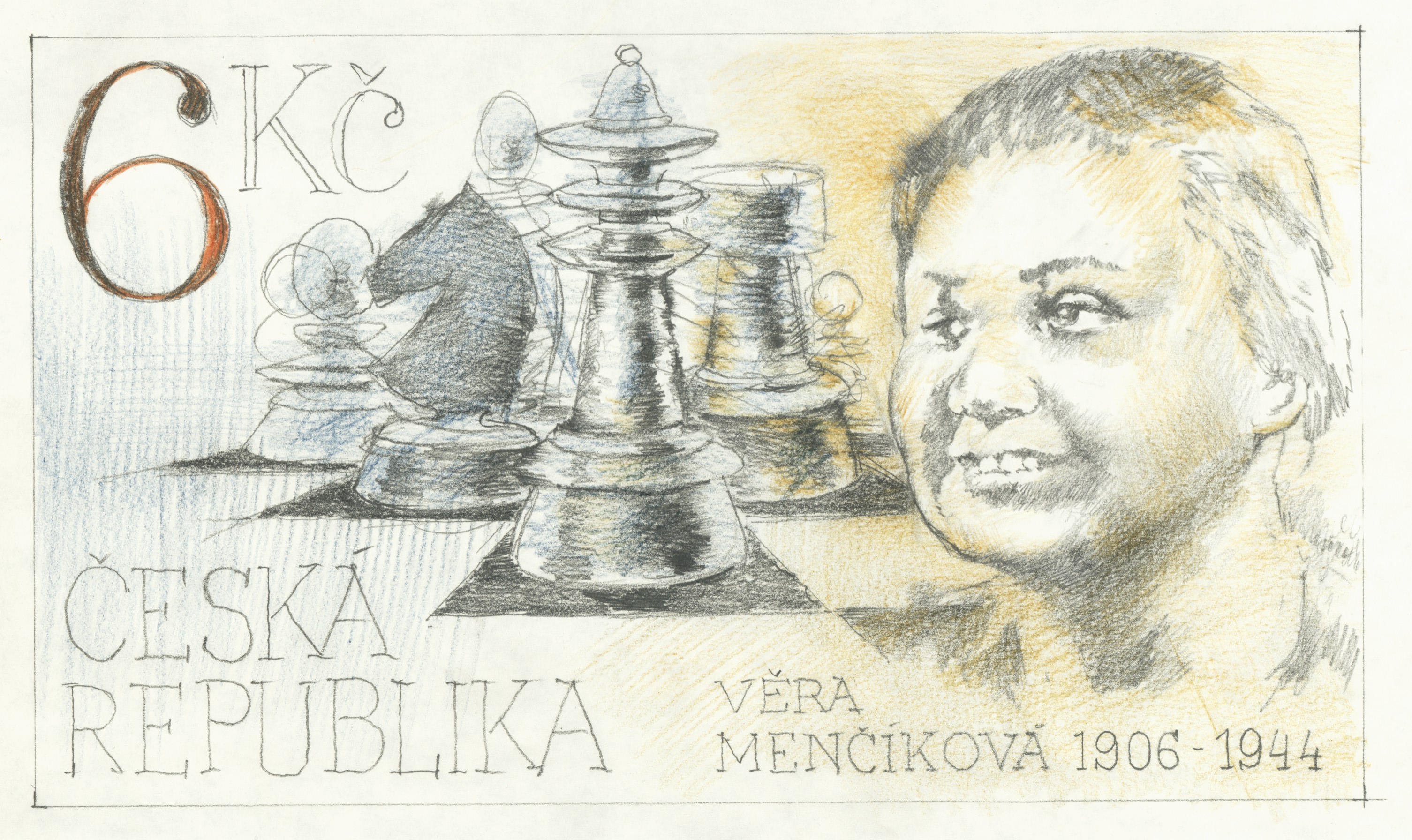
The Czechs honored Menchik with a postage stamp designed by Zdenek Netopil. He could not make up his mind, but eventually let her smile. It was issued February 14, 1996. Menchik held her world title for 17 years, the longest of any woman. Last year, she was inducted into the Chess World Hall of Fame – the first woman among chess giants.

During the 1929 Karlsbad tournament, the Austrian master Albert Becker founded the Vera Menchik Club. He suggested that anyone who loses to the lady should become a member. He was the first victim, but there were others. Among her most famous casualties were dr. Max Euwe and Sammy Reshevsky. Out of 437 tournament games against male opponents, she won 147.

She didn't fare well against the very top players. She was hammered by Jose Raul Capablanca (9-0), Alexander Alekhine (7-0), Mikhail Botvinnik (2-0), Paul Keres (2-0), Reuben Fine (2-0) and Emanuel Lasker (1-0).

In 1921 Menchik's family moved from Moscow to England. Vera was 15. When she saw bottles of milk left outside of English homes, Menchik said: "In Russia, they would immediately be stolen." The quote didn't make it to Elizaveta Bykova's biography of Menchik. Bykova had a different idea of what should be taken.

Saturday Night at the Oldies: Bob Dylan, Traditionalist

The Left owns Dylan as little as it owns dissent.  Every Dylanologist will want to read Christopher Caldwell's Weekly Standard piece, AWOL from the Summer of Love.  It begins like this:

In the mid-1960s the most celebrated folk musician of his era bought a house for his growing family at the southern edge of the Catskills, in the nineteenth-century painters’ retreat of Woodstock. He was a “protest singer,” to use a term that was then new. His lyrics—profound, tender, garrulous—sounded like they were indicting the country for racism (“where black is the color where none is the number”), or prophesying civil war (“you don’t need a weatherman to know the way the wind blows”), or inviting young people to smoke dope (“everybody must get stoned”). Fans and would-be acolytes were soon roaming the town on weekends, hoping to catch a glimpse of him. Eccentric-looking by the standards of the day, they infuriated local residents. Nothing good was going to come of it. One of the town’s more heavily armed reactionaries would later recall:

[A] friend of mine had given me a couple of Colt single-shot repeater pistols, and I also had a clip-fed Winchester blasting rifle around, but it was awful to think about what could be done with those things. .  .  . Creeps thumping their boots across our roof could even take me to court if any of them fell off. .  .  . I wanted to set fire to these people. These gate-crashers, spooks, trespassers, demagogues were all disrupting my home life and the fact that I was not to piss them off or they could press charges really didn’t appeal to me.

The folk singer was Bob Dylan. The reactionary old coot with all the guns .  .  . well, that was Bob Dylan, too. At age 25, he was growing uncomfortable with the role conferred on him by the music he’d written at age 20. “I had very little in common with and knew even less about a generation that I was supposed to be the voice of,” he would later write in his memoir Chronicles.

And it ends like this:

If Dylan was the voice of a generation, it was not of the generation we think. He belonged to the generation before the one that idolized him, as did The Band. For them, the pre-baby boom frameworks of meaning were all still in place, undeconstructed and deployable in art. One of history’s secrets is that revolutionaries’ appeal in the eyes of posterity owes much to the traits they share with the world they overthrew. They secure their greatness less by revealing new virtues than by rendering the ones that made them great impracticable henceforth. There is no reason this should be any less true of Dylan. His virtues are not so much of the world he left us with as of the world he helped usher out.

Dylan and BandSome selections from The Bootleg Series, #11:

Quinn the Eskimo

Lo and Behold!

One Too Many Mornings

Million Dollar Bash (Take 2)

You Ain't Going Nowhere (Take 2)

The Auld Triangle

Punch Bros. version

Too Much of Nothing (Take 2)

Say to Valerie, say hello to Marion
Give them all my salary on the waters of oblivion.

You Win Again

An old Hank Williams number

Jerry Lee Lewis version

Rock Salt and Nails

Joan Baez's unsurpassable and definitive version

A Fool Such as I

Hank Snow's 1952 version

Just a couple of years before the motorcycle accident:

Stuck Inside of Mobile with the Memphis Blues Again

Some, like Jesse Jackson, are still stuck inside of  Selma with the Oxford Blues again. 

Oxford Town is both topical and timeless.  It is about the enrollment of James Meredith at the University of Mississippi in the fall of 1962.  But neither Meredith nor Ole Miss are mentioned.  This allows the song to float free of the events of the day and assume its rightful place in the audio aether of Americana.

Happy Super π Day!

π day is 3/14.  But today is super π day: 3/14/15.  To celebrate it properly you must do so at 9:26 A.M. or P. M. Years ago, as a student of electrical engineering, I memorized π this far out: 3.14159.

The decimal expansion is non-terminating.  But that is not what makes it an irrational  number.  What makes it irrational is that it cannot be expressed as a fraction the numerator and denominator of which are integers.  Compare 1/3.  Its decimal expansion is also non-terminating: .3333333 . . . .  But it is a rational number because it can be expressed as a fraction the numerator and denominator of which are integers (whole numbers).

An irrational (rational) number is so-called because it cannot (can) be expressed as a ratio of two integers. Thus any puzzlement as to how a number, as opposed to a person, could be rational or irrational calls for therapeutic dissolution, not solution (he said with a sidelong glance in the direction of Wittgenstein).

Yes, there are pseudo-questions.  Sometimes we succumb to the bewitchment of our understanding by language.  But, pace Wittgestein, it is not the case that all the questions of philosophy are pseudo-questions sired by linguistic bewitchment.  I say almost none of them are.  So it cannot be the case that philosophy just is the struggle against such bewitchment. (PU #109: Die Philosophie ist ein Kampf gegen die Verhexung unsres Verstandes durch die Mittel unserer Sprache.)  What a miserable conception of philosophy! As bad as that of a benighted logical positivist.

Many people don't understand that certain words and phrases are terms of art, technical terms, whose meanings are, or are determined by, their uses in specialized contexts.    I once foolishly allowed myself to be suckered into a conversation with an old man.  I had occasion to bring up imaginary (complex) numbers in support of some point I was making.  He snorted derisively, "How can a number be imaginary?!"  The same old fool — and I was a fool too for talking to him twice — once balked incredulously at the imago dei.  "You mean to tell me that God has an intestinal tract!"

Finally a quick question about infinity.  The decimal expansion of π is non-terminating.  It thus continues infinitely.  The number of digits is infinite.  Potentially or actually?  I wonder: can the definiteness of π — its being the ratio of diameter to circumference in a circle — be taken to show that the number of digits in the decimal expansion is actually infinite?  

I'm just asking.

Now go ye forth and celebrate π day in some appropriate and inoffensive way.  Eat some pie.  Calculate the area of some circle.  A = πr2.  

Dream about π in the sky.  Mock a leftist for wanting π in the future.  'The philosophers have variously interpreted π; the point is to change it!'

UPDATE:  Ingvar writes,

Of course the ne plus ultra pi day was 3-14-1592 and whatever happened that day
at 6:53 in the morning.
So we have one yearly, one every millennium, and one
once.

 Related articles

Friday the 13th Cat Blogging! In the Foothills of the Superstition Mountains.

Cat black Cat in tie

I Ain't Superstitious, leastways no more than Howlin' Wolf, but two twin black tuxedo cats just crossed my path.  All dressed up with nowhere to go.  Nine lives and dressed to the nines.  Stevie Ray Vaughan, Superstition.  Guitar solo starts at 3:03.  And of course you've heard the story about Niels Bohr and the horseshoe over the door:

A friend was visiting in the home of Nobel Prize winner Niels Bohr, the famous atomic scientist.

As they were talking, the friend kept glancing at a horseshoe hanging over the door. Finally, unable to contain his curiosity any longer, he demanded:

“Niels, it can’t possibly be that you, a brilliant scientist, believe that foolish horseshoe superstition! ? !”

“Of course not,” replied the scientist. “But I understand it’s lucky whether you believe in it or not.”

Bill O’Reilly the Other Night

It "drives him crazy" that people say 'at the end of the day.'

(Now why did I use double and then revert to single quotation marks?  Because I went from quoting a particular person to mentioning a phrase in widespread use, but not quoting any particular person.  There is no need for you to be so punctilious.  Just don't call me inconsistent.)