What About Infertile Heterosexual Couples?

Keith Burgess-Jackson writes,

The purpose and point of marriage, as everyone knows, and as the law has long recognized, is to bind a man and a woman to one another for the sake of any children they produce. Please, please, please don't say that infertile heterosexual couples are allowed to marry, as though that refutes my claim. Immature 21-year-olds are allowed to drink alcohol, but that doesn't mean the purpose and point of the drinking age isn't to prevent immature individuals from drinking alcohol.

That's right.  As I say near the end of a long entry, The Infertility Argument for Same-Sex Marriage:

The law cannot cater to individual cases or even to unusual classes of cases.  Consider laws regulating driving age.  If the legal driving age is 16, this is unfair to all the 13-16 year olds who are competent drivers.  (E.g., farm boys and girls who learned to operate heavy machinery safely before the age of 16.)  If the law were to cater to these cases, the law would become excessively complex and its application and enforcement much more difficult.  Practical legislation must issue in demarcations that are clear and easily recognized, and therefore 'unfair' to some.

But a better analogy is voting.  One is allowed to vote if one satisfies quite minimal requirements of age, residency, etc.  Thus the voting law countenances a situation in which the well-informed and thoughtful votes of mature, successful, and productive members of society are given the same weight as the votes of people who for various reasons have no business in a voting booth.  We don't, for example, prevent  the senile elderly from voting even though they are living in the past out of touch with the issues of the day and incapable of thinking coherently about them.  We don't exclude them or other groups for a very good reason: it would complicate the voting law enormously and in highly contentious ways.  (Picture armies of gray panthers with plenty of time on their hands roaming the corridors of Congress armed with pitchforks.)  Now there is a certain unfairness in this permissiveness: it is unfair to thoughtful and competent voters that their votes be cancelled out by the votes of the thoughtless and incompetent.  But we of the thoughtful and competent tribe must simply 'eat' (i.e., accept) the unfairness as an unavoidable byproduct of workable voting laws.

In the same way, whatever residual unfairness to homosexuals there is in allowing infertile oldsters to marry (after my foregoing arguments have been duly digested) is an unfairness that simply must be accepted if there are to be workable marriage laws.

What is Potentiality? An Exploration

Our Czech friend Vlastimil V. writes,

I believe it is precisely the potentiality — or the in principle capacity — of logical thinking, free decisions, or higher emotions that makes killing human embryos morally problematic, seemingly unlike the killing of non-human embryos. This seems to me a promising hypothesis, to say the least. But I need help with settling several issues.

And then V. peppers me with a bunch of tough questions.  I'll address just the first in this entry:
 
What is potentiality or in principle capacity in general? How does it differ from (metaphysical) possibility?
 
This is indeed the logically first question.  Potentiality is widely misunderstood even by many philosophers.  No wonder they do not appreciate the Potentiality Argument.  Here the focus is not on the Potentiality Argument against abortion, but on the concept of potentiality it requires.  My task is merely to unpack it, not evaluate it.  We may begin by treading the via negativa.
 
1.  A potentiality is not the same as a possibility.  It is obviously not the same as an actualized possibility, but it is also not the same as an unactualized possibility. Potentialities are strange items and their ontological status is puzzling.  Don't assume you know what they are, and don't assume that you can learn what they are from the uses of 'potential' and cognates in English.
 
Take the fragility of a piece of glass.  Its fragility is its potentiality (passive potency, disposition, liability) to shatter in certain circumstances.  Consider two panes of thin glass side by side in a window. The two panes are of the same type of glass, and neither has been specially treated. A small rock is thrown at one, call it pane A, and it shatters under the moderate impact. The other pane, call it B, receives no such impact. We know that A is fragile from the fact that it shattered. ("Potency is known through act," an Aristotelian might say.) We don't have quite the same assurance that B is fragile, but we have good reason to think that it is since it is made of the same kind of glass as A.

Suppose that B never in its existence is shattered or in any way pitted or cracked or broken. Then its fragility, its disposition-to-shatter (break, crack, etc.) is never manifested. We can express that by saying that the manifestation of the disposition remains an unactualized possibility. That is, the shattering of pane B remains, for the whole of B's existence, a merely possible state of affairs, a mere possibility.

But that is not to say that the disposition is a mere possibility, let alone that it is unreal. The disposition is as actual as the thing that has it.  A disposition is distinct from  its manifestation. The disposition is actual whether its manifestation is actual, as in the case of pane A, or merely possible, as in the case of pane B.

So we make a distinction between the (de re) possibility of B's shattering and B's disposition to shatter.  The first is the possibility of the manifestation of the second.  The first may never become actual while the second is as actual as B.  What's more, the possibility of B's shattering is (in some sense needing explanation) grounded in B's disposition to shatter.

The point extends to potentialities: it is an elementary confusion to think of unrealized or unmanifested or unactualized potentialities as unactualized possibilia or mere possibilities. For example, a human embryo has the potentiality to develop, in the normal course of events, into a neonate. This potentiality is something actual in the embryo. It is not a mere or unactualized possibility of the embryo. What is a mere possibility is the realization of the potentiality. Just as we must not confuse a disposition with its manifestation, we must not confuse a potentiality with its realization.

One difference to note is that between a passive potentiality and an active potentiality.  The pane's potentiality to shatter is passive whereas the embryo's potentiality to develop into a neonate is active.  As for terminology, I don't see any non-verbal difference between a potentiality-to-X and a disposition-to-X. (I could be wrong.)  Some people are irascible.  They are disposed to become angry under slight external provocation.  Is that a passive potentiality or an active potentiality?  Put that question on the 'back burner.'

2.  Another difference between a possibility and a potentiality is that, while every actual F is a possible F, no actual F is a potential F.  Therefore, a possible F is not the same as a potential F.  For example, an actual cat is a possible cat, but no actual cat is a potential cat.  A towel that is actually saturated with water is possibly saturated with water; but no towel that is actually saturated with water is potentially saturated with water.  If a man is actually drunk, then he is possibly drunk; but an actually drunk man is not a potentially drunk man.  Potentiality excludes actuality; possibility does not.  But can't a man who is actually drunk at one time be potentially drunk at another?  Of course, but that is not the point.

Necessarily, if x is actually F at time t, then x is possibly F at t.  But, necessarily, if x is actually F at t, then:

a. It is not the case that x is potentially F at t

and

b. X is not potentially F at t.

Furthermore, an actual truth is a possible truth, but it makes  no sense to say that an actual truth is a potential truth.  A truth is a true proposition; propositions are abstract objects; abstract objects are not subjects of real, as opposed to Cambridge, change.  So it makes  no sense to speak of potential truths.

The actual world is a possible world; but what could it mean to say that the actual world is a potential world?

If God necessarily exists, then God actually exists, in which case God possibly exists.  But it makes no sense to say that God potentially exists.  In terms of possible worlds:  If God exists in every world, then he exists in the actual world and in some possible worlds.  But 'God exists in some potential worlds' makes no sense.

It makes sense to say that it is possible that there exist an individual distinct from every actual individual.  But it makes no sense to say that there is the potentiality to exist of some individual distinct from every actual individual. 

3.  So, to answer Vlastimil's question, potentiality is not to be confused with possibility.  And it doesn't matter whether we are talking about narrowly logical possibility, broadly logical possibility, nomological  possibility, institutional possibility, or any other sort of  (real as opposed to epistemic/doxastic) possibility.  Nevertheless, the two are connected.  If it is possible that a boy grow a beard, then presumably that possibility is grounded in a potentiality inherent in the boy.  The point, once again, is that this potentiality is not itself something merely potential, but something actual or existent, though not yet actualized.

I am now seated.  I might now have been standing.  The first is an actual state of affairs, the second is a merely possible state of affairs.  How are we to understand the mere possibility of my standing now?  Pace the shade of David Lewis, it would be 'crazy' to say that there is a possible world in which a counterpart of me is standing now.  But it seems quite sane to say that the possibility of my standing now, when in actual fact I am seated, is grounded in the power (potentiality) I have to stand up.

A mere possibility is not nothing.  So it has some sort of ontological status.  A status can be secured for mere possibilities  if mere possibilities are grounded in really existent powers in agents. 

('Potential' Puzzle.  I have the power to do X iff it is possible that I do X.  But do I have the power because it is possible, or is it possible because I have the power?  Presumably the latter.  But my power is limited.  What constrains my power it not what is antecedently possible?  Throw this on the 'back burner' too, Euthyphro!)

As I understand the Aristotelian position, real possibilities involving natural items are parasitic upon causal powers and causal liabilities ingredient in these items.  That, by the way, implies constituent ontology, does it not?  Score another point for constituent ontology.

The Aristotelian position also implies a certain anti-empiricism, does it not?  A rubber band that is never stretched never empirically manifests its elasticity; yet it possesses the dispositional property of elasticity whether or not the property is ever manifested empirically.   So dispositions and potencies  are in a clear sense occult (hidden) entities, and they are occult in a way the occult blood in your stool sample is not occult.  For the latter, while not visible to gross inspection is yet empirically detectable in the blood lab.

4. Go back to the two panes of glass.  One we know is fragile: it broke under moderate impact.  How do we know that the other is fragile?  I submit that the concept of potentiality underlying the Potentiality Argument is governed by the following Potentiality Universality Principle:

PUP: Necessarily, if a normal F has the potentiality to become a G, then every normal F has the potentiality to become a G.

To revert to the hackneyed example, if an acorn is a potential oak tree, then every normal acorn is a potential oak tree, and this is so as a matter of natural necessity. It cannot be the case that some normal acorns have, while others do not have, the potentiality to become oak trees. Potentialities are inherent in the things that have them. They are not a matter of ascription. We don't ascribe potentialities; things have them regardless of our mental and linguistic performances. And these very performances themselves realize potentialities. So if the potentialities of the ascribing mind were themselves ascribed, who or what would do the ascribing? I cannot ascribe potentialities to myself if the ascribing is itself the realization of my potentiality to ascribe.

Similarly with passive potentialities. To say of a sugar cube that it is water-soluble is to say that, were it placed in water, it would dissolve. Now if this is true of one normal sugar cube, it is true of all normal sugar cubes. Suppose you have 100 sugar cubes, all alike. There would be no reason to say that some of them are water-soluble and some are not. If one is, all are. If one is not, none are.

5. Note that the water-solubility of sugar cubes cannot be identified with the truth of the subjunctive conditional 'If a sugar cube were placed in water then it would dissolve.'  It needs to be identified with the truth maker of that conditional, namely, the passive potency to dissolve inherent in the sugar cube.

6. Potentiality as here understood brings with it further Aristotelian baggage.  

Pointing to a lump of raw ground beef, someone might say, "This is a potential hamburger." Or, pointing to a hunk of bronze, "This is a potential statue." Someone who says such things is not misusing the English language, but he is not using 'potential' in the strong specific way that potentialists — proponents of the Potentiality Principle in the Potentiality Argument– are using the word. What is the difference? What is the difference between the two examples just given, and "This acorn is a potential oak tree," and "This embryo is a potential person?"

The difference is explainable in terms of the difference between identity and constitution. A lump of raw meat cannot come to be a hamburger; at most it can come to constitute one. The same goes for the hunk of bronze: it cannot come to be a statue; at most it can come to constitute one. Note also that an external agent is required to shape and cook the meat and to hammer the bronze. An acorn and an embryo, on the other hand, can come to be an oak tree and a person, respectively, and indeed by their own internal agency. Potentiality in the strong sense here in play is therefore governed by the following Potentiality Identity Principle:

PIP: Necessarily, if x is a potential F, and there is a y such that y realizes, whether partially or fully, x's potentiality to be an F, then x = y.

Note that PIP does not imply that there is a y that realizes x's potential. Potentialities, after all, may go unrealized similarly as dispositions may go unmanifested. A seed's potential will go unrealized if the seed is destroyed, or if the seed is not planted, or if it is improperly planted, or if it is properly planted but left unwatered, etc. What PIP states is that if anything does realize x's potentiality to be an F, then that thing is transtemporally numerically identical to x. So if there is an oak tree that realizes acorn A's potentiality to be an oak tree, then A is identical over time to that oak tree. This implies that when the acorn becomes an oak tree, it still exists, but is an oak tree rather than an acorn. The idea is that numerically one and the same individual passes through a series of developmental stages. In the case of a human being these would include zygote, embryo, fetus, infant, child, adolescent, and adult.

Not so with the hunk of bronze. It is not identical to the statue that is made out of it. Statue and hunk of bronze cannot be identical since they differ in their persistence conditions. The hunk of bronze can, while the statue cannot, survive being melted down and recast in some other form.

Consider the Pauline verse at 1 Corinthians 13:11: "When I was a child, I spake as a child, I understood as a child, I thought as a child: but when I became a man, I put away childish things." This implies that numerically one and the same man, Paul of Tarsus, was first a child and later became an adult: it is not as if there was a numerically different entity, Paul-the-child, who passed out of existence when Paul-the-adult came into existence.

So not only is potentiality (in the strong Aristotelian sense here in play) governed by PIP, it is also governed by what I will call the Potentiality Endurantism Principle:

PEP. Necessarily, if x is a potential F, and there is a y such that y realizes, whether partially or fully, x's potentiality to be an F, then x (= y) is wholly present at every time at which x (= y) exists.

PEP rules out a temporal parts ontology according to which a spatiotemporal particular persists in virtue of having different temporal parts at different times.

Let me throw another principle into the mix, one that is implicit above and governs active potencies.  I'll call it the Potentiality Agency Principle:

PAP. Necessarily, if x is a potential F, and x's potential is to any extent realized, then the realization of x's potential is driven, not by any agency external to x, but by x's own internal agency, with the proviso that the circumambient conditions are favorable.

The notion of (strong) potentiality that figures in the Potentiality Principle and the Potentiality Argument is governed by PUP, PIP, PEP, and PAP at the very least.

7.  When Barack Obama was a community organizer was he 'potentially' president of the U. S.?  It was surely possible that he become POTUS: logically, nomologically, and institutionally: there is nothing in the Constitution that ruled out his becoming president.  And there is nothing incorrect in saying, in ordinary English, that the young Obama was 'potentially' POTUS.  But does it make sense to say that, ingredient in the young Obama, there was a potentiality that was actualized when he became POTUS if we are using 'potentiality' in the Aristotelian sense?

I don't think so.  It looks to be a violation of PUP above.  Let 'F' stand for U. S. citizen. Does every U.S. citizen have the potential to become a presidential candidate? Obviously not: it is is simply false that every normal U. S. citizen develops in the normal course of events into a presidential candidate. A potentiality is a naturally inherent nisus — and as natural not a matter of laws or other conventions — which is the same in all members of the class in question. But the opportunity to become president has nothing natural about it: it is an artifact of our contingent laws and political arrangements. People like Obama do not become presidential contenders in the way acorns become oak trees. 

Saturday Night at the Oldies: Celebrating Freedom and Independence

Not to mention resistance and defiance. 

Johnny Cash, I Won't Back Down. Tom Petty wrote it, with Jeff Lynne.

Byrds, Chimes of Freedom.  One of Dylan's greatest anthems.

Byrds, I Wasn't Born to Follow

Good YouTuber comment: "I keep searching for that door back into the summer of '69, I lost it somewhere long ago." 

Richie Havens, Freedom

Tim Hardin, A Simple Song of Freedom

Crystals, He's a Rebel

Rascals, People Got to be Free

Bob Dylan, I Shall be Free.  This is the first time I've heard this particular delightful 1962 outtake.  A real period piece in the style of Woody Guthrie with appearances by Marilyn Monroe, Anita Ekberg, Sophia Loren, John F. Kennedy, Elizabeth Taylor, Richard Burton, Mr. Clean, Mr. Clean's great granddaughter, fallout shelters . . . .

Cream, I Feel Free  

Against Professional Philosophy

There is some interesting material here.  Certainly contemporary academic philosophy in the Anglosphere and elsewhere is over-specialized and hyper-professionalized.  A critique is needed.  I have given the APP effort only a cursory reading, so I won't say anything more about it now except to observe that the contributors are anonymous.  

I should think that if one is serious about what one maintains and wants to be taken seriously, one should show some civil courage, speak in one's own name, and witness to the truth as one sees it.  And this especially in the case of one of the contributors, Z, who describes himself as follows:  "Z is a 50-something cosmopolitan anarcho-philosopher, and previously was a tenured full professor of philosophy at a public university somewhere in North America, but still managed to escape with his life." Why so coy?

Or is Z still afraid of this guy:

Leiter-537x350

Companion post: Civil Courage

‘Traditional Marriage’ or ‘Natural Marriage’?

This from long-time reader, Bill Tingley:

As always, Bill, I find reading your blog enlightening and enjoyable. I note you are using the term "traditional marriage" to refer to marriage. Now that the Supreme Court has redefined marriage as nothing more than a civil union, the meaning of the word "marriage" is in turmoil. So we do need a term to mean what "marriage" has always meant until the day before yesterday. Instead of "traditional marriage", I suggest "natural marriage". "Natural" more accurately conveys what is essential to marriage than "traditional" does. After all, everything that can be said to be traditional about marriage follows what is natural about it, sexual complementarity. More than that, natural law informs us that the good of sexual complementarity is actualized in marriage. Nor does it hurt that the rhetorical force of "natural" pushes buttons that confuse the Leftists and denies them their knee-jerk response to all that is labeled traditional.

Now that the Left has destroyed the word 'marriage,' we need a word to distinguish the genuine article from the leftist innovation.  I agree with Tingley about this.  I suggest 'traditional marriage.'  He suggests 'natural marriage.'  His reason for the superiority of the latter over the former is that:

. . . everything that can be said to be traditional about marriage follows what is natural about it, sexual complementarity.

I think this overlooks something important, namely, that marriage, while grounded in the biological complementarity of male and female human animals, and essentially so grounded, is a social institution.  So there is more to marriage than the merely natural.  For this reason, I prefer 'traditional marriage' to 'natural marriage.'

To clarify this, a brief look at the relation between the natural-biological and the social-cultural is in order.

Consider three situations, each a kind of 'intercourse.'  (1) A man and a woman playing chess with each other.  (2) A man and a woman just copulating with each other.  (3) A man and a woman getting married to each other and consummating their marriage.

Ad (1).  Chess has no objective reality outside of the system of rules or laws that constitute it, and these are of a conventional nature.  In this regard, the laws of chess are nothing like the laws of nature.*  They are not descriptive of culture-independent occurrences.  Nor are the rules of chess prescriptively regulative of processes and transactions external to them, in the way traffic laws regulate vehicular processes, and laws against fraud regulate business transactions by setting up norms that one ought to follow when one drives or does business.  The rules of chess are constitutive of the game, not regulative of some antecedent process, and what they constitute is something of a wholly conventional nature.  Chess is a social artifact in toto; there is nothing natural about it. A man and a woman playing chess are engaged in a social interaction with no natural or physical process underpinning it.  Of course, the touching and moving of pieces are physical processes, but there is nothing in the physical world corresponding  to an instance of chessic intercourse in the way there is something in nature corresponding to a description of photosynthesis.

Ad (2). Brute copulation is at the opposite extreme.  Copulation is a physical process whether it is done in marriage or outside marriage, whether it is done lovingly or rapaciously.  Brute copulation has nothing social or cultural about it.  It makes sense to say that chess is a social construct or a social artifact; it makes no sense to say that brute copulation is a social construct or social artifact.

I am assuming a healthy-minded realism.  I am assuming that there is an important distinction between what John Searle calls brute facts and what he calls institutional facts.  It is a brute fact that the sun is 93 million miles from the earth or that two animals are copulating.  It is an institutional fact that Barack Obama is POTUS and Michelle Obama FLOTUS.  A woman's being pregnant is a brute fact; a child's being illegitimate is an institutional fact.  The existence of gold, the metal Au, is a brute fact; the existence of money is an institutional fact even if the money is realized in gold coins.  "Brute facts exist independently of any human institutions; institutional facts can exist only within human institutions." (The Construction of Social Reality, p. 27)  It follows from these definitions that the consummation of a marriage, even though it necessarily involves sexual intercourse, is an institutional fact.

(Searle's use of 'brute fact' is a bit idiosyncratic.  I would say, and I think most philosophers would agree, that a brute fact is a contingently obtaining state of affairs the obtaining of which has no causal or other explanation.  If an atheist says that the universe just happens to exist without cause or reason, then he is saying that its existence  is a brute fact in my sense.  Of course, it is also a brute fact in Searle's sense.  Only a leftist loon would maintain that the physical universe is a social construct.  That the moon has craters, however, is not a brute fact in my sense though it is in Searle's inasmuch as it is not an institutional fact.  That astronomical distances are measured in light-years is an institutional fact, but not the distances themselves!)

Ad (3). Marriage is between chess and brute copulation.**  Chess is whatever FIDE or the United States Chess Federation says it is.  Marriage cannot be what any legislative body, or bunch of judges playing legislators, says it is.  For it is grounded essentially in the natural fact of human sexual complementarity. Chess is entirely a social construct; marriage is not.

On the other hand, marriage, unlike brute copulation, has a social side: it is after all a contract.  For this reason, I prefer 'traditional marriage' over 'natural marriage.'  Strictly speaking, there is no natural marriage: non-humans mate and reproduce and cohabit, but they don't marry.

____________________________________

*An interesting question is whether 'laws of chess' can only be construed as a subjective genitive:  the laws of chess are chess's laws, not laws about something external to these laws. But 'laws of nature' can also be construed as an objective genitive:  the laws of nature are laws about something external to them, namely the natural world.  

**And if I may be permitted a joke, too much chess and any extramural copulation, brute or not, can destroy a marriage.

Independence Day Twilight Zone Marathon Schedule

Twilight Zone Time Enough at LastIt starts tomorrow morning.

Kelley Vlahos:

While it might be difficult to fathom, Independence Day and the 1960s television hit “The Twilight Zone” have become virtually synonymous in the eyes of the show’s multigenerational fandom.

[. . .]

One could argue, however, that beyond a Fourth of July staple, “The Twilight Zone is as red, white and blue as the annual BBQ and parades, and this is why: The show, which ran for just five seasons from 1960-1964, is, at the very least, a reflection of our nation and people at a crossroads, between a World War and a New Frontier, the conformist 1950s and a counterculture waiting to explode, the comfort of peacetime and the fear of an atomic age. It’s both a history of our mid-20th century culture, and an X-Ray of humanity.

It is us. 

Well-said except that Vlahos makes a minor mistake: the series ran from 1959-1964.

Liberal Race Lunacy in Oregon

Here.  No commentary necessary.  To post this pernicious nonsense is to refute it.
 
“Many white people in Oregon have no idea that our schools and state are immersed in white culture and are uncomfortable and harmful to our students of color, while also reinforcing the dominant nature of white culture in our white students and families,” one of the conference documents explains.
 
The manual defines this “white culture” with a list of values, such as “promoting independence, self expression, personal choice, individual thinking and achievement,” because apparently those are strictly “white” concepts and not emphasized in black communities.
 
The training instructs participants to stop “blaming when students don’t meet standards” and instead start “examining our beliefs and practices when students don’t meet standards.” It advises faculty to avoid “controlling or teaching discipline to students” and to instead think about “changing school practices that alienate students and lead to disruptions.” 
 
It also tells participants to stop calling dropouts “dropouts” and to call them “pushouts” instead — after all, these kids clearly had no choice. They were basically kicked out of school by all of the white privilege.

If you care to read something intelligent on 'white privilege,' see here.
 

SCOTUS and Benedict

In the wake of recent events, Rod Dreher renews his call for the Benedict Option:

It is now clear that for this Court, extremism in the pursuit of the Sexual Revolution’s goals is no vice. True, the majority opinion nodded and smiled in the direction of the First Amendment, in an attempt to calm the fears of those worried about religious liberty. But when a Supreme Court majority is willing to invent rights out of nothing, it is impossible to have faith that the First Amendment will offer any but the barest protection to religious dissenters from gay rights orthodoxy.

This is especially the case, as it seems to me, given the Left's relentless and characteristically dishonest assault on Second Amendment rights.  The only real back up to the First Amendment is the exercise of the rights guaranteed by the Second.  You will have noticed that the Left never misses an opportunity to limit law-abiding citizens' access to guns and ammunition. What motivates leftists is the drive to curtail and ultimately eliminate what could be called 'real' liberties such as the liberty to own property, to make money and keep it, to defend one's life, liberty and property, together with the liberty to acquire the means to the defense of life, liberty and property. 

Indeed, Chief Justice Roberts and Justice Samuel Alito explicitly warned religious traditionalists that this decision leaves them vulnerable. Alito warns that Obergefell “will be used to vilify Americans who are unwilling to assent to the new orthodoxy,” and will be used to oppress the faithful “by those who are determined to stamp out every vestige of dissent.”

[. . .]

It is time for what I call the Benedict Option. In his 1982 book After Virtue, the eminent philosopher Alasdair MacIntyre likened the current age to the fall of ancient Rome. He pointed to Benedict of Nursia, a pious young Christian who left the chaos of Rome to go to the woods to pray, as an example for us. We who want to live by the traditional virtues, MacIntyre said, have to pioneer new ways of doing so in community. We await, he said “a new — and doubtless very different — St. Benedict.”

Throughout the early Middle Ages, Benedict’s communities formed monasteries, and kept the light of faith burning through the surrounding cultural darkness. Eventually, the Benedictine monks helped refound civilization.

I believe that orthodox Christians today are called to be those new and very different St. Benedicts. How do we take the Benedict Option, and build resilient communities within our condition of internal exile, and under increasingly hostile conditions? I don’t know. But we had better figure this out together, and soon, while there is time.

Last fall, I spoke with the prior of the Benedictine monastery in Nursia, and told him about the Benedict Option. So many Christians, he told me, have no clue how far things have decayed in our aggressively secularizing world. The future for Christians will be within the Benedict Option, the monk said, or it won’t be at all.

Obergefell is a sign of the times, for those with eyes to see. This isn’t the view of wild-eyed prophets wearing animal skins and shouting in the desert. It is the view of four Supreme Court justices, in effect declaring from the bench the decline and fall of the traditional American social, political, and legal order.

There is a potential problem with the Benedict Option, however.  Suppose you and yours join a quasi-monastic community out in the middle of nowhere where you live more or less 'off the grid,' home-school your kids, try to keep alive and transmit our Judeo-Christian and Graeco-Roman traditions, all in keeping with that marvellous admonition of Goethe:

Was du ererbt von deinen Vätern hast,
erwirb es, um es zu besitzen!
 
What from your fathers you  received as heir,
Acquire if  you would possess it. (tr. W. Kaufmann)

The idea is that what one has been lucky enough to inherit, one must actively appropriate, i.e., make one's own by hard work, if one is really to possess it.  The German infinitive erwerben has not merely the meaning of 'earn' or 'acquire' but also the meaning of aneignen, appropriate, make one's own. 

So now you are out in the desert or the forest or in some isolated place free of the toxic influences of a society in collapse.  The problem is that you are now a very easy target for the fascists.  You and yours are all in one place, far away from the rest of society and its infrastructure.  All the fascists have to do is trump up some charges, of child-abuse, of gun violations, whatever.  The rest of society considers you kooks and benighted bigots and won't be bothered if you are wiped off the face of the earth.  You might go the way of the Branch Davidians.

Is this an alarmist scenario?  I hope it is.  But the way things are going, one ought to give careful thought to one's various withdrawal options. 

It might be better to remain in diaspora in the cities and towns, spread out, in the midst of people and infrastructure the fascists of the Left will not target.  A sort of subversive engagement from within may in the long run be better than spatial withdrawal.  One can withdraw spiritually without withdrawing spatially.  One the other hand, we are spatial beings, and perhaps not merely accidentally, so the question is a serious one:  how well can one withdraw spiritually while in the midst of towns and cities and morally corrupt and spiritually dead people?

We are indeed living in very interesting times.  How can one be bored?

Why Not Privatize Marriage?

Being a conservative, I advocate limited government.  Big government leads to big trouble as we fight endlessly, acrimoniously, and fruitlessly over all sorts of issues that we really ought not be fighting over.  As one of my slogans has it, "The bigger the government, the more to fight over."  The final clause of the First Amendment of the U. S. Constitution enshrines the right "to petition the Government for a redress of grievances."  So the more the government does things that grieve us, by intruding into our lives and limiting our liberties, the more we will petition, lobby, and generally raise hell with the government and with our political opponents.  If you try to tell me how much soda I can buy at a pop, or how capacious my ammo mags must be, or how I must speak to assuage the tender sensitivities of the Pee Cee, or if you try to stop me from home-schooling my kids, or force me to buy health insurance, or force me to cater a same-sex 'marriage' ceremony, then you are spoiling for a fight and you will get it.  Think of how much time, energy, and money we waste battling our political enemies, working to undo what we take to be their damage, the damage of ObamaCare being a prime example.

So if you want less contention, work for smaller government.  The smaller the government, the less to fight over.

Along these lines, one might think it wise to sidestep the acrimony of the marriage debate by simply privatizing marriage.  But this would be a mistake.  There are certain legitimate functions of government, and regulating marriage is one of them.  Here is an argument from an important paper entitled "What is Marriage?" by Sherif Girgis, Robert P. George, and Ryan T. Anderson.  (I thank Peter Lupu for bringing this article to my attention.)

Although some libertarians propose to “privatize” marriage, treating marriages the way we treat baptisms and bar mitzvahs, supporters of limited government should recognize that marriage privatization would be a catastrophe for limited government.  In the absence of a flourishing marriage culture, families often fail to form, or to achieve and maintain stability. As absentee fathers and out-of‐wedlock births become common, a train of social pathologies follows.  Naturally, the demand for governmental policing and social services grows. According to a Brookings Institute study, $229 billion in welfare expenditures between 1970 and 1996 can be attributed to the breakdown of the marriage culture and the resulting exacerbation of social ills: teen pregnancy, poverty, crime, drug abuse, and health problems. Sociologists David Popenoe and Alan Wolfe have conducted research on Scandinavian countries that supports the conclusion that as marriage culture declines, state spending rises. (270, footnotes omitted.)

A very interesting argument the gist of which is that the cause of limited government is best served by keeping in place government regulation of marriage.  A libertarian hard-ass might say, well, just let the victims and perpetrators  of the social pathologies perish.  But of course we won't let that happen.  The pressure will be on for  more and more government programs to deal with the drug-addicted, the criminally incorrigible, and the terminally unemployable.  So, somewhat paradoxically, if you want a government limited to essential functions, there is one function that the government ought to perform, namely, the regulation of  marriage.

For a different view, see this from Rand Paul.

Same-Sex Marriage: No Surprise Conservatives Lost

Four reasons off the top of my head.

1. Conservatives don't know how to argue and persuade.  In the main, conservatives are not at home on the plane of ideas and abstractions where one must do battle with leftist obfuscation.   Conservatives are often non-intellectual when they are not anti-intellectual.  I am talking about conservatives 'in the trenches' of ordinary life, politics, and the mass media, the ones with some clout; I am not referring to conservative intellectuals who are intellectual enough but whose influence is limited.

Conservatives, by and large, are doers not thinkers, builders, not scribblers.  They are at home on the terra firma of the concrete particular but at sea in the realm of abstraction.  The know in their dumb inarticulate way that  there is something deeply wrong with same-sex 'marriage,' but they cannot explain what it is in a manner to command the respect of their opponents.  George W. Bush, a well-meaning, earnest fellow whose countenance puts me in mind of that of Alfred E. Neuman, could only get the length of such flat-footed asseverations as: "Marriage is between a man and a woman." 

That's right, but it is a bare assertion. Sometimes bare assertions are justified, but one must know how to counter those who consider them gratuitous assertions.  What is gratuitously asserted may be gratuitously denied without breach of logical propriety, a maxim long enshrined in the Latin tag Quod gratis asseritur, gratis negatur.  This is why one reasonably demands arguments from those who make assertions.  Arguments are supposed to move us beyond mere assertions and counter-assertions.

Could G. W. Bush present a reasoned defense of traditional marriage, or rather, just plain marriage, against the leftist innovators?  If he could he never to my knowledge supplied any evidence that he could.

2. Conservatives muddy the waters with religion, when the topic ought to be approached in a secular way. After all, we need to convince secularists and that will be impossible if we rely on religious traditions and doctrines.  You may believe that traditional marriage is an institution with divine sanction.  But that will cut no ice with an atheist!  Sorry to say something so bloody obvious, but it needs to be said.

Suppose I want to convince you of something.  I must use premises that you accept to have any  hope of  success.  For if I mount an argument sporting one or more premises that you do not accept, you will point to that premise or those premises and pronounce my argument unsound no matter how rigorous and cogent my reasoning. 

One has to be able to make a secular case for the defense of traditional marriage.  The following is the beginning of a secular argument:

One needs to ask about the justification of the state's involvement in marriage in the first place.  It is obvious, I hope, that the state ought not be involved in every form of human association.  State involvement in any particular type of human association must therefore be justified.  We want as much government as we need, but no more.  The state is coercive by its very nature, as it must be if it is to be able to enforce its mandates and exercise its legitimate functions, and is therefore at odds with the liberty and autonomy of citizens.  It is not obvious that the government should be in the marriage business at all.  The burden is on the state to justify its intervention and regulation.  But there is a reason for the state to be involved.  The state has a legitimate interest in its own perpetuation  and maintenance via the production of children, their socializing, their protection, and their transformation into productive citizens who will contribute to the common good.  (My use of 'the state' needn't involve an illict hypostatization.)  It is this interest that justifies the state's recognition  and regulation of marriage as a union of exactly one man and exactly one woman. 

I have just specified a reason for state involvement in marriage, one that doesn't rest  on any religious premise or assumption. But this justification is absent in the case of same-sex couples since they are not and cannot be productive of children.  So here we have a reason why the state ought not recognize same-sex marriage.   One and the same biological fact both justifies state regulation and recognition of marriage and justifies the restriction of such recognition to opposite-sex couples.  The fact, again, is that only heterosexuals can procreate. 

What I have just sketched, if suitably extended, will persuade at least some secularists. Enough to  make a difference?  I don't know.

3. Liberalism is Emotion-Driven.  Just as one cannot hope to persuade people using premises they adamantly reject, one cannot get through to people whose skulls are full of emotional mush.  To the emotion-driven, the obviously discriminatory exclusion of same-sex couples from marriage ends the discussion.  They won't stay to listen to an explanation as to why some forms of discrimination are justified. 

4. The Conservative Disadvantage.

God, Proof, and Desire

From a reader:

. . . I’m confused by some of your epistemic terms. You reject [in the first article referenced below] the view that we can “rigorously prove” the existence of God, and several times say that theistic arguments are not rationally compelling, by which you mean that there are no arguments “that will force every competent philosophical practitioner to accept their conclusions on pain of being irrational if he does not.“

Okay, so far I’m tracking with you. But then you go on to say that “[t]here are all kinds of evidence” for theism (not just non-naturalism), while the atheist “fails to account for obvious facts (consciousness, self-consciousness, conscience, intentionality, purposiveness, etc.) if he assumes that all that exists is in the space-time world. I will expose and question all his assumptions.  I will vigorously and rigorously drive him to dogmatism.  Having had all his arguments neutralized, if not refuted, he will be left with nothing better than the dogmatic assertion of his position."

So how is the atheist not irrational on your view, assuming he is apprised of your arguments? Perhaps the positive case for theism and the negative case against naturalism don’t count as demonstrations in a mathematical sense, but I’m not sure why they’re not supposed to be compelling according to your gloss on the term.

The term 'mathematical' muddies the waters  since it could lead to a side-wrangle over what mathematicians are doing when they construct proofs.  Let's not muddy the waters.  My claim is that we have no demonstrative knowledge of the truth of theism or of the falsity of naturalism.  Demonstrative knowledge is knowledge produced by a demonstration.  A demonstration in this context is an argument that satisfies all of the following conditions:

1. It is deductive
2. It is valid in point of logical form
3. It is free of such informal fallacies as petitio principii
4. It is such that all its premises are true
5. It is such that all its premises are known to be true
6. It is such that its conclusion is relevant to its premises.

To illustrate (6).  The following argument satisfies all of the conditions except the last and is therefore probatively worthless:

Snow is white
ergo
Either Obama is president or he is not.

On my use of terms, a demonstrative argument = a probative argument = a proof = a rationally compelling argument.  Now clearly there are good arguments (of different sorts) that are not demonstrative, probative, rationally compelling.  One type is the strong inductive argument. By definition, no such argument satisfies (1) or (2).  A second type is the argument that satisfies all the conditions except (5). 

Can one prove the existence of God?  That is, can one produce a proof (as above defined) of the existence of God?   I don't think so.  For how will you satisfy condition (5)?  Suppose you give argument A for the existence of God.  How do you know that the premises of A are true?  By argument?  Suppose A has premises P1, P2, P3.  Will you give arguments for these premises?  Then you need three more arguments, one for each of P1, P2, P3, each of which has its own premises.  A vicious infinite regress is in the offing.  Needless to say, moving in an argumentative circle is no better.

At some point you will have to invoke self-evidence.   You will have to say that, e.g., it is just self-evident that every event has a cause.  And you will have to mean objectively self-evident, not just subjectively self-evident.  But how can you prove, to yourself or anyone else, that what is subjectively self-evident is objectively self-evident?  You can't, at least not with respect to states of affairs transcending your consciousness. 

I conclude that no one can prove the existence of God.  But one can reasonably believe that God exists.  The same holds for the nonexistence of God.  No one can prove the nonexistence of God.  But one can reasonably believe that there is no God.

The same goes for naturalism.  I cannot prove that there is more to reality than the space-time system and its contents.  But I can reasonably believe it.  For I have a battery of arguments each of which satisfies conditions (1), (2), (3) and (6) and may even, as far as far as I know, satisfy  (4).

"So how is the atheist not irrational on your view, assuming he is apprised of your arguments?"

He is not irrational because none of my arguments are rationally compelling in the sense I supplied, namely, they are not such as to force every competent philosophical practitioner to accept their conclusions on pain of being irrational if he does not.  To illustrate, consider the following argument from Peter Kreeft (based on C. S. Lewis), an argument I consider good, but not rationally compelling.  I will argue (though I will not prove!) that one who rejects this argument is not irrational.

The Argument From Desire

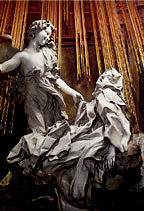
Ecstasy of St. Teresa by Gianlorenzo Bernini   (Permission by Mark Harden; http://www.artchive.com)

  • Premise 1: Every natural, innate desire in us corresponds to some real object that can satisfy that desire.
  • Premise 2: But there exists in us a desire which nothing in time, nothing on earth, no creature can satisfy.
  • Conclusion: Therefore there must exist something more than time, earth and creatures, which can satisfy this desire.

This something is what people call "God" and "life with God forever."

This is surely not a compelling argument.  In fact, as it stands, it is not even valid.  But it is easily repaired.  There is need of an additional premise, one to the effect that the desire that nothing in time can satisfy is a natural desire.  This supplementary  premise is needed for validity, but it is not obviously true.  For it might be — it is epistemically possible that — this desire that nothing in time can satisfy is artificially induced by one's religious upbringing or some other factor or factors.

Furthermore, is premise (1) true?  Not as it stands.  Suppose I am dying of thirst in the desert.  Does that  desire in me correspond to some real object that can satisfy it?  Does the existence of my token desire entail the existence of a token satisfier?  No!  For it may be that there is no potable water in the vicinity, when  only potable water in the immediate vicinity can satisfy my particular thirst.  At most, what the natural desire for water shows is  that water had to have existed at some time.  It doesn't even show that water exists now.  Suppose all the water on earth is suddenly rendered undrinkable.  That is consistent with the continuing existence of the natural desire/need for water.

But this is not a decisive objection since repairs can be made.  One could reformulate:

1* Every type of natural, innate desire in us corresponds to some real object that can satisfy some tokens of that type of desire.

But is (1*) obviously true?  It could be that our spiritual desires are not artificial, like the desire to play chess, but lacking in real objects nonetheless.  It could be that their objects are merely intentional.  Suppose our mental life (sentience, intentionality, self-awareness, the spiritual desires for meaning, for love, for lasting happiness, for an end to ignorance and delusion and enslavement to base desires) is just an evolutionary fluke.  Our spiritual desires would then be natural as opposed to artificial, but lacking in real objects. 

Why do we naturally desire, water, air, sunlight?  Because without them we wouldn't have come into material existence in the first place.  Speaking loosely, Nature implanted these desires in us.  This is what allows us to infer the reality of the object of the desire from the desire.  Now if God created us and implanted in us a desire for fellowship with him, then we could reliably infer the reality of God from the desire.  But we don't know whether God exists; so it may be that the natural desire for God lacks a real object.

Obviously, one cannot define 'natural desire' as a desire that has a real and not merely intentional object, and then take the non-artificiality of a desire as proof that it is natural.  That would be question-begging.

My point is that  (1) or (1*) is not known to be true and is therefore rationally rejectable.  The argument from desire, then, is not rationally compelling.

 As for premise (2), how do we know that it is true? Granting that it is true hitherto, how do we know that it will be true in the future?  The utopian dream of the progressives is precisely that we can achieve here on earth final satisfaction of our deepest desires.  Now I don't believe this for a second.  But I don't think one can reasonably claim to know that (2) is false.  What supports it is a very reasonable induction.  But inductive arguments don't prove anything.

In sum, the argument from desire, suitably deployed and rigorously articulated, helps render theistic belief rationally acceptable.  But it is not a rationally compelling argument.

Saturday Night at the Oldies: Some Suicides

Del Shannon (Charles Weedon Westover), December 30, 1934 – February 8, 1990, known prmarily for his Billboard Hot 100 #1 hit, Runaway, 1961.  "Suffering from depression, Shannon committed suicide on February 8, 1990, with a .22-caliber rifle at his home in Santa Clarita, California, while on a prescription dose of the anti-depressant drug Prozac. Following his death, The Traveling Wilburys honored him by recording a version of "Runaway"." (Wikipedia)

Dalida, O Sole Mio.  I think I'm in love.  "Dalida (17 January 1933 – 3 May 1987), birth name Iolanda Cristina Gigliotti, was a singer and actress who performed and recorded in more than 10 languages including: French, Arabic, Italian, Greek, German, English, Japanese, Hebrew, Dutch and Spanish." [. . .]On Saturday, 2 May 1987, Dalida committed suicide by overdosing on barbiturates.[7][8] She left behind a note which read, "La vie m'est insupportable… Pardonnez-moi." ("Life has become unbearable for me… Forgive me.")" (Wikipedia) 

The Singing Nun, Dominique, 1963.   "Jeanine Deckers (17 October 1933 – 29 March 1985) was a Belgian singer-songwriter and initially a member of the Dominican Order in Belgium (as Sister Luc Gabrielle). She acquired world fame in 1963 as Sœur Sourire (Sister Smile) when she scored a hit with the her French-language song "Dominique". She is sometimes credited as "The Singing Nun". [. . .]

Citing their financial difficulties in a note, she and her companion of ten years[8][9][10], Annie Pécher, both committed suicide by an overdose of barbiturates and alcohol on 29 March 1985.[11][12] In their suicide note, Decker and Pécher stated they had not given up their faith and wished to be buried together after a church funeral.[7] They were buried together in Cheremont Cemetery in Wavre, Walloon Brabant, the town where they died.[13] The inscription on their tombstone reads "I saw her soul fly across the clouds", a line from Deckers' song "Sister Smile is dead". (Wikipedia)

Phil Ochs, Small Circle of FriendsThere but for Fortune.   "Philip David Ochs (/ˈks/; December 19, 1940 – April 9, 1976) was an American protest singer (or, as he preferred, a topical singer) and songwriter who was known for his sharp wit, sardonic humor, earnest humanism, political activism, insightful and alliterative lyrics, and distinctive voice. He wrote hundreds of songs in the 1960s and released eight albums in his lifetime." [. . .] "On April 9, 1976, Ochs hanged himself.[110]" (Wikipedia)

My favorite suicide song is Shiver Me Timbers by Tom Waits.  James Taylor offers a beautiful interpretation.  Is it really about suicide at sea?  The reference to Martin Eden suggests to me that it is.  But you might reasonably disagree.