
Money, power, sex, and recognition form what I call the Mighty Tetrad of human motivators, the chief goads to action here below. Hillary specializes in the inordinate love of the first two, Bill in the inordinate love of the second.
Two Senses of ‘Contingency’ and a Bad Cosmological Argument
Fr. Aidan Kimel asked me to comment on a couple of divine simplicity entries of his. When I began reading the first, however, I soon got bogged down in a preliminary matter concerning wonder at the existence of the world, its contingency, and whether its contingency leads us straightaway to a causa prima. So I will offer some comments on these topics and perhaps get around to divine simplicity later.
Fr. Kimel writes,
Why is it obvious to [David Bentley] Hart, when it is not obvious to so many modern theologians and philosophers, that a proper understanding of divinity entails divine simplicity? Earlier in his book Hart invites us to consider with wonder the very fact of existence. “How odd it is, and how unfathomable,” he muses, “that anything at all exists; how disconcerting that the world and one’s consciousness of it are simply there, joined in a single ineffable event. … Every encounter with the world has always been an encounter with an enigma that no merely physical explanation can resolve” (pp. 88-89). The universe poses the question “why?” and in so posing this question, it reveals to us its absolute contingency. The universe need not have been. [Emphasis added.]“Nothing within the cosmos contains the ground of its existence” (p. 92):
All things that do not possess the cause of their existence in themselves must be brought into existence by something outside themselves. Or, more tersely, the contingent is always contingent on something else. This is not a difficult or rationally problematic proposition. The complications lie in its application. Before all else, however, one must define what real contingency is. It is, first, simply the condition of being conditional: that is, the condition of depending upon anything external or prior or circumambient in order to exist and to persist in being. It is also mutability, the capacity to change over time, to move constantly from potential to actual states, and to abandon one actual state in favor of another. It is also the condition of being extended in both space and time, and thus of being incapable of perfect “self-possession” in some absolute here and now. It is the capacity and the tendency both to come into and pass out of being. It is the condition of being composite, made up of and dependent upon logically prior parts, and therefore capable of division and dissolution. It is also, in consequence, the state of possessing limits and boundaries, external and internal, and so of achieving identity through excluding—and thus inevitably, depending upon—other realities; it is, in short, finitude. (pp. 99-100)
And now some comments of mine.
- Strictly speaking, the universe does not pose any questions; we pose, formulate, and try to answer questions. I share with Hart, Wittgenstein, et al. the sense of wonder that anything at all exists. But this sense of wonder is ours, not the universe's. We sometimes express this sense of wonder in a grammatically interrogative sentence, 'Why does/should anything at all exist?'
- But please note that this expression of wonder, although grammatically interrogative, is not the same as the explanation-seeking why-question, Why does anything at all exist? And again, this is a question we ask; it is not one that the universe asks.
- Nor does the universe reveal to us its absolute contingency by asking this question: it does not ask the question. We ask the explanation-seeking why-question, and in asking it we presuppose that the universe is contingent, that it "need not have been," that it is not necessary. For if the universe were necessary, it would make little or no sense to ask why it exists.
- But is the universe contingent? Its contingency does not follow from the fact that we presuppose it to be contingent. But for the sake of this discussion I will just assume that the universe is contingent. It is, after all, a reasonable assumption.
- But what is it to be contingent? There seems to be two nonequivalent definitions of 'contingency' at work above. I will call them the modal definition and the dependency definition.
- X is modally contingent =df x exists in some but not all metaphysically (broadly logically) possible worlds. But since possible worlds jargon is very confusing to many, I will also put the definition like this: X is modally contingent =df x is possibly nonexistent if existent and possibly existent if nonexistent. For example, I am modally contingent because I might not have existed: my nonexistence is metaphysically possible. Unicorns, on the other hand, are also modally contingent items because they are possibly existent despite their actual nonexistence. This is what Aquinas meant when he said that the contingent is what is possible to be and possible not to be. Note that the contingent and the actual are not coextensive. Unicorns are contingent but not actual, and God and the number 9 are actual but not contingent. If you balk at the idea that unicorns are contingent, then I will ask you: Are they then necessary beings? Or impossible beings? Since they can't be either, then they must be contingent.
- Now for the dependency definition. X is dependently contingent =df there is some y such that (i) x is not identical to y; (ii) necessarily, if x exists, then y exists; (iii) y is in some sense the ground or source of x's existence. We need something like the third clause in the definiens for the following reason. Any two distinct necessary beings will satisfy the first two clauses. Let x be the property of being prime and y the number 9. The two items are distinct and it is necessarily the case that if being prime exists, then 9 exists. But we don't want to say that the the property is contingently dependent upon the number.
- The two definitions of 'contingency' are not equivalent. What is modally contingent may or may not be dependently contingent. Bertrand Russell and others have held that the universe exists as a matter of brute fact. (Cf. his famous BBC debate with Fr. Copleston.) Thus it exists and is modally contingent, but does not depend on anything for its existence, and so is not dependently contingent, contingent on something. It is not a contradiction, or at least not an obvious contradiction, to maintain that the universe is modally contingent but not depend on anything distinct from itself. 'Contingent' and 'contingent upon' must not be confused. On the other hand, Aquinas held that there are two sorts of necessary beings, those that have their necessity from another and those that have their necessity in themselves. God, and God alone, has his necessity in himself, whereas Platonica have their necessity from God. That is to say that they derive their esse from God; they depend for their existence of God despite their metaphysical necessity. If, per impossibile, God were not to exist, then the denizens of the Platonic menagerie would not exist either. It follows that Platonica are dependently contingent.
- So I would urge that it is not the case that, as Hart says, "the contingent is always contingent on something else." Or at least that is not obviously the case: it needs arguing. Hart appears to be confusing the two senses of 'contingency' and making things far too easy on himself. The following is a bad argument: The universe is contingent; the contingent, by definition, is contingent on something else; ergo the universe is contingent on something else, and this all men call God. It is a bad argument because it either equivocates on 'contingency,' or else the second premise is false. I am not sure that Hart endorses this argument. I am sure, however, that it is a bad argument.
The Parable of the Lion and the Turtle
The lion said to the turtle, "Come out of your shell, and join the party!" The turtle said to the lion, "OK, Leo, after you have had yourself declawed and defanged."
Defense mechanisms, both physical and psychological, serve a good purpose even as they limit relations with others. But too much armor, psychic and otherwise, will stunt your life. Too little may end it.
Among a body politic's defense mechanisms are secure borders and a wise immigration policy.
The USA at present has neither. You know what to do.
Other parables:
Camille Paglia on Free Speech and the Modern Campus
A rich, historically informed article. Excerpt:
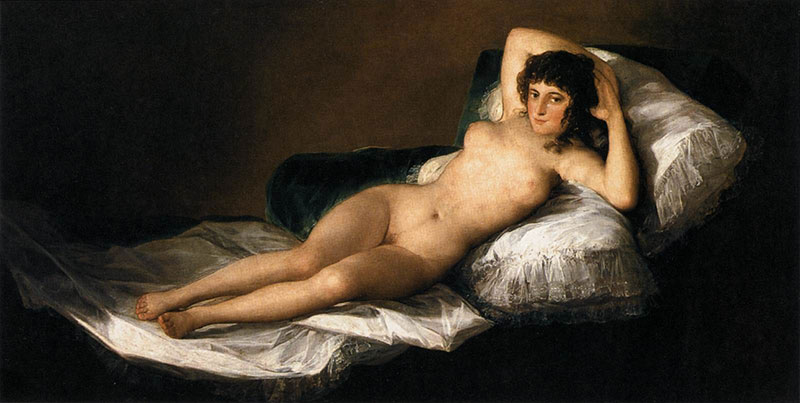
Let me give just one example of political correctness run amok in campus women’s studies in the U.S. In 1991, a veteran instructor in English and women’s studies at the Schuylkill campus of Pennsylvania State University raised objections to the presence in her classroom of a print of Francisco Goya’s famous late-18th-century painting, Naked Maja. The traditional association of this work with the Duchess of Alba, played by Ava Gardner in a 1958 movie called The Naked Maja, has been questioned, but there is no doubt that the painting, now owned by the Prado in Madrid, is a landmark in the history of the nude in art and that it anticipated major 19th-century works like Manet’s Olympia.
The instructor brought her case to a committee called the University Women’s Commission, which supported her, and she was offered further assistance from a committee member, the campus Affirmative Action officer, who conveyed her belief that there were grounds for a complaint of sexual harassment, based on the “hostile workplace” clause in federal regulations. The university, responding to the complaint, offered to change the teacher’s classroom, which she refused. She also refused an offer to move the painting to a less visible place in the classroom or to cover it while she was teaching. No, she was insistent that images of nude women must never be displayed in a classroom — which would of course gut quite a bit of major Western art since ancient Greece.
Sunday Morning Sermon: Life Well Lived
To make good use of your time in this world, think of your life above all as a quest, a seeking, a searching, a striving. For what? For the ultimate in reality, truth, value, and for their existential appropriation.
One appropriates reality by being authentic, truth by being truthful, values and norms by living them.
It may all be absurd in the end, a "tale told by an idiot, full of sound and fury, signifying nothing." But one cannot live well on the assumption that it is.
So assume that it is not and explore the question along all avenues of advance.
Micro-aggression
When macro-aggression is no more, when wrongs have been righted and justice has been promoted and protected to the extent that it can be by government, it is then that leftists invent micro-aggressions to keep themselves in business and assure themselves of an ever-expanding clientele of victims and losers.
Leftists have lost their minds. To the extent that they have willfully destroyed their own thinking capacity, they deserve our contempt and condemnation. To the extent that they have succumbed to suggestions and forces beyond their control, they deserve our pity and help. Thomas Sowell on micro-aggression. Two examples from Sowell:
If you just sit in a room where all the people are white, you are considered to be guilty of "micro-aggression" against people who are not white, who will supposedly feel uncomfortable when they enter such a room.
At UCLA, a professor who changed the capitalization of the word "indigenous" to lower case in a student's dissertation was accused of "micro-aggression," apparently because he preferred to follow the University of Chicago Manual of Style, rather than the student's attempt to enhance the importance of being indigenous.
Next stop: The Twilight Zone. Sowell's analysis:
The concept of "micro-aggression" is just one of many tactics used to stifle differences of opinion by declaring some opinions to be "hate speech," instead of debating those differences in a marketplace of ideas. To accuse people of aggression for not marching in lockstep with political correctness is to set the stage for justifying real aggression against them.
This tactic reaches far beyond academia and far beyond the United States. France's Jean-Paul Sartre has been credited — if that is the word — with calling social conditions he didn't like "violence," as a prelude to justifying real violence as a response to those conditions. Sartre's American imitators have used the same verbal tactic to justify ghetto riots.
Word games are just one of the ways of silencing politically incorrect ideas, instead of debating them. Demands that various conservative organizations be forced to reveal the names of their donors are another way of silencing ideas by intimidating people who facilitate the spread of those ideas. Whatever the rationale for wanting those names, the implicit threat is retaliation.
This same tactic was used, decades ago, by Southern segregationists who tried to force black civil rights organizations to reveal the names of their donors, in a situation where retaliation might have included violence as well as economic losses.
In a sense, the political left's attempts to silence ideas they cannot, or will not, debate are a confession of intellectual bankruptcy. But this is just one of the left's ever-increasing restrictions on other people's freedom to live their lives as they see fit, rather than as their betters tell them.
Current attempts by the Obama administration to force low-income housing to be built in middle class and upscale communities are on a par with forcing people to buy the kind of health insurance the government wants them to buy — ObamaCare — rather than leaving them free to buy whatever suits their own situation and preferences.
The left is not necessarily aiming at totalitarianism. But their know-it-all mindset leads repeatedly and pervasively in that direction, even if by small steps, each of which might be called "micro-totalitarianism."
Saturday Night at the Oldies: Luck, Good and Bad
Big Mama Thornton, Born Under a Bad Sign
Albert King and Stevie Ray Vaughn, Born Under a Bad Sign
Ray Charles, Busted. Made the #4 slot on the Billboard Hot 100 for 1963.
Elvis Presley, Good Luck Charm
Lightnin' Slim, Bad Luck Blues
Ray Charles, That Lucky Old Sun
Sonny Boy Williamson, Bad Luck Blues
Tommy Johnson, Canned Heat Blues, 1928. Interesting guitar work and an eerie falsetto. Sterno may light your fire but don't drink the stuff. And now you know where Canned Heat got their name.
Peter Wehner on the Dennis Prager Argument for Trump
Peter Wehner, Trump Supporters are Wrong, not Evil:
The argument of people like Prager is that we know how Mrs. Clinton would govern if she were president: as a person of the left. In addition, she’s an ethical mess. The Trump-over-Clinton crowd also argue that Mrs. Clinton is sure to nominate Supreme Court justices that will lock in a liberal court for a generation. Trump may do that, too, but he may not. He might put an actual conservative on the Supreme Court. At least the chances of getting some good things done are better under a President Trump than a President Clinton.
I disagree with this bottom line judgment for several reasons. The first is that in considering those who run for the presidency, one needs to look beyond which candidate correctly checks the preferred policy boxes. That matters, but it’s not all that matters. And it may not even be what matters most.
Judgment, wisdom, temperament, and prudence are the most important qualities by which to evaluate a potential president. It’s obvious to me that Mr. Trump is not only temperamentally unsuited for the Oval Office; I think he’s quite dangerous—emotionally unstable, erratic, narcissistic, impulsive, cruel and vindictive. He is appealing to our darker impulses. He’s also stunningly uninformed and shallow, at least on matters of policy and philosophy. Even when running for president, he has shown no interest in even acquainting himself with the issues, let alone mastering them.
But there’s something else as well: Mr. Trump, if he were to win the presidency, would redefine the Republican Party and conservatism in ways that Hillary Clinton or Bernie Sanders never could. As president, he and the Republican Party would essentially become one. Trump and Trumpism would be definitional, and therefore discrediting. As Bret Stephens puts it:
Trumpism isn’t just a triumph of marketing or the excrescence of a personality cult. It is a regression to the conservatism of blood and soil, of ethnic polarization and bullying nationalism. Modern conservatives sought to bury this rubbish with a politics that strikes a balance between respect for tradition and faith in the dynamic and culture-shifting possibilities of open markets. When that balance collapses—under a Republican president, no less—it may never again be restored, at least in our lifetimes.
“The conservative movement can wait out a Clinton presidency intact,” added Jonah Goldberg. “A Trump presidency is a ride straight to perdition, with a capital H.”
That is where I have been and where I remain. Like other conservative commentators, I will continue to speak out against Trump during this campaign, despite the fact—and in some respects because of the fact—that he’s running as a Republican. It matters to me that he’s soiling the party of Lincoln and Reagan. I have higher expectations for my side than the other side.
I count three arguments here.
First, the argument from bad character. It is true: Trump does have a bad character, but then so does Hillary, who is an "ethical mess" as Wehner admits. Is there some algorithm by which we can compute who is worse? No. What criteria would you use? How would you weight them? Is it worse to store state secrets on a home server or to be a vulgarian who gratuitously insults women and references in public the efficacy of his primary male characteristic?
It looks to be a wash. Both are liars. And both are opportunists who quite plainly place their own personal ambitions above all else. Proof of that is that both readily change their positions when it is expedient to do so. Hillary is famous for her 'flip flops' or policy reversals. Here is a list of 20. Perhaps some of these reversals are justified. But an objective observer would have to conclude that Mrs. Clinton is not 'principled,' not rooted in carefully thought-through principles that guide her decisions. Personal ambition and the needs of the moment guide her decisions. In this respect she is surely not better than Trump. And let's not forget that she is staring at a federal indictment, which is not something that could be said of Mr. Trump. Furthermore, what has Hillary accomplished on her own? What qualifies her for the presidency? Being a woman? Trump inherited a pile, true, but he did something with it and lot of people get a paycheck because of him.
So I reject the first argument. I see no good reason to think that Trump is ethically worse than Hillary. Both are bad people. Neither is really presidential. But who else is there who is electable? Given that Trump and Hillary are equally bad character-wise, policy considerations ought to push a conservative over to the Trump camp.
Wehner's second argument is hard to make out, but it has something do with altering the Republican Party beyond recognition. But unless one's livelihood is tied to the preservation of this feckless, joke of a political party, why should anyone care about its continuance? Clearly, we don't need two left-wing parties, the liberal Republicans and the hard-left Dems. If you are headed for a cliff it is better to be riding an elephant than a jackass, but you are going over the cliff all the same.
The third argument is the Goldberg argument I refuted the other day. As I said,
Hillarious appointments to SCOTUS will damage the country irrepararably. I am told there might be as many as three.
Suppose I am becoming weaker by the day and you are becoming stronger by the day. You are my sworn enemy and I must defeat you. Does it make sense for me to wait four years to fight you?
Think about it. Can conservatism remain "intact" during four to eight more years of a hard-left administration? Yes it can — as a debating society, which is essentially what the boys in the bow ties have going. But meanwhile in the real world we will still have sanctuary cities, a flood of illegal immigrants, a.k.a. 'undocumented Democrats,' the destruction of the universities, the state assault on religious liberties . . . . While the bow tie boys talk, the country moves ever Left-ward.
I see no reason to abandon the Prager argument. Trump is bad, but Hillary is worse. Hold your nose and vote for Trump. Because Hillary is worse, abstention is not the right course.
There is more to be said. In particular, we need to discuss whether there can be a conservatism that avoids both the impotence of the go-along-to-get-along Republican establishmentarians but also does not descend into a Blut und Boden nativism that certain neo-reactionaries seems to be slouching towards.
By the way, there is something very strange about fearing a merely potential Trumpian fascism when actual left-wing fascism is being imposed upon the country by Barack Hussein Obama. Latest outrage: Obama's Transgender Edict.
Friday the 13th Cat Blogging!
I Ain't Superstitious, leastways no more than Howlin' Wolf, but two twin black tuxedo cats just crossed my path. All dressed up with nowhere to go. Nine lives and dressed to the nines. Stevie Ray Vaughan, Superstition. Guitar solo starts at 3:03. And of course you've heard the story about Niels Bohr and the horseshoe over the door:
A friend was visiting in the home of Nobel Prize winner Niels Bohr, the famous atomic scientist.
As they were talking, the friend kept glancing at a horseshoe hanging over the door. Finally, unable to contain his curiosity any longer, he demanded:
“Niels, it can’t possibly be that you, a brilliant scientist, believe that foolish horseshoe superstition! ? !”
“Of course not,” replied the scientist. “But I understand it’s lucky whether you believe in it or not.”
God as Biblical Character and as Divine Reality
When Thomas Aquinas and Baruch Spinoza write about the God of the Old Testament, they write about numerically the same Biblical character using the same Latin word, Deus. They write about this character, refer to it, and indeed succeed in referring to it. But Aquinas and Spinoza do not believe in the same divine reality. Of course they both believe in a divine reality; but their conceptions of a divine reality are so different that it cannot be maintained — or so I argue here contra F. Beckwith — that it is one and the same reality that they believe in. Nor do they succeed in referring to the same reality. Since it cannot be the case that both divine realities exist, one of the two philosophers fails to refer to anything at all. It follows that they cannot be said to worship the same God: one of them worships an idol.
God, Adam, Moses, "and all them prophets good and gone" (Bob Dylan, Gospel Plow) actually exist qua characters in the Biblical narrative. But of course it does not follow that they exist 'outside' the narrative in reality.
A few months ago in the wake of the Wheaton contretemps we were much exercised over the question whether the God of the Christians is the same as the God of the Muslims. I wonder if the distinction between God as Biblical character and God as divine reality can help in that dispute. Perhaps some variants of the dispute arise from a failure to draw this distinction. Perhaps the following irenic proposal will be acceptable:
Christians and Muslims write about, talk about, and refer to one and the same Biblical character when they use 'God' and 'Allah.' In this sense, the God of the Christians and that of the Muslims is the same God. It is one and the same Biblical character, God. But Christians and Muslims do not refer to one and the same divine reality by their uses of 'God' and 'Allah.' This is because extralinguistic reference is conceptually mediated, not direct, and no one item can instantiate both the Christian and the Muslim conceptions of God. Nothing can be both triune and non-triune, to mention just one important different in the two conceptions.
So either the Christian is failing to refer to anything such that his worship is of an idol, or the Muslim is failing to refer to anything such that his worship is of an idol. The situation is strictly parallel to the Aquinas-Spinoza case. The two philosophers are clearly referring to the same Biblical character when they write Deus. But their conceptions of God are so different that they cannot be said to be referring to the same being in external reality.
My suggestion, then, is that some may have got their knickers in a knot for no good reason by failing to make the above-captioned distinction.
According to Ed Buckner over at Dale Tuggy's place,
. . . there is at least one sort of case where it is clear they [Aquinas and Spinoza] are using the name ‘God’ in exactly the same way, namely when they discuss the interpretation of the scriptures. Aquinas does this many times in Summa Theologiae, using the words of the Bible and the Church Fathers to support complex theological and philosophical arguments. Spinoza’s Theologico-Political Treatise is an extensive commentary on the text of the Bible and its meaning, also supported throughout by biblical quotation. So when Thomas writes
According to Chrysostom (Hom. iii in Genes.), Moses prefaces his record by speaking of the works of God (Deus) collectively. (Summa TheologiaeIª q. 68 a. 1 ad 1)
and Spinoza writes
As for the fact that God [Deus] was angry with him [Balak] while he was on his journey, that happened also to Moses when he was setting out for Egypt at the command of God [Dei]. (Tractatus ch. 3, alluding to Exodus 4:24-26)
it is clear that they are talking about the same persons, i.e. they are both talking about God, and they are both talking about Moses. It is somewhat more complicated than that, because Spinoza has a special theory about what the word ‘God’ means in the scriptures, but more of that later. In the present case, it seems clear that whenever we indirectly quote the scriptures, e.g. ‘Exodus 3:1 says that Moses was setting out for Egypt at the command of God’, we are specifying what the Bible says by using the names ‘Moses’ and ‘God’ exactly as the Bible uses them. Bill might disagree here, but we shall see.
I agree that they are both talking about the same persons qua characters in the Old Testament. The fact that Ed puts 'God' and 'Moses' in italics suggests, however, that he thinks that there is more here than reference to Biblical characters: there is also reference to really existent persons, and that our two philosophers are referring to the same really existent persons. But here I suspect that Ed is attempting a reduction of bona fide extralinguistic reference to what I will call text- and discourse-immanent reference, whether intertextual (as in the present case) or intratextual (as in the case of back references within one and the same narrative). If Ed is proposing a reduction — or God forbid an elimination — of real extralinguistic reference in favor of some form of discourse-immanent reference, then I have a bone to pick with him.
The issues here are much trickier than one might suspect. They involve questions Ed and I have been wrangling over for years, questions about fiction and intentionality and existence and quantification and logical form and what all else.
Schadenfreude
How much of your righteous satisfaction at another's comeuppance is really just Schadenfreude?
The NeverTrump Mentality
Jonah Goldberg, 10 May 2016:
For conservatives, party unity is another way of saying “suicide pact.” I will never vote for Hillary Clinton because she believes things I can never support. I will never vote for Donald Trump because he’s a bullying fool who believes in nothing but himself. The conservative movement can wait out a Clinton presidency intact. But Perry was right. A Trump presidency is a ride straight to perdition, with a capital H.
The problem is wrapped in the sentence, "The conservative movement can wait out a Clinton presidency intact." How does Mr. Goldberg know this? George Will and other members of the 'bow-tie brigade' have said similar things recently. It seems rather unlikely to me. Hillarious appointments to SCOTUS will damage the country irrepararably. I am told there might be as many as three.
Suppose I am becoming weaker by the day and you are becoming stronger by the day. You are my sworn enemy and I must defeat you. Does it make sense for me to wait four years to fight you?
Goldberg seems to be making two assumptions predicated on wishful thinking. One is that in four years someone will arise in the conservative ranks who can prevail against the Dems and win the presidency. The other is that it won't be too late by then given four more years of leftist consolidation and government takeover.
By leftist consolidation I means things like four more years of the illegal immigration of 'undocumented Democrats.'
Goldberg, Will, and the rest of the bow-tie boys need to argue for the truth of those two assumptions.
I think the assumptions are worse than unargued; they are false. While Trump is admittedly awful, Hillary is worse. Conservatives must unite behind Trump. He is all we got. He alone has a chance of beating Hillary.
My position strikes me as the only reasonable one for a conservative to occupy. I am assuming that one is not prepared for the Benedict Option or other forms of withdrawal. See my Activism and Quietism category.
Can you budge me from my position? You will need arguments, something that Goldberg, Boot, Kristol, Will and the boys haven't provided as far as I know. What are those arguments?
Erich Przywara, Analogia Entis
The book has been recently translated.
Unfortunately, I find myself in agreement with Josef Pieper as to the 'unreadibility' of the book: "The unfinished, and hardly readable book, Analogia Entis (1932), which he himself declares is the quintessence of his view, in fact gives no idea of the wealth of concrete material he spread out before us in those days."
Of course, the book is not strictly unreadable: I am reading it and getting something out of it. But it has many of the faults of Continental writing and old-time scholastic writing.
To make a really good philosopher you need to start with someone possessing a love of truth, spiritual depth, metaphysical aptitude, and historical erudition. Then some nuts-and-bolts analyst needs to beat on him with the logic stick until he can express himself clearly and precisely. Such a thrashing would have done gentlemen such as E. Gilson and J. Maritain a world of good. Gallic writing in philosophy tends toward the flabby and the florid.
A Time to be Careful
It is admirable to speak the truth courageously in your own name, but the exercise of civil courage might cost you and yours dearly. So I feel duty-bound to warn my younger readers. This is a time to be very careful. The following from Journal of American Greatness:
Who Are We?
Who are you?
You mean in the Samuel Huntington sense? We are American patriots aghast at the stupidity and corruption of American politics, particularly in the Republican Party, and above all in what passes for the “conservative” intellectual movement.No, literally—who are you guys?None of your damned business.Why won’t you tell us?Because the times are so corrupt that simply stating certain truths is enough to make one unemployable for life.That’s a bit dramatic, isn’t it?Ask Brendan Eich.
Paul Johnson on Political Correctness and Donald Trump
Article here. I reproduce it in toto so that you can read it in peace without being assaulted by advertising. Bolding added.
The problem with Johnson's article is that he does not define 'political correctness' and seems dangerously close to conflating politically incorrect speech with "vigorous, outspoken, raw and raucous speech" and politically incorrect behavior with "vulgar, abusive, nasty, rude, boorish and outrageous" behavior. See below. But this would be to ignore the important point I made the other day, namely, that to be politically incorrect is not to engage in offensive speech or behavior but to oppose the Left.
……………………………………
THE MENTAL INFECTION known as “political correctness” is one of the most dangerous intellectual afflictions ever to attack mankind. The fact that we began by laughing at it–and to some extent, still do–doesn’t diminish its venom one bit.
PC has an enormous appeal to the semieducated, one reason that it’s struck roots among overseas students at minor colleges. But it also appeals to pseudo-intellectuals everywhere, since it evokes the strong streak of cowardice notable among those wielding academic authority nowadays. Any empty-headed student with a powerful voice can claim someone (never specified) will be “hurt” by a hitherto harmless term, object or activity and be reasonably assured that the dons and professors in charge will show a white feather and do as the student demands. Thus, there isn’t a university campus on either side of the Atlantic that’s not in danger of censorship. The brutal young don’t even need to impose it themselves; their trembling elders will do it for them.
The insidious thing about PC is that it wasn’t–and isn’t–the creation of anyone in particular. It’s usually the anonymous work of such Kafkaesque figures as civil servants, municipal librarians, post office sorters and employees at similar levels. It penetrates the interstices of society, especially those where the hierarchies of privilege and property are growing. To a great extent PC is the revenge of the resentful underdog.
Nowhere has PC been more triumphant than in the U.S. This is remarkable, because America has traditionally been the home of vigorous, outspoken, raw and raucous speech. From the early 17th century, when the clerical discipline the Pilgrim Fathers sought to impose broke down and those who had things to say struck out westward or southward for the freedom to say them, America has been a land of unrestricted comment on anything–until recently. Now the U.S. has been inundated with PC inquisitors, and PC poison is spreading worldwide in the Anglo zone.
For these reasons it’s good news that Donald Trump is doing so well in the American political primaries. He is vulgar, abusive, nasty, rude, boorish and outrageous. He is also saying what he thinks and, more important, teaching Americans how to think for themselves again.
No one could be a bigger contrast to the spineless, pusillanimous and underdeserving Barack Obama, who has never done a thing for himself and is entirely the creation of reverse discrimination. The fact that he was elected President–not once, but twice–shows how deep-set the rot is and how far along the road to national impotence the country has traveled.
Under Obama the U.S.–by far the richest and most productive nation on earth–has been outsmarted, outmaneuvered and made to appear a second-class power by Vladimir Putin’s Russia. America has presented itself as a victim of political and economic Alzheimer’s disease, a case of national debility and geopolitical collapse.
TIME FOR A SCARE
None of the Republican candidates trailing Trump has the character to reverse this deplorable declension. The Democratic nomination seems likely to go to the relic of the Clinton era, herself a patiently assembled model of political correctness, who is carefully instructing America’s most powerful pressure groups in what they want to hear and whose strongest card is the simplistic notion that the U.S. has never had a woman President and ought to have one now, merit being a secondary consideration.
The world is disorderly and needs its leading nation to take charge and scare it back into decency. Donald Trump fits the bill. Other formidable figures, including Dwight Eisenhower and Ronald Reagan, have performed a similar service in the past. But each President is unique and cast in his own mold. Trump is a man of excess–and today a man of excess is what’s needed.