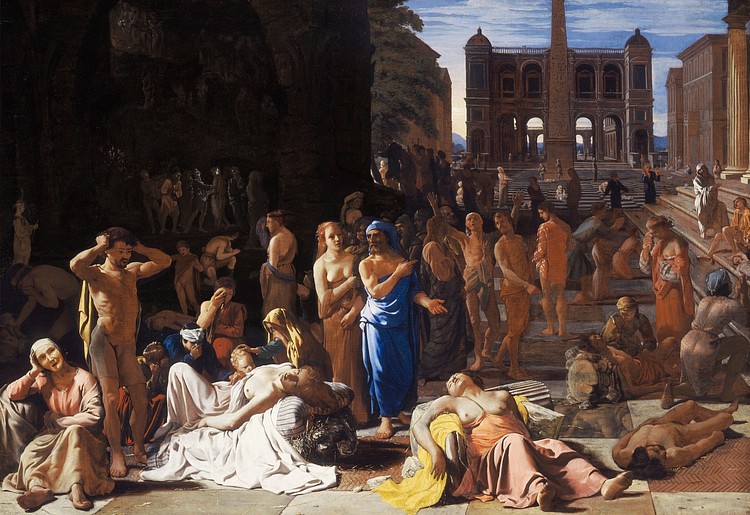
Patrick Kurp on the urge to sack, defile, vandalize, despoil, tear down and raze

Here at Anecdotal Evidence:

Anno 1527, when Rome was sacked by Burbonius [Charles V, the Holy Roman Emperor], the common soldiers made such spoil that fair churches were turned to stables, old monuments and books, made horse-litter, or burned like straw; reliques, costly pictures defaced; altars demolished; rich hangings, carpets, &c. trampled in the dirt.”

The human urge to sack, defile, vandalize, despoil, tear down and raze has a long and ever-present history. Let’s distinguish it from a related crime, theft, which is most often motivated by greed and envy. Heaving a brick through a window in order to steal a flat-screen television is one thing; it almost makes sense. Pulling down the statue of someone about whom you know little or nothing, and that was paid for with private or public funds, is quite another. There’s a blind hatred in many humans for all that is sacred, noble and aesthetically pleasing. Such things reproach us and remind us that we are not always worthy of them. Entropy never sleeps but its slow-grinding work is accelerated by the human mania for desecration. The passage above is from Burton’s Anatomy of Melancholy. He confirms what we already suspected — vandals will not remain content destroying only inanimate objects:

“. . . senators and cardinals themselves dragged along the streets, and put to exquisite torments, to confess where their money was hid; the rest murdered on heaps, lay stinking in the streets; infants’ brains dashed out before their mothers’ eyes.”

Once the appetite for vandalism is whetted and goes unstanched, what’s next? Churches, synagogues, libraries and schools, and then human beings, individually and in groups. Murder is vandalism with its logic extended. Even the educated and enlightened revel in the destruction, so long as it’s undertaken by proxies. Referring to Martin Luther in The Pleasure of Ruins (1953), Rose Macaulay writes:

“Rome to him had no virtues. He was, no doubt, of those who grimly rejoiced in the awful sack and massacre by the Imperialist troops in 1527. This shattering event and its consequences, while increasing the number of Roman ruins, for some years kept visitors nervously away, as well as driving into exile and beggary hundreds of the noble families and the scholars.”

Another Reason Why Defunding the Police is Idiotic

Government is by its very nature coercive. To be effective, it has to have the power to force people to do what they might not want to do, and to refrain from doing what they might want to do, such as drive drunk, loot, and rape. It follows straightaway that eliminating enforcement agencies eliminates government.

In an ideal world in which everyone is an angel, there would be no need for government. But our world is not ideal and there is no reason to think it ever will be. Government is therefore a necessary evil as are the enforcement agencies without which government cannot exist.

To think otherwise is to live in Cloud Cuckoo Land.

Is Philosophy Justified in a Time of Crisis?

The country is unraveling, and you sit in your ivory tower pondering arcane questions about time and existence?  How is that a justifiable use of your time, energy, and brain power?

Here is my answer. Or rather one of them.

There have always been crises.  Human history is just one crisis after another.  The 20th Century was a doosy: two world wars, economic depression, the rise of unspeakably evil totalitarian states, genocide, the nuclear annihilation of whole cities, the Cold War that nearly led to World War III (remember the Cuban Missile Crisis of October, 1962?), and then after the Evil Empire was quashed, the resurrection of radical Islam. I could go on.

Should we conclude that philosophy has never been justified?  But then science has never been justified and much of the rest of what we consider high culture.  For they have their origin in philosophy.

Perhaps you don't agree with my 'origins' claim.  Still, plenty in life is of value regardless  of its utility in mitigating whatever crisis happens to be in progress.  Or do you think Beethoven should have been a social worker?

And what makes you think that your activism will make a damned bit of difference?  The world is a mess; it always has been.  You are not going to change it. Live for what is beyond it. Strive for the Higher Things.

But the really fundamental error is to think that philosophy needs justification in terms of something external to it. I demolish this notion with the precision and trenchancy you have come to expect in Should One Stoop to a Defense of Philosophy or the Humanities? 

No Fool Like an Old Fool

Ed is an 80-year-old neighbor of mine. We've been casual acquaintances for years, running into each other on the trails, exchanging greetings and snatches of conversation. The other day politics came up for the first time, and to my surprise I learned that Ed, originally a Republican, had become an Independent, and was now a Democrat. I said, perhaps with a bit of surprise, "How can you support the Dems, given their current leadership?"

Ed, the quintessentially nice guy, said, "Let's stay friends, Bill, and avoid politics." I agreed that this was the wisest course, and we parted amicably. But my opinion of old Ed had dropped, and I resolved to limit my contact with him, limited as it already was. I knew there was no reaching him.

What explains the utter political stupidity of otherwise good, intelligent, and basically conservative people? Doesn't Ed understand what is in his and his family's interest?

One factor is mindless Trump hatred. A second is that old people live in the past and simply cannot see what is happening. A third is a life too much absorbed in the private and the quotidian. Luckily, old Ed probably won't be around to wake up to the day when the private life is no more.

No fool like an old fool.

Carpe Diem!

Carpe diem skullSeize the day,  my friends, the hour of death is near for young and old alike.  How would you like death to find you?  In what condition, and immersed in which activity?  Contemplating the eternal or stuck in the mud of the mundane or lost in the diaspora of sensuous indulgence?

The clock is running, and in the game of life it is sudden death with no way of knowing when the flag will fall.

For some of us the harvest years come late and we hope for many such years in which  to reap what we have sown, but we dare not count on them.  For another and greater Reaper is gaining on us and we cannot stay the hand that wields the scythe that will cut us down.

A Limit to Self-Reliance

Among our fellows, and in relation to the government, we ought to be as self-reliant as possible. 

But in matters moral and spiritual we ought freely to confess our exigency  and ultimate inability to help ourselves.  Honesty demands it. To appreciate properly the need for outside help, however, one ought first to try to go it alone.  When the self-therapeutics of Buddhism and Stoicism and cognate systems fail, then one will have a concrete motive for the confession of impotence.

The help we need in matters moral and spiritual we cannot provide for ourselves.

Our Pyrrhonian Predicament

It is widely admitted that there is something deeply unsatisfactory about the human condition.  One aspect of our wretched state is recognized and addressed by the Pyrrhonists: we want certain knowledge but it eludes us. And so we must content ourselves with belief. But beliefs are in conflict and this conflict causes suffering which ranges from mental turmoil to physical violence.  

Ours is a two-fold misery. We lack what we want and need, knowledge. We must make do with a substitute that engenders bitter controversy, belief.

Skeptic solution? Live belieflessly, adoxastos! But that is no solution at all, or so say I.

For details, see the following meatier entries:

Is Pyrrhonism a Doctrine? Can One Live without Beliefs?

The Pious Pyrrhonian: Is Beliefless Piety Possible?

A Cure for Infatuation?

DulcineaOne of the very best is marriage. 

Infatuation is a form of idolatry that cannot last long in a marriage. Marriage cures it. That's an argument for marriage. There was no cure for Don Quixote's romantic fantasies because their object, the fair Dulcinea del Toboso, existed only in his imagination.*

But while infatuation lasts, it is blissful. One is made silly, often harmlessly so. One walks on air and can think of nothing but the beloved. The moon hits your eye like a bigga pizza pie. The world starts to shine like you've had too much wine. So smitten was I in the early days of my relationship to the woman I married that I sat in my carrel at the university one day and just thought about her for eight hours straight when I was supposed to be finishing an article on Frege. Life is both love and logic. But sometimes hot love trumps cold logic.

The best marriages begin with the romantic transports of infatuation, but a marriage lasts only if the Rousseauian transports are undergirded by good solid reasons of the big head without interference from the heart or the little head. The love then matures. Real love replaces illusory idealization. The big head ought to be the ruling element in a man.

It takes an Italian to capture the aforementioned romantic transports, and Dean Martin (Dino Crocetti) does the job well in the schmaltzy That's Amore

Il Mio Mondo is a good expression of the idolatry of infatuation.  Cilla Black's 1964 rendition of the Italian song is You're My World.

But whence the idealization, the infatuation, the idolatry?  And why the perennial popularity of silly love songs? What we really want in the deepest depths of the heart no man or woman can provide.  That is known to all who know their own hearts and have seen through the idols.  What we want is an infinite and eternal love.  This infinite desire may have no object in reality. Arguments from desire are not rationally compelling.

But given the fact of the desire, a fact that does not entail the reality of its object, we have what we need to explain the idealization, the infatuation, and the idolatry of the sexual other. We substitute an immanent object for Transcendence inaccessible.

_____________________________

*The great novel of Miguel Cervantes is a work of fiction. And so both Don Quixote/Quijote and Dulcinea are fictional characters. But the first is posited as real within the fiction while the other is posited as imaginary, as Don Quixote's fiction, even if based upon the posited-in-the-fiction real Aldonza Lorenzo. Herewith a bit of grist for the mill of the philosophy of fiction. The real-imaginary distinction operates within an imaginary construct.


Richard Peck, Seeker of Lost Gold

Superstition Mountain Peck

(A re-post, with corrections and additions, from 13 January 2010)

Living as I do in the foothills of the Superstition Mountains, I am familiar with the legends and lore of the Lost Dutchman Gold Mine. Out on the trails or around town I sometimes run into those characters called Dutchman Hunters. One I came close to meeting was Richard Peck, but by the time I found out about his passion from his wife, Joan, he had passed away. Sadly enough, Joan unexpectedly died recently.

Joan had me and my wife over for dinner on Easter Sunday a few years ago, and my journal (vol. XXI, pp. 34-35, 28 March 2005) reports the following:

Joan's dead husband Rick was a true believer in the Dutchman mine, and thought he knew where it was: in the vicinity of Weaver's Needle, and accessible via the Terrapin trail. A few days before he died he wanted Joan to accompany his pal Bruce, an unbeliever, to a digging operation which Bruce, a man who knows something about mining, did not perform. Rick to Joan, "I want you to be there when he digs up the gold."

Richard Peck, 44, is a Princeton graduate, the father of three children and the owner of a Cincinnati advertising agency. He has spent the past 16 months trying to find the famed Lost Dutchman gold mine in Arizona's barren Superstition Mountain range. "The more I read about the Lost Dutchman," he recalls, "the more I kept coming back to it. Finally, I was sure I knew where the Lost Dutchman was. I was going to tear this thing open. I thought I was going to have it wrapped up in two weeks." So far his search has cost him $80,000. "I had to try something like this because it was so impossible. But if this mine is ever found it's still going to hurt in a lot of ways. Something is going to be lost out of this world."

Coming Together and Moving Apart

Is it an unalloyed good that people be 'brought together'? I rather doubt it. Mark Zuckerberg would seem to agree by his actions if not by his words. The man who touts his Facebook as bringing people together has had a huge wall built around his Hawaiian compound. Apparently, those who engineer 'bringing together' think of themselves as very special people who have every right not to be brought together with those they bring together.