Review of Barry Miller, A Most Unlikely God

I reviewed A Most Unlikely God in Dialogue: Canadian Philosophical Review (vol. XXXVIII, no. 3, Summer 1999, pp. 614-617).  Prof. N.M.L Nathan  expressed an interest in reading it, so here it is.

A Most Unlikely God: A Philosophical Enquiry into the Nature of God. By Barry Miller. Notre Dame, Indiana: University of Notre Dame Press, 1996, viii + 175 pp. $27.00.

This is the sequel to Professor Miller's From Existence to God: A Contemporary Philosophical Argument (Routledge, 1992). (See my review in American Catholic Philosophical Quarterly, vol. LXVII, no. 3, Summer 1993, pp. 390-394.) In that book he presents a version of the cosmological argument for the existence of God that does not rely on the principle of sufficient reason in any of its forms. A central upshot of that argument is that God as uncaused cause of the universe must be Subsistent Existence, i.e., a being not distinct from its existence. The notion that anything whatever could be non-distinct from its existence is of course an exasperatingly difficult one, and is rejected as incoherent by many, along with the doctrine of divine simplicity of which it is an integral part. An ontologically simple God is a most unlikely God since he is one in whom there is no real distinction between form and matter, act and potency, essence and existence, or individual and attribute. Since Miller's theistic argument terminates in the affirmation of a simple God, it is essential to his overall project to show the coherence of the very idea of a simple God and to rebut the numerous objections that have been brought against it. That is the task of the book under review.

Chapter 1 contrasts Miller's approach with the 'perfect-being theology' of the Anselmians. For the latter, God's perfection is construed as his possession of a maximally consistent set of great-making properties or perfections. Omnipotence is an example of a great-making property, and is taken by Anselmians as the logical maximum of a property that can be had by creatures. Thus Socrates is powerful, but God is maximally powerful. Miller rejects this approach to divine perfection in that it implies that such terms as 'powerful,' 'knowing,' 'loving,' etc., can be used univocally of God and creatures. (p. 2) On the Anselmian approach, the gulf between God and creatures is not an absolute divide, and thus God on this approach fails to be absolutely transcendent. The God of the Anselmians is thus "discomfitingly anthropomorphic." (p. 3)

Miller's alternative is to think of the greatest F not as a maximum or limit simpliciter in an ordered series of Fs, but as the limit case of such a series. (p. 4) Whereas the limit simpliciter of an F is an F, the limit case of an F is not an F. Consider, for example, the series: 3-place predicable, 2-place predicable, 1-place predicable. Since a predicable (e.g.,'___is wise') must have at least one place if it is to be a predicable, a 1-place predicable is a limit simpliciter of the ordered series of predicables. Although talk of zero-place predicables comes naturally, as when we speak of a proposition as a zero-place  predicable, a zero-place predicable is no more a predicable than negative growth is growth. 'Zero-place' is thus an alienans adjective like 'negative' in 'negative growth' and 'decoy' in 'decoy duck.' Zero-place predicable is thus not a limit simpliciter of the series in question, but a limit case of this series: it is not a member of the series of which it is the limit case. It nevertheless stands in some relation to the members of the series inasmuch as they and the way they are ordered point to this limit case. (p. 8)

The idea, then, is that God's power is not the maximum or limit simpliciter of an ordered series of instances of power, but the limit case instance of power. This implies that God's power is not an instance of power any more than a zero-place predicable is a predicable. No doubt this will shock the Anselmians, but in mitigation it can be said that God's power, though not an instance of power, is that to which the ordered series of power-instances points, and is therefore something to which the members of that series stand in a definite relation.

Chapters 2, 3 and 4 engage the problem of how it could be that God is his existence. If sense can be made of this identity, the problem of how God can be identical with his non- existential properties should present no special difficulty. The story begins with Socrates who is spectacularly distinct from his existence. Of course, Socrates can be distinct from his existence only if there is some sense in which existence is a property of him. Since Frege, Russell and their epigones deny this, holding instead that existence is always a property of concepts or propositional functions, Miller devotes Chapter 2 to showing that there are first-level uses of '___exists'  and thus that existence is a first-level property of contingent individuals. Miller makes a strong, and to this reviewer's mind convincing, case for this view.

But given that existence is a first-level property, it does not follow straightaway that it is a real (non-Cambridge) property. One is tempted to wonder what existence could 'add' to Socrates, and tempted to conclude that it could 'add' nothing and thus that existence is a Cambridge property. But so to conclude would be to labor under a false assumption as to how an individual is related to its existence. Chapter 3 argues that Socrates is not related to his existence in the way he is related to his wisdom. His wisdom inheres in him as subject; but it makes no sense to think of his existence as inhering in him as subject: "Socrates' existence could not inhere in him unless there was a sense in which he himself was real logically prior to his existence." (p. 30) And there is no such sense, as Miller goes on to argue. Plantinga's haecceities come in for a drubbing (pp. 31-32), and in general it is plausibly argued that individuals are inconceivable before they exist. That is, before Socrates came to exist, there were no de re possibilities involving him.

So although Socrates individuates his existence, i.e., makes his instance of existence distinct from every other such instance, Socrates cannot actualize his existence in the way he actualizes his wisdom: Socrates is logically posterior to his existence in respect of actuality. (p. 33) This seems right: Socrates' existence is what 'makes' him exist. But how can Socrates be logically posterior to his existence in respect of actuality and also logically prior to his existence in respect of individuation?

This question has an answer if Socrates is related to his existence, not as subject to what inheres in it, but as bound to what it bounds. A bound is logically posterior to what it bounds in respect of actuality, but logically prior in respect of individuation. Consider two blocks of ice cut from the same larger block. The two blocks are individuated by their bounding surfaces, which are logically posterior in respect of actuality to the blocks they bound. Bounds are parasitic on what they bound. But the bounding surfaces are logically prior in respect of individuation to the blocks they bound. This is a creative, if not wholly unproblematic, solution to what I am convinced is a genuine problem, namely, the problem of how existence can belong to an individual without being related to it as to a subject.

We are now in a position to understand the notion of Subsistent Existence as an identity of limit cases (Ch 4). Having seen that Socrates is the bound rather than the subject of his instance of existence, we form the notions of the limit case instance of existence and of the limit case bound of existence. "The notion of Subsistent Existence, then, is the notion of the entity which is jointly and identically the limit case instance of existence and the limit case bound of existence." (67) But doesn't this amount to the self-contradictory claim that some bound of existence is identical with the instance of existence which it bounds? No, because 'limit case' is an alienans adjective; a limit case bound of existence is not a bound at all, nor is a limit case instance of existence an instance of existence.

The rest of the book is an elaboration of this basic idea. Chapter 5 shows how God can be identical with his non-existential properties. Chapters 6 and 7 discuss the bearing of the simplicity doctrine on divine cognition, willing, and causation. Chapter 8 addresses the possibility of literal talk about a simple God. Miller attempts to show that on the limit case account of God's simplicity, "…absolute transcendence does not entail total ineffability…" (p. 154) Chapter 9 concludes the work.

There are some minor errors in the book, one of which should be mentioned. On p. 1, n. 1, Miller ascribes to Alvin Plantinga the view that God has no nature. This is a mistake, as Miller readily conceded when I pointed it out to him in correspondence. Plantinga of course holds that God has a nature; what he denies is that God is identical with his nature.

Minor errors aside, this work is the best defense of the divine simplicity to date. Anyone who thinks that this doctrine is obviously incoherent or easily dismissed should read this book — and think again.

God, Proof, and Desire

From a reader:

. . . I’m confused by some of your epistemic terms. You reject [in the first article referenced below] the view that we can “rigorously prove” the existence of God, and several times say that theistic arguments are not rationally compelling, by which you mean that there are no arguments “that will force every competent philosophical practitioner to accept their conclusions on pain of being irrational if he does not.“

Okay, so far I’m tracking with you. But then you go on to say that “[t]here are all kinds of evidence” for theism (not just non-naturalism), while the atheist “fails to account for obvious facts (consciousness, self-consciousness, conscience, intentionality, purposiveness, etc.) if he assumes that all that exists is in the space-time world. I will expose and question all his assumptions.  I will vigorously and rigorously drive him to dogmatism.  Having had all his arguments neutralized, if not refuted, he will be left with nothing better than the dogmatic assertion of his position."

So how is the atheist not irrational on your view, assuming he is apprised of your arguments? Perhaps the positive case for theism and the negative case against naturalism don’t count as demonstrations in a mathematical sense, but I’m not sure why they’re not supposed to be compelling according to your gloss on the term.

The term 'mathematical' muddies the waters  since it could lead to a side-wrangle over what mathematicians are doing when they construct proofs.  Let's not muddy the waters.  My claim is that we have no demonstrative knowledge of the truth of theism or of the falsity of naturalism.  Demonstrative knowledge is knowledge produced by a demonstration.  A demonstration in this context is an argument that satisfies all of the following conditions:

1. It is deductive
2. It is valid in point of logical form
3. It is free of such informal fallacies as petitio principii
4. It is such that all its premises are true
5. It is such that all its premises are known to be true
6. It is such that its conclusion is relevant to its premises.

To illustrate (6).  The following argument satisfies all of the conditions except the last and is therefore probatively worthless:

Snow is white
ergo
Either Obama is president or he is not.

On my use of terms, a demonstrative argument = a probative argument = a proof = a rationally compelling argument.  Now clearly there are good arguments (of different sorts) that are not demonstrative, probative, rationally compelling.  One type is the strong inductive argument. By definition, no such argument satisfies (1) or (2).  A second type is the argument that satisfies all the conditions except (5). 

Can one prove the existence of God?  That is, can one produce a proof (as above defined) of the existence of God?   I don't think so.  For how will you satisfy condition (5)?  Suppose you give argument A for the existence of God.  How do you know that the premises of A are true?  By argument?  Suppose A has premises P1, P2, P3.  Will you give arguments for these premises?  Then you need three more arguments, one for each of P1, P2, P3, each of which has its own premises.  A vicious infinite regress is in the offing.  Needless to say, moving in an argumentative circle is no better.

At some point you will have to invoke self-evidence.   You will have to say that, e.g., it is just self-evident that every event has a cause.  And you will have to mean objectively self-evident, not just subjectively self-evident.  But how can you prove, to yourself or anyone else, that what is subjectively self-evident is objectively self-evident?  You can't, at least not with respect to states of affairs transcending your consciousness. 

I conclude that no one can prove the existence of God.  But one can reasonably believe that God exists.  The same holds for the nonexistence of God.  No one can prove the nonexistence of God.  But one can reasonably believe that there is no God.

The same goes for naturalism.  I cannot prove that there is more to reality than the space-time system and its contents.  But I can reasonably believe it.  For I have a battery of arguments each of which satisfies conditions (1), (2), (3) and (6) and may even, as far as far as I know, satisfy  (4).

"So how is the atheist not irrational on your view, assuming he is apprised of your arguments?"

He is not irrational because none of my arguments are rationally compelling in the sense I supplied, namely, they are not such as to force every competent philosophical practitioner to accept their conclusions on pain of being irrational if he does not.  To illustrate, consider the following argument from Peter Kreeft (based on C. S. Lewis), an argument I consider good, but not rationally compelling.  I will argue (though I will not prove!) that one who rejects this argument is not irrational.

The Argument From Desire

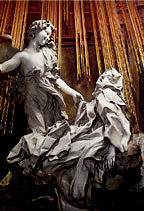
Ecstasy of St. Teresa by Gianlorenzo Bernini   (Permission by Mark Harden; http://www.artchive.com)

  • Premise 1: Every natural, innate desire in us corresponds to some real object that can satisfy that desire.
  • Premise 2: But there exists in us a desire which nothing in time, nothing on earth, no creature can satisfy.
  • Conclusion: Therefore there must exist something more than time, earth and creatures, which can satisfy this desire.

This something is what people call "God" and "life with God forever."

This is surely not a compelling argument.  In fact, as it stands, it is not even valid.  But it is easily repaired.  There is need of an additional premise, one to the effect that the desire that nothing in time can satisfy is a natural desire.  This supplementary  premise is needed for validity, but it is not obviously true.  For it might be — it is epistemically possible that — this desire that nothing in time can satisfy is artificially induced by one's religious upbringing or some other factor or factors.

Furthermore, is premise (1) true?  Not as it stands.  Suppose I am dying of thirst in the desert.  Does that  desire in me correspond to some real object that can satisfy it?  Does the existence of my token desire entail the existence of a token satisfier?  No!  For it may be that there is no potable water in the vicinity, when  only potable water in the immediate vicinity can satisfy my particular thirst.  At most, what the natural desire for water shows is  that water had to have existed at some time.  It doesn't even show that water exists now.  Suppose all the water on earth is suddenly rendered undrinkable.  That is consistent with the continuing existence of the natural desire/need for water.

But this is not a decisive objection since repairs can be made.  One could reformulate:

1* Every type of natural, innate desire in us corresponds to some real object that can satisfy some tokens of that type of desire.

But is (1*) obviously true?  It could be that our spiritual desires are not artificial, like the desire to play chess, but lacking in real objects nonetheless.  It could be that their objects are merely intentional.  Suppose our mental life (sentience, intentionality, self-awareness, the spiritual desires for meaning, for love, for lasting happiness, for an end to ignorance and delusion and enslavement to base desires) is just an evolutionary fluke.  Our spiritual desires would then be natural as opposed to artificial, but lacking in real objects. 

Why do we naturally desire, water, air, sunlight?  Because without them we wouldn't have come into material existence in the first place.  Speaking loosely, Nature implanted these desires in us.  This is what allows us to infer the reality of the object of the desire from the desire.  Now if God created us and implanted in us a desire for fellowship with him, then we could reliably infer the reality of God from the desire.  But we don't know whether God exists; so it may be that the natural desire for God lacks a real object.

Obviously, one cannot define 'natural desire' as a desire that has a real and not merely intentional object, and then take the non-artificiality of a desire as proof that it is natural.  That would be question-begging.

My point is that  (1) or (1*) is not known to be true and is therefore rationally rejectable.  The argument from desire, then, is not rationally compelling.

 As for premise (2), how do we know that it is true? Granting that it is true hitherto, how do we know that it will be true in the future?  The utopian dream of the progressives is precisely that we can achieve here on earth final satisfaction of our deepest desires.  Now I don't believe this for a second.  But I don't think one can reasonably claim to know that (2) is false.  What supports it is a very reasonable induction.  But inductive arguments don't prove anything.

In sum, the argument from desire, suitably deployed and rigorously articulated, helps render theistic belief rationally acceptable.  But it is not a rationally compelling argument.

Infinite Desire and God as Being Itself

A reader from Portugal raised a question I hadn't thought of before:  "Can God satisfy our infinite desire if God is a being among beings?"  This question presupposes that our desire is in some sense infinite.  I will explain and defend this presupposition in a moment.  Now if our desire is infinite, then it is arguable that only a truly infinite object could satisfy it, and that such an object cannot be a being among beings, not even a being supreme among beings, but must be an absolute reality, that is, God as Being itself.  To put it another way, the ultimate good for man cannot be a good thing among good things, not even the best of all good things, but must be Goodness itself.  Anything less would be a sort of high-class idol.  So let's start with an analysis of idolatry.

I

What is idolatry? I suggest that the essence of idolatry lies in the illicit absolutizing of the relative. A finite good becomes an idol when it is treated as if it were an infinite good, i.e., one capable of satisfying our infinite desire. But is our desire infinite?

That our desire is infinite is shown by the fact that it is never fully satisfied by any finite object or series of finite objects. Not even an infinite series of finite objects could satisfy it since what we really want is not an endless series of finite satisfactions — say a different black-eyed virgin every night as in popular Islam's depiction of paradise — but a satisfaction in which one could finally rest. "Our hearts are restless until they rest in Thee." (Augustine) What we really want, though we don't know it, is the absolute good which is goodness itself, namely God. This idea is common to Plato, Augustine, Malebranche, and Simone Weil.

For thinkers of this stripe,  all desire is ultimately desire for the Absolute. A desire that understood itself would understand this. But our deluded desire does not understand this.  Our deluded desire is played for a fool by the trinkets and bagatelles of this fleeting world.  It thinks it can find satisfaction in the finite. Therein lies the root of idolatry.

Buddha understood this very well: he saw that desire is infinite in that it desires its own ultimate quenching or extinguishing, its own nibbana, but that finite quenchings are unsatisfactory in that they only exacerbate desire by giving birth to new desires endlessly. No desire is finally sated; each is reborn in a later desire. Thus the enjoyment of virgin A does not put an end to lust; the next night or the next morning you are hot for virgin  B, and so on, back to A or on to C, D, . . . and around and around on the wheel of Samsara. The more you dive into the flesh looking for the ultimate satisfaction, the more frustrated you become. You are looking for Love in all the wrong places.

So Buddha understood the nature of desire as infinite. But since he had convinced himself that there is no Absolute, no Atman, nothing possessing self-nature, he made a drastic move: he preached salvation through the extirpation of desire itself. Desire itself is at the root of suffering, dukkha, not desire for the wrong objects; so the way to salvation is not via redirection of desire upon the right Object, but via an uprooting of desire itself.

In Buddhist terms, we could say that idolatry is the treating of something that is anatta, devoid of self-nature, as if it were atta, possessive of self-nature. Idolatry arises when some finite foreground object, a man or a woman say, is falsely ascribed the power to provide ultimate satisfaction. This sort of delusion is betrayed in practically every love song ever written. Here are some typical lyrics (trivia question: name the song, the singer, the date):

You are my world, you're every move I make
You are my world, you're every breath I take.

There are thousands more lyrics like them, and anyone who has been in love knows that they capture the peculiar madness of the lover, the delectable madness of taking the finite for infinite.

Or will you deny that this is madness, a very deep philosophical and perhaps also religious mistake? I say it is madness whether or not an absolute good exists. Whether or not an absolute good exists, reason suggests that we should love the finite as finite, that our love should be ordered to, and commensurate with, its object. Finite love for finite objects, and for all objects if there is no infinite Object.

II

Suppose you accept what I just wrote about desire being infinite and ultimately unsatisfiable by any finite object.  Would this show that God cannot be a being among beings?  Not obviously!  The supreme being theists could agree that infinite desire is ultimately satisfiable only by an infinite object, but that the omni-qualified supreme being fills the bill.  Furthermore, they could argue, plausibly, that talk of Goodness itself and Being itself, which imply the divine simplicity, is just incoherent to the discursive intellect.  To which one response is: so much the worse for the discursive intellect.  The ultimate goal is attainable only by transcending it.

A Question About God and Existence

A reader asks:

You seem to hold that, if God is identical to his existence, then God is Existence itself. Why think that? Why not think instead that, if God is identical to his existence, then he is identical to his 'parcel' of existence, as it were?
This is an entirely reasonable question. I will try to answer it.
 
First of all, when we say that God is identical to his existence, we mean that there is no real distinction in God between essence (nature) and existence in the way in which there is a real distinction in Socrates (our representative creature) between essence (nature) and existence.  It is the real distinction in Socrates that grounds his metaphysical contingency, while it is the lack of such a distinction in God that grounds his metaphysical necessity.
 
This is to say that God, unlike creatures, is ontologically simple.  In a slogan of St Augustine, God is what he has.  Thus he has his existence by being his existence.  Why must God be simple?  Because he is the absolute reality.  If your god is not the absolute reality, then your god is not God but an idol.  The absolute cannot depend on anything else for its nature or existence on pain of ceasing to be the absolute.  It must possess aseity, from-itself-ness. 
 
Now Existence is in some way common to everything that exists, though it is not common in the manner of a property or a concept.  Thus God and Socrates have Existence in common.  If God is not identical to Existence, then he is like Socrates and must depend on Existence as something other than himself to exist.  But this violates the divine aseity.
 
Therefore, God is not only identical to his existence, he is identical to Existence itself.
 
Objection:  "If God is identical to Existence, then God alone exists, which flies in the face of the evident fact that there is a plurality of non-divine existents."
 
Reply:   The objection succeeds only if there are no different ways of existing.  But if God exists-underivatively and creatures exist-derivatively, then God's identity with Existence does not entail that God alone exists; it entails that God alone exists-underivatively.
 
The picture is this.  Existence is that which makes derivative existents exist.  If Existence did not itself exist, then nothing would exist.  So Existence itself exists.  It is identical to God.  God is the unsourced Source of everything distinct from God.  God, as Existence itself, is the Paradigm Existent.  God is at once both Existence and the prime case of Existence.
 
In this respect, God is like a Platonic Form in which all else participates.  (It is worth recalling in this connection that Aquinas speaks of God as forma formarum, the form of all forms.)  God is self-existent Existence; creatures are not self-existent, but derive their existence from self-existent Existence.
 
Objection:  "This scheme issues in something like the dreaded Third Man Regress.  If Socrates and Plato both exist by participating in Existence, which exists, then there are three things that exist, Socrates, Plato, and Existence, each of which exists by participation.  If so, there must be a second Existence, Existence-2 that Socrates, Plato and Existence-1 participate in.  But then an infinite regress is up and running, one that is, moreover, vicious."
 
Response:  The Third Man Regress is easily blocked by distinguishing the way Existence exists and the way derivative existents exist.  Socrates exists by participating in Existence; Existence exists, not by participation, but by being (identical to) Existence.
 
There is exactly one case in which existence = self-identity.  This is the case of the Paradigm Existent, which is Existence itself, which is God.  In every other case, existence is not self-identity.  No doubt Socrates is self-identical; but his self-identity is not the ground of his existence.

In Defense of Modes of Being: Substance and Accident

Scylla_and_CharybdisThe following entry, first posted on February 20, 2011, is relevant to the question whether God is a being among beings.  My rejection of this claim requires that there be modes of Being.  If talk of modes of Being is unintelligible, or based on an obvious mistake, then the claim that God is not a being among beings, but Being itself, is unintelligible, or based on an obvious mistake.  Herewith, something in defense of the MOB doctrine.

To ward off misunderstanding, I am  not saying that the 'relation' of God to the world of creatures is the 'relation' of a substance to its accidents or modes.  Creatures do not inhere in God.   They are not accidents. They are derivative substances in their own right, difficult as it may be to make sense of this.  Christian metaphysics must somehow navigate between the Scylla of Spinozism and Charybdis of the sort of radical ontological pluralism to which my friend Dale Tuggy 'succumbs' (to put it tendentiously).

On second thought, since Spinozism sucks everything into itself, I should have written 'Charybdis of Spinozism.'  Charybdis was a sea nymph transmogrified by Zeus into a whirlpool.

In his History of Philosophy Hegel jokes that due to the all-consumptiveness of the Spinozistic Absolute, it is in some sense fitting that Spinoza should die of consumption.  As the story goes, Spinoza the lens-grinder died of what used to be called consumption (tuberculosis) from breathing in the glass dust. 

……………….

The 'thin' conception of Being or existence, lately explained, entails that there are no modes of Being. Most analytic philosophers accept the thin conception and reject modes of Being. Flying in the face of analytic orthodoxy, I maintain that the modes-of-Being doctrine is defensible. Indeed, I should like to say something stronger, namely, that it is indispensable for metaphysics.
 
My task in this series of posts is not to specify what the modes of Being are, but the preliminary one of defending the very idea of there being different modes of Being. So I plan to look at a range of   examples without necessarily endorsing the modes of Being they  involve.  Against van Inwagen (see post linked above), I maintain that no mistake is made by partisans of the thick conception.  They do not, pace van Inwagen, illicitly transfer what properly belongs to the nature of a thing to its existence.

This post focuses on substances and accidents and argues that an accident and a substance of which it is the accident differ in their very mode of Being, and not merely in their respective natures.

1. Intuitively, some items exist on their own while others are dependent in their existence on items that exist on their own. Smiles, grimaces, frowns, white caps, and carpet bulges are items that exist, but not on their own. They need — as a matter of metaphysical necessity — faces, waves, and carpets to exist in. This suggests some definitions:

D1. S is a (primary) substance =df S is metaphysically capable of independent existence.

D2. A is an accident =df A is not metaphysically capable of independent existence, but exists, if it exists, in a substance.

By 'metaphysically' I mean broadly logically in Plantinga's sense. So if a particular statue is a substance, then it is broadly logically possible that it exist even if nothing else exists. And if the smoothness or color of the statue are accidents, then it is broadly logically impossible that they exist (i) apart from some substance or other and indeed (ii) apart from the very substance of which they are the accidents.

The second point implies that accidents are particulars, not universals. Accidents cannot be shared. They are not 'repeatable' in the manner of universals. Nor can they 'migrate' from one substance to   another. You can't catch my cold if my cold is an accident of me as substance. Your cold is your numerically distinct cold. Socrates' whiteness is his whiteness and is as such numerically distinct from   Plato's whiteness. The connection between a substance and its accidents is a peculiarly intimate one.

2. Now suppose there is a substance S and an accident A of S. I do not deny that there is a sense of 'exist' according to which both S and A  exist.  There is a sense — the quantificational sense — in which both items exist and exist univocally: each is something and not nothing.  Both are there to be talked about and referred to.  We can write '(∃x)(x = S)' and '(∃x)(x = A)':  'Something is (identically) S' and 'Something is (identically) A.'  The symbol for the particular quantifier — '(∃x)(. . . x . . .)' — has exactly the same sense in both occurrences.

3. The issue, however, is this: Does what I said in #2 exhaust what there is to be said about the Being or existence of S and A? On the thin conception, that is all there is to it. To be is to be something or other. If there are substances and accidents then both are in the same sense and in the same mode. ('Sense' is a semantic term; 'mode' is an ontological term.) Since S and A both exist in the same way on the thin conception, they are not distinguished by their mode of Being.  They are distinguished by their respective natures alone.

4. In order to see what is wrong with the thin conception, let us ask how the two entities S and A are related. Indeed, can one speak of a relation at all? Traditionally, one speaks of inherence: A inheres in S. Inherence cannot be an external relation since if a and b are externally related, then a and b can each exist apart from the relation. But A cannot exist apart from the inherence 'relation' to S. The whiteness of Socrates cannot exist apart from Socrates.  On the other hand, if S and A were internally related, then neither  could exist without the other. But S can exist without A.  Socrates' needn't be white.  Since S can exist without A, but A cannot exist without S, A is existentially  dependent on S, dependent on S for its very existence, while S is capable of independent existence. But this is just to say that A  exists in a different way than S exists. Thus S and A differ in their  modes of Being. One cannot make sense of inherence without  distinguishing substantial and accidental modes of Being.

5. In sum: Talk of substances and their accidents is intelligible. But it is intelligible only if there are two modes of Being, substantial and accidental. Therefore, talk of modes of being is intelligible. Since the thin conception of Being entails that there cannot be modes of Being, because the very idea is unintelligible, the thin conception ought to be rejected.

Again on ‘God + World = God’

The thesis under examination as expressed by Diogenes Allen: "The world plus God is not more than God alone. God less the world is not less than God alone." Is this a defensible position?  Let's consider both sides of the question.

A. First, a crisp little argument against the view.

Consider two possible scenarios.  In the first, God alone exists.  In the second, God exists and creates a world.  On a classical view of God, according to which he is libertarianly free, both scenarios are indeed possible.  There is no necessity that God create; his creating is free in the 'could have done otherwise' sense.  Clearly, the scenarios are different.  But if God + World = God, then there is no difference between the two scenarios.  For on that supposition, God alone exists in both scenarios.  Therefore,it is not the case that God + World = God.

To extend the argument:

If God is Being itself, ipsum esse subsistens, Being in its plenitude and infinity, then how could there be anything else?   If God is Being itself, and thus not a being among beings, how could there be any 'ontological room' for anything else?  How is creation so much as possible if God is Being itself?  Isn't the Thomist line, as articulated by Diogenes Allen and Etienne Gilson (quoted previously) just obviously mistaken?

After all, it is evident to the senses (though not self-evident, cf. Descartes' Dream Argument) that this material world of time and change exists: it is not nothing.  Nor it is a dream or an illusion.  Clearly, it is 'better known' that this material world of multiplicity exists than that God exists.  But suppose God does exist.  Then both the world (creatures) and God exist.  Is it not perfectly obvious that the totality of reality is greater with both God and creation than with God alone?

B. Now let's consider what could be said in favor of the view.

Given the force of the arguments for the thesis that God is not a being among beings, arguments we cannot rehearse again here, it is reasonable to hold that God is Being itself. This leaves us with the task of attaching some tolerably clear meaning to 'God + world = God' in the teeth of the argument contra. This cannot be done if there are no modes of Being.  For if everything that exists exists in the same way (mode), and if G exists and W exists, and they are numerically distinct,  then it is self-evident that there is a totality of existents and that this  totality is greater if G and W both exist than if G alone exists.

So we need to bring in modes of Being or existence.  To motivate the modes-of-Being doctrine, consider an analogy.  I am standing before a mirror looking at my image.  How many men?  One, not two.  I'm a man; my mirror image is not a man.  An image, reflection, picture, drawing, sculpture of a man is not a man.  And yet my mirror image is not nothing: it exists.  I exist and my image exists.  Both exist, but in different ways.  I exist whether or not any mirror image of me exists; but no mirror image of me exists unless I exist.  Note too that the mirror image is dependent on me for its existence at each moment of its existence, unlike a photograph or a sculpture.  (Herein an analogy with creatio continuans.) 

It is also worth noting that there is a correspondence between the visual properties of the man and the visual properties displayed in the image.  (This fact is what allows a dentist to do precision work on a tooth without looking at it directly.)  Now we cannot say that the seen man and his image instantiate the same quidditative properties since, e.g., the man is bearded but his image is not.  But we can say that the same visual properties instantiated by the man are displayed in the image. While the image is not bearded, it is an image of a bearded man.   There are two different properties, but they are related: being bearded, being of something bearded, where the 'of' is an an objective genitive.

Man and image both exist.  Yet there is an important difference.  I say it is a difference in mode of existence.  The image, unlike the man, exists dependently or derivatively, and it depends existentially on the very original of which it is the image. Existential dependence is not a quidditative property.  This mode of existence is no more a quidditative property than existence is.

So I say we need a tripartite distinction: quiddity (nature, essence in the broad sense); general or quantificational existence, the existence expressed by the particular quantifier; mode of existence. 

Now it makes a certain amount of sense to say that Man + Mirror Image = Man.  This could be explained by saying that there is no totality of independent existents that has both me and my mirror image in it.  If we are adding and subtracting over a domain of independent existents, then it is true that Man + Image  = Man.

Accordingly, 'God + World = God' could be explained by saying that there is no totality of a se existents that has both God and creatures in it. 

C. Aporetic Conclusion

The argument I gave in section A will strike many as compelling.  But what I said in section B shows that it is not compelling.  If one holds that God exists in a different way than creatures, then there is no totality in reality to which God and creatures all belong.  One can of course say that something is (identically) God and that something is (identically) Socrates and that *Something is (identically) ____* has exactly the same sense, no matter what you throw into the gap: no matter what its mode of Being.  But that implies only that there is a merely conceptual totality to which God and creatures all belong.  In this merely excogitated conceptual totality, however, abstraction is made from the real existence of the things in question, and their different modes of Being.

I grant that God and Socrates both exist in the quantificational sense of 'exists,' a sense univocal across all existential sentences regardless of subject matter; but that is consistent with there being no commonality in reality between God and creatures to warrant talk of a totality in reality containing both.

My interim conclusion is aporetic:  both positions on our question are reasonably maintained.  They cannot both be true, but they can both be reasonably upheld.

I would be satisfied if Dale Tuggy and the 'supreme (miniscule) being theists' would agree with me and other '(majuscule) Being theists' that it is a stand-off.

World + God = God: A Mathematical Analogy

 The Big Henry offers the following comment on my post, World + God = God?

"World + God = God" is (mathematically) analogous to "number + infinity = infinity", where "number" is finite. If God embodies all existence, then God is "existential infinity", and, therefore, no amount of existence can be added to or subtracted from God's totality.
 
The numerical concept of infinity does not comply with the rules of arithmetic addition or subtraction. Similarly, if God is presumed to be the embodiment of all existence, He does not comply with the rules of arithmetic addition or subtraction.
To supply an example that supports Big Henry's point, 8 + \aleph_0 = \aleph_0\aleph_0 (aleph-nought, aleph-zero, aleph-null) is the first transfinite cardinal.  A cardinal number answers the How many? question.  Thus the cardinal number of the set {Manny, Moe, Jack} is 3, and the cardinal number of {1, 3, 5, 7} is 4.  Cardinality is a measure of a set's size. What about the infinite set of natural numbers {0, 1, 2, 3, 4 . . . n, n + 1, . . .}?  How many?  \aleph_0.  And as was known long before Georg Cantor, it is possible to have two infinite sets, call them E and N such that E is a proper subset of N, but both E and N have the same size or cardinality.  Thus the evens are a proper subset of the naturals, but there are just as many of the former as there are of the latter, namely, \aleph_0.  How can this be?  Well, EACH element of the evens can be put into 1-1 correspondence with an element of the naturals.
 
So far the analogy holds.  But I think Big Henry has overlooked the transfinite ordinals.  The first transfinite ordinal, denoted omega, is the order type of the set of nonnegative integers.  (See here.)  You could think of omega as the successor of the natural numbers.  It is the first number following the entire infinite sequence of natural numbers. (Dauben, 97)  The successor of  omega  is  omega + 1.  These two numbers are therefore different.  Here the analogy breaks down.  God + Socrates = God.  omega + 1 is not equal to omega.
 
Moreover, it is not true to say that "The numerical concept of infinity does not comply with the rules of arithmetic addition or subtraction."  This ignores the rules of transfinite cardinal arithmetic and those of transfinite ordinal arithmetic.  Big Henry seems to be operating with a pre-Cantorian notion of infinity.  Since Cantor we have an exact mathematics of infinity.
 
In any case,  I rather doubt that mathematical infinity provides a good analogy for the divine infinity.  God is not a set!

World + God = God? The Aporetics of the God-World ‘Relation’

Fr. Aidan Kimel in a recent comment:

I just started reading Philosophy for Understanding Theology by Diogenes Allen. The first chapter is devoted to the doctrine of creation.  These two sentences jumped out at me: "The world plus God is not more than God alone. God less the world is not less than God alone." Do you agree? How would you unpack them?

These are hard sayings indeed.  Herewith, some rough notes on the aporetics of the situation.

By 'world' here is meant the totality of creatures, the totality of beings brought into existence by God from nothing.  Now if  God is a being among beings, it would make no sense at all to say that "The world plus God is not more than God alone."  For if we add the uncreated being (God) to the created beings, then we have more beings.  We have a totality T that is larger than T minus God.  If God is a being among beings, then there is a totality of beings that all exist in the same way and in the same sense, and this totality includes both God and creatures such that subtracting God or subtracting creatures would affect the 'cardinality' of this totality.

But if God is not a being among beings, but Being itself in its absolute fullness, as per the metaphysics of Exodus 3:14 (Ego sum qui sum, "I am who am") then there is no totality of beings all existing  in the same way having both God and creatures as members.  When we speak of God and creatures,

. . . we are dealing with two orders of being not to be added together or subtracted; they are, in all rigour, incommensurable, and that is also why they are compossible.  God added nothing to Himself by the creation of the world, nor would anything be taken away from Him by its annihilation — events which would be of capital importance for the created things concerned, but null for Being Who would be in no wise concerned qua being. (Etienne Gilson, The Spirit of Medieval Philosophy, Scribners 1936, p. 96.  Gilson's Gifford lectures, 1931-1932.)

Gilson_w_cluny_49Here, I am afraid, I will end up supplying some 'ammo' to Tuggy, Rhoda, and Anderson. For the Gilson passage teeters on the brink of incoherence.  We are told that there are two orders of being but that they are incommensurable. This can't be right, at least not without qualification.   If there are two orders of being, then they are commensurable in respect of being.  There has to be some sense in which God and Socrates both are.  Otherwise, God and creatures are totally disconnected, with the consequence that creatures fall away into nothingness.  For if God is Being itself, and there is no common measure, no commensurability whatsoever, between God and creatures, then creatures are nothing.  God is all in all. God alone is.  Gilson is well aware of the dialectical pressure in this monistic direction: "As soon as we identify God with Being it becomes clear that there is a sense in which God alone is." (65)  If we emphasize the plenitude and transcendence of God, then this sensible world of matter and change is "banished at one stroke into the penumbra of mere appearance, relegated to the inferior status of a quasi-unreality." (64)  But of course Christian metaphysics is not a strict monism; so a way must be found to assign the proper degree of reality to the plural world.

Here is the problem in a nutshell.  God cannot be a being among beings.  "But if God is Being, how can there be anything other than Himself?" (84)  We need to find a way to avoid both radical ontological pluralism and radical ontological monism.

It's a variation on the old problem of the One and the Many.

A. If Being itself alone is, then beings are not.  But then  the One lacks the many.  Not good: the manifold is evident to the senses and the intellect.

B. If beings alone are, then Being is not.  But then the many lacks the One.  Not good: the many is the many of the One.  A sheer manifold with no real unity would not a cosmos make.  The world is one, really one.

C. If Being and beings both are in the same way and and the same sense, then either Being is itself just another being among beings and we are back with radical pluralism, or Being alone is and we are back with radical monism.

Gilson's Thomist solution  invokes the notions of participation and analogy.  God is Being itself in its purity and plenitude and infinity.  Creatures exist by participation in the divine Being: they are limited participators in unlimited Being. So both God and creatures exist, but in different ways.  God exists simply and 'unparticipatedly.'  Creatures exist by participation.  God and creatures do not form a totality in which each member exists in the same way.  We can thus avoid each of (A), (B), and (C).

But the notion of participation is a difficult one as Gilson realizes.  It appears "repugnant to logical thought" (96):  ". . . every participation supposes that the participator  both is, and is not, that in which it participates." (96)  How so?

I exist, but contingently.  My Being is not my own, but received from another, from God, who is Being itself.  So my Being is God's Being.  But I am not God or anything else.  So I have my own Being that distinguishes me numerically from everything else.  So I am and am not that in which I participate.

Gilson does not show a convincing way around this contradiction.

The One of the many is not one of the many: as the source of the many, the One cannot be just one more member of the many.  Nor can the One of the many be the same as the many: it cannot divide without remainder into the many.  The One is transcendent of the many.  But while transcendent, it cannot be wholly other than the many. For, as Plotinus says, "It is by the One that all beings are beings."  The One, as the principle by which each member of the many exists, cannot be something indifferent to the many or external to the many, or other than the many, or merely related to the many. The One is immanent to the many.  The One is immanent to the many without being the same as the many.  The One is neither the same as the many nor other than the many.  The One is both transcendent of the many and immanent in the many. Theologically, God is said to be both transcendent and omnipresent.

What should we conclude from these affronts to the discursive intellect?  That there is just nothing to talk about here, or that there is but it is beyond the grasp of our paltry intellects?  If what I have written above is logical nonsense, yet it seems to be important, well-motivated, rigorously articulated nonsense.

Realism, Idealism, and Classical Theism

 
I have just finished reading your most instructive and thought-provoking book, A Paradigm Theory of Existence.
 
On p. 257, you write: "(We will have to consider whether our view also undercuts realism.)" However, I did not see any discussion of this issue in the rest of the book.
 
On its face, the Paradigm Theory of Existence (PTE) seems to be close to Berkeley's position—the being of existents is grounded in the voluntary action/perception of a transcendent Mind (God/Paradigm Existent)—and yet if I understand you correctly, you wish to maintain that your theory is a version of "realism."
 
I realize, of course, that these are crude characterizations, and that the problem of what constitutes "realism" is a difficult one. Still, there is an apparent tension in your book—indicated by the passage I quoted above, which constitutes an unredeemed promissory note.
 
So, I was wondering:
 
1. What I am missing?;
 
2. Have you published anything else directly addressing how the PTE manages to avoid the charge of "idealism"?
 
Any help you could give me in understanding your thoughts about the PTE and "realism" would be most appreciated.
 
These questions are reasonable ones and one of them is easy to answer: No, I haven't published anything about PTE and idealism.   I probably should.  What follows are some rough thoughts.
 
1. Is the position of PTE realistic or idealistic? The short answer is that it is realistic with respect to most of the objects of finite minds, but idealistic with respect to all of the objects of Infinite Mind. 
 
First something in defense of the second conjunct of my short answer.
 
If God creates ex nihilo, and everything concrete other than God is created by God, and God is a pure spirit, then one type of metaphysical realism can be excluded at the outset, namely, a realism that asserts that there are radically transcendent uncreated concrete things in themselves.  'Radically transcendent' means 'transcendent of any mind, finite or infinite.' Radically transcendent items exist and have most of their properties independently of any mind.  Call this realism-1.  No classical theist could be a realist-1.  Corresponding to realism-1, as its opposite, is idealism-1.  This is the view that everything other than God is created ex nihilo by God, who is a pure spirit, and who therefore creates in a purely spiritual way.  (To simplify the discussion, let us leave to one side the problem of so-called 'abstract objects.')  It seems to me, therefore, that there is a very clear sense in which classical theism is a type of idealism.   For on classical theism God brings into existence and keeps in existence every concretum other than himself and he does so by his  purely mental/spiritual activity.  We could call this type of idealism onto-theological absolute idealism. This is not to say that the entire physical cosmos is a content of the divine mind; it is rather an accusative or intentional object of the divine mind.  Though not radically transcendent, it is a transcendence-in-immanence, to borrow some Husserlian phraseology.  So if the universe is expanding, that is not to say that the divine mind or any part thereof is expanding.  If an intentional object has a property P it does not follow that a mind trained upon this object, or an act of this mind or a content in this mind has P.  Perceiving a blue coffee cup, I have as intentional object something blue; but my mind is not blue, nor is the perceiving blue, nor any mental content.  If I perceive or imagine or in any way think of an extended sticky surface, neither my mind nor any part of it becomes extended or sticky.  Same with God.  He retains his difference from the physical cosmos even while said cosmos is nothing more than his merely intentional object incapable of existing on its own.
 
Actually, what I just wrote is only an approximation to what I really want to say.  For just as God is sui generis, I think the relation between God and the world is sui generis, and as such not an instance of the intentional relation with which we are familiar in our own mental lives.  The former is only analogous to the latter.  If one takes the divine transcendence seriously, then God cannot be a being among beings; equally, God's relation to the world cannot be a relation among relations.  If we achieve any understanding in these lofty precincts, it is not the sort of understanding one achieves by subsuming a new case under an old pattern; God does not fit any pre-existing pattern, nor does his 'relation' to the world fit any pre-existing pattern.  If we achieve any understanding here it will be via various groping analogies.  These analogies can only take us so far.  In the end we must confess the infirmity of finite reason in respect of the Absolute that is the Paradigm Existent.
 
There is also the well known problem that the intentional 'relation' is not, strictly speaking, a relation.  It is at best analogous to a relation.  So it looks as if we have a double analogy going here.  The God-world relation is analogous to something analogous to a relation in the strict sense.  Let me explain.
 
If x stands in relation R to y, then both x, y exist.  But x can stand in the intentional 'relation' to y even if y does not exist in reality.  It is a plain fact that we sometimes have very definite thoughts about objects that do not exist, the planet Vulcan, for example.  What about the creating/sustaining 'relation'? The holding of this 'relation' as between God and Socrates cannot presuppose the existence in reality of both relata.  It presupposes the existence of God no doubt, but if it presupposed the existence of Socrates then there would be no need for the creating/sustaining ex nihilo of Socrates.  Creating is a producing, a causing to exist, and indeed moment by moment.
 
For this reason, creation/sustaining cannot be a relation, strictly speaking.  It follows that the createdness of a creature cannot be a relational property, strictly speaking.   Now the createdness of a creature is its existence or Being.  So the existence of a creature cannot be a relational property thereof; but it is like a relational property thereof.
 
What I have done so far is argue that classical theism is a form of idealism, a form of idealism that is the opposite of an extreme from of metaphysical realism, the form I referred to as 'realism-1.'  If you say that no one has ever held such a form of realism, I will point to Ayn Rand. 
 
2. According to the first conjunct of my short answer, realism holds with respect to some of the objects of finite minds.  Not for purely intentional objects, of course, but for things like trees and mountains and cats and chairs.  They exist and have most of their properties independently of the mental activity of finite minds such as ours.
 
3.  Kant held that empirical realism and transcendental idealism are logically compatible and he subscribed to both.  Now the idealism I urge is not a mere transcendental idealism, but a full-throated onto-theological absolute idealism; but it too is compatible, as far as I can see, with the empirical reality of most of the objects of ectypal intellects such as ours.  The divine spontaneity makes them exist and renders them available to the receptivity of ectypal intellects.
 
Sorry, Manny!
 

Does the Atheist Deny What the Theist Affirms? Reply to a Comment

Dr. James Anderson writes,

I appreciated your recent post with the above title. However, I note that you didn't connect your comments there with your ongoing discussion with Dale Tuggy. From point 3 of your post:

Ryan seems to think that to believe in God is to believe that there is a special object in addition to the objects we normally take to exist. But this is not what a sophisticated theist maintains.

 
And:

People like Ryan, Russell, Dawkins, and Dennett who compare God to a celestial teapot betray by so doing a failure to understand, and engage, the very sense of the theist's assertions. To sum up. […] (iii) God is not a being who simply exists alongside other beings.

Yet Tuggy apparently affirms [the negation of] (iii) and thus agrees with Ryan et al. on that point at least. So should we conclude that Tuggy isn't really a theist? Or that he isn't a sophisticated theist? Neither seems fair! But then if Tuggy (and his fellow non-classical theists) can be appropriately categorized as theists, it seems your analysis of "theist-atheist debates" needs some qualification.

Just some more grist for the mill!

REPLY

Thanks, James.  The entry in question is an old post from six or seven years ago. That explains the lack of reference to my present conversation with Dale Tuggy.  So let me now bring Tuggy into the picture.

Let us first note that 'God is a being among beings' does not imply the existence of God.  It is a claim about how God exists should he exist.  It is like the claim 'Chairs are not (subjective) concepts.'  That is true whether or not there are any chairs.  It says something about how chairs exist should any exist, namely, extramentally.  The same goes for 'God is not a concept,' which is true whether or not God exists. 

A second point to note is that  'God is a being among beings' is not equivalent to 'God is a physical thing among physical things.'  Maybe Yuri Gagarin believed in that equivalence, and maybe Dawkins does, but surely it would be uncharitable in the extreme to impute such a belief to Russell despite his comparison of God to a teapot.  That wasn't the point of the comparison.  And of course Tuggy does not hold to the equivalence.

Is Dale a sophisticated theist?  Well, he is sophisticated, holding a Ph.D. in philosophy from Brown University, and he is a theist.  So he is a sophisticated theist. But it doesn't follow that his theism is sophisticated.  I say it isn't.  A sophisticated X-ist can hold to an unsophisticated X-ism.

God, if he exists, is not just one more thing that exists having properties that distinguish him from everything else that exists.  God is the ultimate source, the absolute ground, of the existence, properties, intelligibility, and value  of everything distinct from himself.  As such, he cannot be just one more thing that exists, one more item in the ontological inventory.  Why not?  Here is one argument.

God creates ex nihilo, out of nothing, everything (or at least every contingent thing) distinct from himself.  So everything distinct from God depends on God for its existence, while God does not depend on anything for his existence.  The Being of creatures is their Being-created-by-God while the Being of God is not his Being-created-by-God.  Therefore, there are two very different modes of Being in play here, one pertaining to God, the other to creatures.  Since God and creatures exist in different ways (modes), God is not a being among beings.  For when we say that God is a being among beings part of what we mean is that God exists or is in the very same way that everything else is or exists.

Is this not a good argument?  It is not a compelling argument, but then no argument for any substantive claim in philosophy is compelling.

Rather than say more in defense of the above sketch of an argument, I will enable Comments and let my esteemed and astute readers poke holes in the argument if they can.

Being Itself: Continuing the Discussion with Dale Tuggy

Parmenides Aquinas Heidegger TuggyI admire Dale Tuggy's resolve to continue this difficult discussion despite the manifold demands on his time and energy.  (This Gen-X dude is no slacker!  If one of us is a slacker, it's this Boomer. Or, if you prefer, I am a man of leisure, otium liberale, in the classical sense.) The core question, you will recall, is whether God is best thought of as a being among beings, or as Being itself.  The best way to push forward, I think, is via very short exchanges.  In Part 2, near the top, we read:

“Being itself,” I take it, is something like a universal property, an abstract and not a concrete object. (Or at least, it’s not supposed to be concrete; maybe he thinks that it is neither abstract nor concrete.)  I’m not sure if Bill would accept those characterizations, but if not, I invite him to say a little more about what he means by “Being itself.” The “itself,” I assume, entails not being a self. But God – that is, the God of Christianity, or of biblical monotheism – is a god, and a god is, analytically, a self. I’m pretty sure that no self can be “Being itself” in the way that Bill means it, but again, I invite him to say more about what it is to be “Being itself.”

1.  First a comment on 'itself' in 'Being itself.'  I don't understand why Dale thinks that 'itself' entails not being a self or person.  In expressions of the form 'X itself,' the 'itself' in typical instances functions as a device to focus attention on X in its difference from items with which it could be conflated or confused. In a Platonic dialogue Socrates might say to an interlocutor:  "You gave me an instance of a just act, but I want to know what justice itself is."  Justice itself is justice as distinct from just acts whether the latter are taken distributively or collectively.  The same goes for knowledge itself, virtue itself, piety itself.  Piety itself is not any given pious act or the collection of pious acts, but that in virtue of which pious acts are pious.  It is that which 'makes' pious acts pious.   'Itself' in these constructions is a device of emphasis.  It is a form of pleonasm that serves a sort of underlining function.  Compare the sentence, 'Obama himself called for transparency in government.'  'Himself' adds a nuance absent without it.  It serves to insure that the reader appreciates that it is Obama and not some other person who made the call for transparency; Obama, that very man, who is not known for his contributions to transparency.

Similarly with Being itself and Existence itself.  When I speak of Being/Existence itself, I speak of Being/Existence in its difference from beings/existents.  I am making it clear that I intend Being as other than each being and from the whole lot of beings.  I am emphasizing the difference between Being and beings.  I am warning against their conflation or confusion or (thoughtless) identification.  I am implying, among other things, that Being does not divide  without remainder into beings.  Or rather, I am raising this as a question.  For after investigation we may decide that Being does, in the end, divide without remainder into beings.  But note that to make this assertion one has to have distinguished Being from beings.  Otherwise, the assertion would be a miserable tautology along the lines of: beings are beings.

2.  Now does 'Being itself' imply that Being is not a self?  'Self' has a narrow use and a wide use.  In the narrow use, a self is a person.  Now suppose it were said that God himself is a person.  Would that imply that God is not a person?  Of course not.   In the wide use, a self is anything that has what Buddhists call self-nature or own-being.  The Buddhist anatta doctrine amounts to the claim that nothing has self-nature, that nothing is a self in the broad sense.  This could be interpreted to mean that nothing is a substance in the Aristotelian sense.  (Cf. T. R. V. Murti)  A mark of substance in this sense is independence: X is a substance iff x  is logically capable of independent existence.  Now God is either a substance or analogous to a substance.  If God is a self in the broad sense, than this is consistent with God's being a person either univocally or analogically.

3.  Can an abstract object be a person?  No!  On this point I am confident that Dale and I will rejoice in agreement.  Here is a quick argument.  Persons are agents.  Agents do things.  No abstract object does anything: abstracta are causally inert.  They cannot act or be acted upon.  Therefore, no person is an abstract object.

Dale operates within a certain general-metaphysical scheme common to most analytic philosophers, a scheme that he does not question and that perhaps seems obvious to him.  On this scheme, every object or being is either abstract or concrete, no object is both, and no object is neither.  For Dale, then, persons are concrete objects; God is a person; hence God is a concrete object. 

On this understanding of 'concrete,' a concretum  is anything that is either capable of being causally active or capable of being causally passive.  And this, whether or not the item is a denizen of space and time.  For Dale, God is not in space or time without prejudice to his being concrete.  I don't know whether Dale thinks of God as impassible, and I rather doubt that he does; but one could hold that God is impassible while also holding that God is concrete given the definition above.  On some conceptions, God acts but cannot be acted upon.

4. But is Being an abstract object?  No!  First of all, I question Dale's general-metaphysical scheme according to which everything is either abstract or concrete, nothing is neither, and nothing is both.  So I don't feel any dialectical pressure to cram Being or Existence into this scheme.  Being is not a being among beings; therefore, it is not an abstract being or a concrete being. 

Being is that which makes beings be: outside their causes, outside the mind, outside language and its logic, outside of nothing.  Being is that without which beings are nothing at all.

5. Is Being a property of beings?  No. But this denial does not give aid and comfort to the Fregean view that Being or existence is a property of properties.  There is a clear sense in which Being belongs to beings: one cannot kick it upstairs in the Fressellian manner.  But while Being belongs to beings, it is not a property of them in any standard sense of 'property.'  Suppose we agree with this definition that I got from Roderick Chisholm:

P is a property =df P is possibly such that it is instantiated.

Accordingly, every property is an instantiable item, and every instantiable item is a property.  The question whether Being is a property of beings then becomes the question whether Being is instantiated by beings.  In simpler terms, are beings instances of Being in the way Max and Manny are instances of felinity?  I argue against this in my existence book.  Being (existence) does not and cannot have instances or examples.  Max is an instance of felinity, an example of cat; he is not an instance or example of Being. 

Here is one consideration among several. If x, y are instances of F-ness, then x, y are not numerically distinct just in virtue of being instances of F-ness.  Qua instances of F-ness, x, y are identical and interchangeable.  Whatever it is that makes x, y two and not one has nothing to do with their being instances of F-ness. Max and Manny, for example, are numerically distinct, but not numerically distinct as cats, i.e., as instances of felinity.  But they are numerically distinct as existents.  Therefore, existents are not instances of existence.  If you think otherwise, you are thinking of existence as a quidditative determination, a highest what-property.  But existence pertains not to what a thing is, but to its very Being.  Two cats are not numerically different as cats, but they are numerically different as existents: existence enters into their numerical diversity.  For this reason, existence is not common to existents in the manner of a property or essence or quiddity or what-determination or concept.

Here is a second argument.  First-level instantiation is a dyadic relation that connects an individual to a property.  Now it is a necessary truth about relations that  if a relation holds between or among two or more items, then all of these items exist.  For example, Socrates cannot be an instance of the property of being a philosopher, as he is, unless he exists and unless the property exists.   But then it should be clear that nothing exists in virtue of being an instance of a property, including the putative property of existence.

6.  Is Being universal?  Yes.  It is common to every being, and in that sense universal.  But it is not universal in the manner of a property or concept.  If existence itself is God, then existence is common to existents in the manner of a common metaphysical cause, or as I prefer to say, common metaphysical ground.  (I reserve 'cause' for so-called 'secondary causes.')

7.  I suspect the above won't make much sense to Dale.  It is very difficult to get analytically-trained philosophers to 'think outside the box.'  They (the vast majority of them anyway) are boxed in by dogmas that they never question such as that "existence is what existential quantification expresses" (Quine); that there are no modes of existence; that properties are 'abstract objects,' and others.

Soloveitchik on Proving the Existence of God

Joseph B. Soloveitchik's The Lonely Man of Faith (Doubleday 2006) is rich and stimulating and packed with insights.  I thank Peter Lupu for having a copy sent to me.  But there is a long footnote on p. 49 with which I heartily disagree. Here is part of it:

The trouble with all rational demonstrations of the existence of God, with which the history of philosophy abounds, consists in their being exactly what they were meant to be by those who formulated them: abstract logical demonstrations divorced from the living primal experiences in which these demonstrations are rooted.  For instance, the cosmic experience was transformed into a cosmological proof, the ontic experience into an ontological proof, et cetera.  Instead of stating that  the the most elementary existential awareness as a subjective 'I exist' and an objective 'the world around me exists' awareness is unsustainable as long as the the ultimate reality of God is not part of this experience, the theologians engaged in formal postulating and deducing in an experiential vacuum.  Because of this they exposed themselves to Hume's and Kant's biting criticism that logical categories are applicable only within the limits of the human scientific experience. 

Does the loving bride in the embrace of her beloved ask for proof that he is alive and real? Must the prayerful soul clinging in passionate love ecstasy to her Beloved demonstrate that He exists?  So asked Soren Kierkegaard sarcastically when told that Anselm of Canterbury, the father of the very abstract and complex ontological proof, spent many days in prayer and supplication that he be presented with rational evidence of the existence of God.

SoloveitchikA man like me has one foot in Jerusalem and the other in Athens. Soloveitchik and Kierkegaard, however, have both feet in Jerusalem. They just can't understand what drives the philosopher to seek a rational demonstration of the existence of God.  Soloveitchik's analogy betrays him as a two-footed Hierosolymian.  Obviously, the bride in the embrace of the beloved needs no proof of his reality.  The bride's experience of the beloved is ongoing and coherent and repeatable ad libitum.  If she leaves him for a while, she can come back and be assured that he is the same as the person she left.  She can taste his kisses and enjoy his scent while seeing  him and touching him and hearing him.  He remains self-same as a unity in and through the manifold of sensory modes whereby he is presented to her.  And in any given mode, he is a unity across a manifold.  Shifting her position, she can see him from different angles with the visual noemata cohering in such a way as to present a self-same individual. What's more, her intercourse with his body fits coherently with her intercourse with his mind as mediated by his voice and gestures.

I could go on, but point is plain.  There is simply no room for any practical doubt as to the beloved's reality given the forceful, coherent, vivacious, and obtrusive character of the bride's experience of him. She is compelled to accept his reality.  There is no room here for any doxastic vountarism. The will does not play a role in her believing that he is real.  There is no need for decision or faith or a leap of faith in her acceptance of his reality.

Our experience of God is very different.  It comes by fleeting glimpses and gleanings and intimations. The sensus divinitatis is weak and experienced only by some.  The bite of conscience is not unambiguously of higher origin than Freudian superego and social suggestion.  Mystical experiences are few and far-between. Though unquestionable as to their occurrence, they are questionable as to their veridicality because of their fitful and fragmentary character.  They are not validated in the ongoing way of ordinary sense perception. They don't integrate well with ordinary perceptual experiences.  And so the truth of these mystical and religious experiences can and perhaps should be doubted.  It is this fact that motivates philosophers to seek independent confirmation of the reality of the object of these experiences by the arguments that Soloveitchik and Co. dismiss.

The claim above that the awareness expressed by 'I exist' is unsustainable unless the awareness of God is part of the experience is simply false.  That I exist is certain to me.  But it is far from certain what the I is in its inner nature and what existence is and whether the I requires God as its ultimate support.  The cogito is not an experience of God even if God exists and no cogito is possible without him.  The same goes for the existence of the world.  The existence of God is not co-given with the existence of the world.  It is plain to the bride's senses that the beloved is real.  It is not plain to our senses that nature is God's nature, that the cosmos is a divine artifact.  That is why one cannot rely solely on the cosmic experience of nature as of a divine artifact, but must proceed cosmologically by inference from what is evident to what is non-evident.

Soloveitchik is making the same kind of move that St. Paul makes in Romans 1: 18-20.  My critique of that move here.

Evil as it Appears to Theists and Atheists

In the preface to his magnum opus, F. H. Bradley observes that "Metaphysics is the finding of bad reasons for what we believe upon instinct, but to find these reasons is no less an instinct." (Appearance and Reality, Oxford 1893, p. x) The qualifier 'bad' is out of place and curiously off-putting at the outset of a 570 page metaphysical tome, so  if, per impossibile, I had had  the philosopher's ear I would have suggested 'good but not rationally compelling.'  Be that as it may, the point is that our basic sense of things comes first, and only later, if at all, do we take up the task of the orderly discursive articulation of that basic sense.

Thus atheism is bred in the bone before it is born in the brain.  The atheist feels it in his bones and guts that the universe is godless and that theistic conceptions are so many fairy tales dreamt up for false consolation.  This world is just too horrifying to be a divine creation: meaningless unredeemed suffering; ignorance and delusion; the way nature, its claws dripping with blood, feasts on itself; moral evil and injustice — all bespeak godlessness.   There can't be a God of love behind all this horror!  For most atheists, theism is not a Jamesian live option.  What point, then, in debating them?

This deep intuition of the godlessness of the world  is prior to and the force behind arguments from evil.  The arguments merely articulate and rationalize the intuition.  The counterarguments of theists don't stand a chance in the face of the fundamental, gut-grounded, atheist attitude.  No one who strongly  FEELS that things are a certain way is likely to be moved by what he will dismiss as so much verbiage, hairsplitting, and intellectualizing.

But for the theist it is precisely the horror of this world that motivates the quest for a solution, or rather, the horror of this world together with the conviction that we cannot provide the solution for ourselves whether individually or collectively. Evil is taken by the theist, not as a 'proof' of the nonexistence of God, but as a reason, a motive, to seek God.  'Without God, life is horror.' 

I should add that it would be pointless to seek God if any of the atheist arguments were rationally compelling.  But none are. 

In fact, no argument for any substantive conclusion in such fields of controversy as philosophy and theology is rationally compelling.  Reason is a god-like element in us, but she is weak, very weak.  As I see it, the infirmity of reason is itself part of the problem of evil.

Does the Divine Transcendence Require that God not be a Being among Beings?

Herewith, a second response to Aidan Kimel.  He writes,

The claim that God is a being among beings is immediately ruled out, so it seems to me, by the classical understanding of divine transcendence: if all beings have been created from nothing by the self-existent One, then this One cannot be classified as one of them, as sharing a world with them. To think of God as a being would thus represent nothing less than a return to paganism. We would be back at Mt Carmel with Elijah and the priests of Ba’al.

I myself incline to the view that the divine transcendence entails that God cannot be a being among beings. But I do not see in the passage above a good argument for the view to which I incline.  Fr. Kimel's argument appears to be this:

1. All beings have been created from nothing by the self-existent One.

Therefore

2. The self-existent One cannot be a being among beings.

This argument is valid in point of logical form — the conclusion follows from the premise — but the premise is false.  If all beings have been created ex nihilo by the self-existent One, then, given that the One cannot create itself, it follows that the One does not exist and thus cannot be self-existent.  The premise is self-refuting.

But let us be charitable.  Perhaps what Fr. Kimel intends is the following argument:

1*. All beings other than the self-existent One have been created from nothing by the self-existent One.

Therefore

2. The self-existent One cannot be a being among beings.

The premise is now true, but the conclusion does not follow — or at least it is not clear how the conclusion is supposed to follow.  Why cannot it be like this?  God, the self-existent One, creates beings distinct from himself.  These beings 'now' (either temporally or logically) form with God a collection of beings.  So although God has all sorts of properties that make him the supreme being such as omniscience, and the rest of the omni-attributes, he remains a being among beings.

It is a simple point of logic that one can give a bad argument for a true conclusion.  This is what Fr. Kimel does above.  I agree with his conclusion, but I reject his reasoning as confused.  He in effect confuses the two arguments displayed.  The first is valid with a false premise; the second is invalid with a true premise.