
God, Pronouns, and Anthropomorphism

I was delighted to hear from an old student of mine from 35 years ago. He writes,

In your writings, you often refer to God in pronouns bearing gender.  Does such language result in God’s anthropomorphism?

I would reformulate the question as follows:

In your writings, whenever you refer to God using a third-person pronoun, you use the masculine pronoun 'he.' Does this use of 'he' promote an anthropomorphic conception of God?

I would say No. It is true that the pronoun I use in reference to God is 'he.' And because I write almost always as a philosopher, I do not write upper-case 'He' in reference to God except at the beginning of a sentence. This is not a sign of disrespect; it arises from a desire not to mix the strictly philosophical with the pious.

Does a use of 'he' in reference to God imply that God is of the male sex? Not at all. Otherwise one would have to say that a use of 'she' in reference to a ships and airplanes implies that these things  are of the female sex.  But ships and airplances, being inanimate material objects, are of no sex.*

God too is of no sex, but for a different reason: he is wholly immaterial.  (I will suggest a qualification below.) Still, we need to be able to refer to God. Assuming we don't want to keep repeating 'God,' we need pronouns. 'It' is out. 'He or she' makes no sense. Why not then use 'he'? Note that any argument against 'he' would also work against 'she.' 

As a conservative, I of course oppose silly and unnecessary innovations; so I use 'he' to refer to God.  For a conservative, there is a defeasible presumption in favor of traditional practices: the burden of proof is on the innovator.

One must distinguish between grammatical gender, which is a property of words, and sex which is a property of some referents of words.  As already noted, if one uses 'she' to refer to something it doesn't follow that the thing referred to is female. That shows that grammatical gender and sex come apart.  One ought to bear in mind that gender is first and foremost a grammatical category. Sex is a biological category.  I have no objection to talk of gender roles as (in part) socio-cultural constructs, which involves an extended use of 'gender.' 

That grammatical gender and sex come apart  is also the case with nouns. In English, the nouns 'table' and 'boat' have no gender, but in Italian (and other languages such as German) their counterparts do: tavolo is masculine while barca is feminine. This is reflected in the difference between the appropriate definite articles, il and la, where in English we have the gender-neutral 'the.'   But while tavolo and barca are masculine and feminine respectively, their referents are sexless.  So again grammatical gender and sex come apart.

So when I use 'he' in reference to God there is no implication that God is of the male sex.

It is also worth pointing out that an anthropomorphic conception of God is not a concept of God as a male, but as a human being. So if I use 'he' in reference to God am I implying that God is  a human being?  No. But he is more like a human being than he is like any other type of animal or any inanimate object. So 'he' is an appropriate pronoun to use.

But why 'he' rather than 'she'? 

Recall that when his disciples asked Jesus how they should pray, he taught them the "Our Father." Was Jesus suggesting that we are all the biological offspring of God? Of course not. Still, he used 'Father' or the equivalent in Aramaic.

Is there a hint of sexism here? If there is, it would seem to be mitigated By God's having a mother, the Virgin Mary: Sancte Maria, mater dei . . . . Mary is not merely the mother of Jesus, but the mother of God:

According to St. John (1:15Jesus is the Word made flesh, the Word Who assumed human nature in the womb of Mary. As Mary was truly the mother of Jesus, and as Jesus was truly God from the first moment of His conception, Mary is truly the mother of God. (here)

This divine motherhood does not elevate Mary above God, for she remains a creature, even after her Assumption into heaven. She is not worshipped or adored (latria) but she is due a special sort of veneration called hyperdulia, dulia being the name for the veneration appropriate to saints.  Or at least that is the Catholic doctrine.

Is God Immaterial?

There is another curious theological wrinkle. Christ is supposed to have ascended into heaven body and soul. The Ascension was therefore not a process of de-materialization or disembodiment. Christ returned to the Godhead body and soul. The Ascension did not undo the Incarnation: returning to the Godhead, Christ did not become disincarnate. After the Word (Logos, Second Person of the Trinity) became flesh and dwelt among us it remained flesh even after it ceased to dwell among us.

This seems to imply that after the Ascension  matter was imported into the Godhead, perhaps not the gross matter of the sublunary plane, but matter nonetheless.  But not only that: the matter imported into the Godhead, even if appropriately transfigured or spiritualized, was the matter of a male animal. For Jesus was male.  

So while we tend to think of God and the Persons of the Trinity as wholly immaterial and sexless when we prescind from the Incarnation and Ascension, God after these events includes a material and indeed sexually male element. This is a further reason to think that 'he' is an appropriate pronoun to apply to God.

But what if God is Being Itself?

According to Aquinas, Deus est ipsum esse subsistens. God is self-subsistent Being. He is not an ens among entia but esse itself. He is Being itself in its primary instance.

Is it appropriate to refer to such a metaphysical absolute as 'he'? Not entirely, but 'he' is better than any other pronoun I can think of.  Of course, one could coin a pronoun for use only in reference to God, say 'de.' But as I said, conservatives are chary of innovations, especially when they are unnecessary. Just use 'he' but realize what you are doing. 

___________________

* Is 'he' ever used to refer to what is not a male animal? I should think so.  Suppose a man gives his primary male characteristic the name 'Max.' He may go on to say: 'Old Max ain't what he used to be.'  This use of 'he' refers to the penis of a human being which is a proper part of a male human being. But I should think that no proper part of a human being is a human being. 
Institutional Corruption and the Death of Cardinal Law

Without institutions, where would we be? But they are all corrupt, potentially if not actually, in part if not in whole. The Roman Catholic Church is no exception despite its claim to divine sanction and guidance.

Bernard Law died yesterday in Rome at the age of 86, a pariah who was granted a kind of protective custody in a Roman basilica by the Vatican.

Law, who distinguished himself as a civil rights activist while serving in Mississippi and Missouri, came to act as the chief facilitator of the sex abuse scandal that rocked the Boston archdiocese and sent shock waves across the nation and around the world. (here)

You should be skeptical of all institutions.  Like the houses out here, they either have termites or will get them.

But institutional corruption reflects personal corruption. So you should be skeptical of all persons, including the one in the mirror. Especially him, since he is the one you have direct control over.

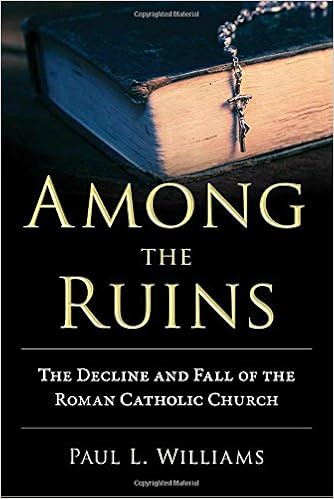
Have Any of You Read This? Should I Buy It?

Karl White writes, 

Just thought I'd pass this on in case you come across it. I read some of it in a bookstore today. It looks very good: clinical, to the point, merciless. 

(I had no idea that when Francis invited the first ever Imam to speak Koranic verses in the Vatican, the latter chose a verse that urged the killing of infidels!)

www.amazon.com/Among-Ruins-Decline-Catholic-Church/dp/1633883035

Private Judgment?

Yesterday I commented critically on the Roman Catholic teaching on indulgences. One who refuses to accept, or questions, a teaching of the Church on faith or morals may be accused of reliance upon private judgment and failure to submit to the Magisterium or teaching authority of the Church.  Two quick observations on this accusation.

First, for many of us private judgment is not merely private, based as it is on consultation with many, many public sources.  It is as public as private. Everything I've read over the years from Parmenides on down in the West, the Bible on down in the Near East, and the Upanishads on down in the Far East feeds into my 'private' judgment.  So my 'private' judgment is not merely mine as to content inasmuch as it is a collective cultural upshot, albeit processed through my admittedly fallible and limited pate. Though collective as to content, its acceptance by me is of course my sole responsibility.

Second, the party line or official doctrine of any institution is profoundly influenced by the private judgments of individuals. Think of the profound role that St. Augustine played in the development of doctrine.  He was a man of powerful will, penetrating intellect, and great personal presence.  Imagine going up against him at a theological conference or council.  

So the private is not merely private, and the official is not merely official.

Of course, part of the official doctrine of the Roman church is that its pronunciamenti anent faith and morals are guided and directed by the Holy Ghost. (Use of the old phrase, besides chiming nicely with der Heilige Geist, is a way for this conservative to thumb his nose at Vatican II-type innovations which, though some of them may have had some sense, tended to be deleterious in the long run.  A meatier question which I ought to take up at some time is the one concerning the upsurge of priestly paederasty after Vatican II: post hoc ergo propter hoc?)

What I have just written may sound as if I am hostile to the Church. I am not. Nor have I ever had any negative experiences with priests, except, perhaps to have been bored by their sermons. All of the ones I have known have been upright, and some exemplars of the virtues they profess.  In the main they were manly and admirable men.

I have no time now to discuss the Church's guidance by the third person of the Trinity, except to express some skepticism: if that is so, how could the estimable Ratzinger be followed by the benighted Bergoglio? (Yes, I am aware that there were far, far worse popes than the current one.)

Of course, I have just, once again, delivered my private judgment. But, once again, it is not merely private inasmuch as it is based on evidence and argument: I am not merely emoting in the manner of a liberal such as Bergoglio when he emoted, in response to the proposed Great Wall of Trump, that nations need bridges, not walls. Well, then, Vatican City needs bridges not walls the better to allow jihadis easy access for their destructive purposes. Mercy and appeasement even unto those who would wipe Christianity from the face of the earth, and are in process of doing so.

Addendum

But how can my judgment, even if not merely private, carry any weight, even for me, when it contradicts the Magisterium, the Church's teaching authority, when we understand the source and nature of this authority? ('Magisterium' from L. magister, teacher.)

By the Magisterium we mean the teaching office of the Church. It consists of the Pope and Bishops. Christ promised to protect the teaching of the Church : "He who hears you, hears me; he who rejects you rejects me, he who rejects me, rejects Him who sent me" (Luke 10. 16). Now of course the promise of Christ cannot fail: hence when the Church presents some doctrine as definitive or final, it comes under this protection, it cannot be in error; in other words, it is infallible. 

In a nutshell: God in Christ founded the Roman church upon St. Peter, the first pope, as upon a rock. The legitimate succession culminates in Pope Francis. The Roman church as the one true holy and apostolic church teaches with divine authority and thus infallibly. Hence its teaching on indulgences not only cannot be incorrect, it cannot even be reasonably questioned. So who am I to — in effect — question God himself?

Well, it is obvious that if I disagree with God, then I am wrong.  But if a human being, or a group of human beings, no matter how learned, no matter how saintly, claims to be speaking with divine authority, and thus infallibly, then I have excellent reason to be skeptical. How do I know that they are not, in a minor or major way, schismatics diverging from the true teaching, the one Christ promised to protect?  Maybe it was some version of Eastern Orthodoxy that Christ had in mind as warranting his protection.

These and other questions legitimately arise in the vicinity of what Josiah Royce calls the Religious Paradox

On Indulgences

I linked recently to a piece hostile to Islam, "the saddest and poorest form of theism." (Schopenhauer) I now point out a problem with a rather happier and richer form of theism, that of the Roman Catholic Church. Here:

November is the month the Church especially dedicates to praying for the dead. To encourage this holy practice, the Church offers a daily plenary indulgence for the souls in Purgatory, under the usual conditions (right intention, confession, Communion, prayer for the intentions of the pope) to those who visit a cemetery in the period November 1-8. She offers a partial indulgence at other times.

Essential to anything worthy of the label 'religion' is the belief that there is what William James calls an "unseen order." (Varieties of Religious Experience, p. 53.) (See The Essence of Religion for seven essential characteristics of religion.) What worries me, though, are those who claim to possess an exact cartography of the transcendent country beyond the senses and an exact understanding of the mechanics of salvation.

Purgatory is of course a sound and necessary idea within a classically theistic scheme inasmuch as almost none of us are worthy of immediate access to the Beatific Vision. (Besides, how many so-called Catholics would even want it? I suspect many of them believe in something along the lines of  'hillbilly heaven' complete with BBQs, fiddles and banjoes, cousin Jethro, and his old dog Blue.) Except for a few saints we will all need more or less purgation. For many this will take the form of a weaning-away from one's attachments to earthly loves and a gradual re-direction of one's misdirected desires upon the Absolute.  Death will detach us physically from our bodies, but it is highly naive to think that it will thereby detach us spiritually from our earthly loves.  It is a reasonable speculation that Hugh Hefner, if he survived his bodily death, is still lusting after nubile females; it is just that he no longer has the physical apparatus with which to implement his lust.

Now let's suppose that your child, who committed suicide, is in purgatory and that you are a Catholic.  A plenary indulgence is a full or total indulgence: it is a get-out-of-purgatory-right-now card.  So you do the things listed above, and your child is sprung from Purgatory.

But isn't this incredible?  I at  least find it hard to swallow. You could dismiss my misgivings as merely autobiographical remarks, but I suspect they are more.

What bothers me is the presumption on the part of the Church that it possesses exact knowledge of the afterlife and the mechanics of salvation. This pretense to detailed, indeed quantifiable, information about matters far, far beyond the human horizon strikes me as deeply dubious if not mendacious. Of course, there was something 'infinitely' worse, namely, the sale by greedy clerics of indulgences. That outrage, you will recall, was part of what fueled the protest of a certain failed monk by the name of Martin Luther.

How can I formulate my misgiving?  What bothers me, I suppose, is the dogmatic over-specification of the Unseen Order. Its 'satellite mapping,' if you will is a sort of secularization of the trans-secular which does not respect the transcendence and mystery of the trans-secular.  Appeal to mystery is often made by the Church in defense of doctrines (Trinity, Incarnation, Transubstantiation, et al.) that appear to flout the logical requirements of the discursive intellect; how does that appeal comport with the boringly prosaic  'green eyeshade' quantification and allotment of benefits and allowances pursuant upon so many Pater Nosters, this many Ave Marias, etc?

More later.  There are a number of deep issues here. 

Now, however, I have to take my wife, a good old-fashioned Catholic girl, God bless her, and an exemplar of the Eternal Feminine that leads us upward, to church.  Why do I go to church given how screwed-up the Roman church and its  clergy are (especially those of the American Catholic Bishops who  are leftists first and Catholics second in emulation of their leader Bergoglio the Benighted?)

The highest human pursuit is the pursuit of the ultimate truth about the ultimate matters. One has to prosecute the pursuit  in different ways. One is by working from within one's own tradition, despite its manifold limitations and defects, penetrating into it as deeply as possible,  and taking what is good from it. 

Addendum

John B. writes,

I read your two recent posts on indulgences, and I would like to offer a clarification: indulgences obtained for the souls in purgatory operate  per modum suffragii. An indulgence obtained for the dead is seen as a prayer that the faithful can have special confidence in, since it is, after a fashion, an intercessory prayer made by the Church itself. But it remains a prayer and not a juridical act. The Church on earth does not claim to have jurisdiction over the souls of the dead.
 
I doubt that this resolves all of the problems that indulgences present for you. There are still the questions surrounding indulgences for the living, after all. To be honest, I have a hard time with indulgences myself, for a few reasons, and I'm Catholic.  But the clarification seemed worth making.
 
Bernhard Poschmann's Penance and the Anointing of the Sick includes a very good chapter on indulgences if you want to read more on how they are understood and have been understood historically, and how they arose. The whole book is excellent, and at times surprising.


Latest Georgetown University Outrage

More proof that leftists are termites:

Georgetown’s website proclaims it is “the oldest Catholic and Jesuit institute of higher learning in the United States” and is “deeply rooted in the Catholic faith.” One campus group is learning, however, Georgetown’s roots might not be deep enough.

Love Saxa is a recognized student group on the Georgetown campus, and it exists “to promote healthy relationships on campus through cultivating a proper understanding of sex, gender, marriage, and family among Georgetown students.” Given the emphasis the Catholic Church puts on these issues (for example, see here and here), and Love Saxa’s alignment with church doctrine, one might believe it safe to assume Love Saxa is squarely within safe territory at a Catholic university.

But, oh, the perils of assumption. Love Saxa is in danger of being stripped of its status as an official student group. Its offense: holding to a Catholic view of human sexuality.

What can you do? Well, if you are a GU alumnus or alumna, make sure GU does not get one penny from you. When they call for a contribution, explain why you are withholding your donation.

You can't reason with termites, but money will get their attention.

Dianne Feinstein and the Anti-Catholic Bigots

George Neumayr:

It came out, thanks to the WikiLeaks disclosures during the 2016 campaign, that Hillary Clinton’s aides were trading nasty notes about Catholics, calling them “severely backwards.” The Dems had long been the party of anti-Catholic bigotry and the exposed emails only confirmed that reputation.

American bishops appointed by Pope Francis didn’t make a peep about Hillary’s anti-Catholic bigotry for the simple reason that they share it. They, too, see believing Catholics as “severely backwards.” Many of the Francis-appointed bishops, such as Chicago’s Blasé Cupich, were in the tank for Hillary. Patrick McGrath, the bishop of San Jose, California, used propaganda from the Hillary campaign as his crib notes, penning a ludicrous column to parishioners in which he said that Donald Trump “borders on the seditious.”

Cupich joined Illinois Senator Dick Durbin at Democratic dog-and-pony shows to push amnesty and socialism. Cupich’s sermons were indistinguishable from Hillary’s stump speeches.

But even with this help, even after decades of left-wing infiltration of the Church, Hillary couldn’t win the Catholic vote. Trump’s gibe at the Al Smith dinner — “here she is tonight, in public, pretending not to hate Catholics” — rang true for many Catholics in the pews.

Related: What Does Abortion Have to Do with Religion?

Iconoclasm: Another Similarity Between Muslims and Leftists

Muslims are well-known for their iconoclasm, hostility to the arts, and destruction of cultural artifacts. Leftists are like unto Muslims in this regard too. There is also the iconoclasm of the Left. For now, a couple of links to introduce the topic.

Leftist Iconoclasm Must Stop

Stomping on Jesus: The Iconoclasm of the Left

The trouble with iconoclasm is that all parties can play the game. 

Mass-murdering communist regimes are responsible for some 94 million deaths in the 20th century. Why not then destroy all the statues and monuments that honor the likes of Karl Marx, V. I. Lenin, Fidel Castro and all others who either laid the foundations for or carried out mass murder?  

You understand, of course, that I am not advocating this.  For one thing, the erasure of history would make it rather more difficult to learn from it. For another thing, there would be no end to it.  Why not destroy the Colosseum in Rome? You know what went on there.

Or how about St. Robert Bellarmine, S. J. ?  Should paintings and statues of him be destroyed?  He had a hand in the burning at the stake of the philosopher Giordano Bruno! According to Wikipedia:

Bellarmine was made rector of the Roman College in 1592, examiner of bishops in 1598, and cardinal in 1599. Immediately after his appointment as Cardinal, Pope Clement made him a Cardinal Inquisitor, in which capacity he served as one of the judges at the trial of Giordano Bruno, and concurred in the decision which condemned Bruno to be burned at the stake as a heretic.[5]

Better known is the fact that Bellarmine is the man who hauled the great Galileo before the Inquisition. 

Calling all philosophers and scientists! To your sledge hammers and blow torches!

And then there are the paintings, statues, etc. of Dr. Martin Luther King, Jr., plagiarist and adulterer.

There is no need to multiply examples. You should be getting the point along about now.

Statue_of_Lenin_SeattleThe Statue of Lenin is a 16-foot (4.9 m) bronze sculpture of Communist revolutionary Vladimir Lenin located in the Fremont neighborhood of SeattleWashington. Initially installed in Czechoslovakia in 1988, the sculpture was removed after the Velvet Revolution and brought to the United States in the 1990s.

Continence

The Catholic Church is in sad shape. Have you heard a good sermon lately? I could do better off the top of my head, and I am a very poor public speaker.

Here are some notes for a sermon I will never give, unless this weblog is my pulpit.

Remind people of the importance of continence both for their happiness here below, and for the good of their souls. Distinguish the following sorts of continence: mental (control of thoughts), emotional (control and custody of the heart), sensory-appetitive (custody of the eyes together with sexual restraint). Explain the importance of containing the outgoing flow, whether mental, emotional, or sensory-appetitive, and the misery consequent upon incontinence.

Illustrate by adducing the sad case of Bill Cosby.

Explain the key words and phrases. Don't use words like 'adduce.'  Attention spans in these hyperkinetic times are short, so keep it short.

The abdication of authorities has lead to the dumbing-down of the masses. Don't expect much.

Stupid Catholics with a Death Wish

Yet another example:

The Diocese of Orlando recently reprimanded a sixth grade teacher at a Catholic school for an “unfortunate exhibit of disrespect.” What did he do? He provided printouts to students of St. John Bosco’s negative assessment of Islam. St. John Bosco called Islam a “monstrous mixture of Judaism, Paganism, and Christianity,” and explained that Muhammad “propagated his religion, not through miracles or persuasive words, but by military force.”

Infested with leftist termites, the Church is in dire need of fumigation. Every Catholic church should display, instead of a sign prohibiting weapons — how stupid is that? — the following sign:

No Libruls!

The Collapse of the Catholic Universities

Yet another example, one so egregious that I pinch myself to see if I am awake:

Stéphane Mercier, a lecturer in philosophy at the Catholic University of Leuven (UCL) in Belgium initially was suspended from teaching, pending the outcome of disciplinary proceedings, because there was opposition in a class from a feminist group to his philosophical argument to the effect that abortion is the killing of an innocent unborn human life, which is an “intrinsically evil,” always unacceptable, regardless of the circumstances. The response from both the UCL administration and the Belgium Bishops Conference to his philosophical argument, which was put forth in a document entitled “The Philosophy Supporting Life: Against a so-called Right to Choose an Abortion", has been confusing.

UPDATE 2/24:

A reader sends this:

A student at the institution informs me this is the passage that led to the lecturer's sacking. It was a First Year Philosophy course:

"[…] reminds me of Newspeak, the official language of Oceania in George Orwell's 1984. Voluntary interruption of pregnancy is a euphemism that hides a message, namely the truth, which is that abortion is the murder of an innocent person. It is a murder particularly abject, because the victim has no defense against it. if murdering an  innocent person capable of self-defense weren't repulsive enough, taking the life of someone who doesn't have the power to defend himself is even more vile. Today, we hear people who believe abortion is immoral, but don't think about making it illegal, a disturbingly absurd way of reasoning. […] Imagine that the same person declares rape immoral, but thinks it shouldn't be made illegal in order to protect the freedoms of an individual (except for the victim…). that's absurd, right? So, if abortion is murder, as it is said to be by some, doesn't that make it worse than rape? Rape is immoral, and fortunately illegal as well. Shouldn't abortion, which is even more immoral, be illegal too?"

BV's comment: Imagine getting sacked at any university, let alone a supposedly Catholic university with the word 'Catholic' in its name, for giving this argument!

Leftist termites are undermining the great institutions of the West, and the authorities in charge of these institutions have either abdicated, or are termites themselves.  The edifices of higher culture are in dire need of fumigation. Figuratively speaking, of course . . . .