
In this Substack entry I defend the Frenchman against the Englishman. Continentals 1 – Insular Islanders 0.
A number of contrast arguments are examined.
In this Substack entry I defend the Frenchman against the Englishman. Continentals 1 – Insular Islanders 0.
A number of contrast arguments are examined.
A couple of ballsy articles for your cojonic delectation.
Jonathan Turley, The Judicial Calvinball of Justice Ketanji Brown Jackson
An excellent piece that ends on a weak and decidedly unmanly note: "I truly believe that Jackson can leave a lasting legacy and bring an important voice to the court." I'm guessing that the erudite and distinguished Professor Turley is afraid of being called a racist and a sexist.
Mike Solana, Age of Balls
It's an 'interesting' time to be alive. Who could be bored?
Neil Diamond, Solitary Man. His first song, his best song. The only one of his I really like. Johnny Cash does it better. There is nothing better than the sound of an acoustic guitar, well-made, well-played, steel-stringed, with fresh strings. This one goes out to Dave Bagwill, Oregon luthier.
Calexico, Alone Again Or.
Original (1967) by Love, an underrated '60s psychedelic band.
Roy Orbison, Only the Lonely
Roy's last recorded tune: You Got It.
Bob Dylan, I am a Lonesome Hobo
Stay free from petty jealousy
Live by no man's code
Save your judgment for yourself
Lest you wind up on this road.
Bob Dylan, The Lonesome Death of Hattie Carroll. Young Bob from his topical days. Whatever happened to William Zantzinger? Well, he died at 69 in 2009. NYT obituary here.
A couple of bonus cuts for a NYC friend:
Lovin' Spoonful, Summer in the City. Great song, great video.
Barrett Strong, Money (1959) There won't be much left there after madman Mandami, the Islamo-Commie, become mayor. New Yorkers have shown themselves stupid enough to vote for the worthless and incompetent. The smart money is already heading south. Florida has a great governor in Ron DeSantis, unlike the incompetent leftards 'governing' California and New York, Newsom and Hochul.
Stack topper. Here are four addenda to what I say in the Substack entry.
1) A skeptic is an inquirer, not a denier. Too many confuse doubt, the engine of inquiry, with denial. If I doubt that such-and-such, I neither affirm it nor deny it.
2) Is doubting whether a proposition is true the same as suspending judgment as to its truth-value? A subtle question. I think we should say that it is not. For if doubt is the engine of inquiry, then we doubt in order to attain such truth as we are able to attain. But if one suspends judgment as to the truth-value of some proposition P — if one 'suspends P' for short — one may do so with no intention of trying to determine whether P is true. For example, I suspend judgment, take no doxastic stance, on the question whether the number of registered Democrats in Maricopa County is odd or even. I don't know, I don't care, and I will do nothing to find out. Suspension, not doubt.
3) Another subtle difference is that between suspension (withholding of assent) or Pyrrhonist epoché in the broad sense, which is related to but quite different from Husserlian epoché, and Pyrrhonist epoché in the narrow sense. A standard treatment of the former is along the following lines (Wikipedia):
The Pyrrhonists developed the concept of "epoché" to describe the state where all judgments about non-evident matters are suspended to induce a state of ataraxia (freedom from worry and anxiety). The Pyrrhonist philosopher Sextus Empiricus gives this definition: "Epoché is a state of the intellect on account of which we neither deny nor affirm anything." This concept is similarly employed in Academic Skepticism but without the objective of ataraxia.
Benson Mates adds a nuance by distinguishing between withholding assent with respect to truth-value and withholding assent with respect to sense (Frege's Sinn). I endorse the distinction. Consider the proposition expressed by the standard Trinitarian formula, 'There is one God in three divine persons.' (My example.) What mental attitudes can we take up with respect to this proposition? I count five: Affirm, Deny, Doubt, Suspendtv (withhold assent with respect to truth-value), Suspends (withhold assent with respect to the question whether the proposition has a determinate sense or meaning). For example, one might maintain that the Trinitarian formula has or makes no sense, which is to say that no definite proposition is expressed by the verbal utterance or inscription. If the formula makes no sense, then it does not express a proposition, a proposition being a sense, whence it follows that the formula cannot have a truth-value.
4) A solubility skeptic with respect to the central problems of philosophy is not the same as a problem skeptic. I am not a problem skeptic. I don't doubt that the central problems are genuine, pace the later Wittgenstein. The central problems are genuine, not pseudo, but I doubt whether they are soluble by us. So doubting, I conjecture that they are not soluble by us as the best explanation of why they haven't been solved.
I am nothing if not self-critical. And so a partial retraction may be in order. In A Problem for Hylomorphic Dualism in the Philosophy of Mind, I opened with:
1) A primary substance (a substance hereafter) is a concrete individual. A man, a horse, a tree, a statue are stock examples of substances. A substance in this technical sense is not to be confused with stuff or material. Substances are individuals in that they have properties but are not themselves properties. Properties are predicable; substances are not. Substances are concrete in that they are causally active/passive.
What I wrote is not obviously wrong as a summary of what Aristotle means by ‘primary substance,’ (πρότη οὐσία) and I could cite Aristotle commentators who have maintained something similar. But it is not obviously right either. Although it comports well with what we find in the Categories, it does not agree with what we read in the later Metaphysics, and in particular, Metaphysics VII (Zeta). For in the latter work, Aristotle maintains the surprising thesis that each primary substance is identical with its essence. (VII.6) This is what Aristotle seems to be saying at 1031b18-20 and at 1034a4-6 in Metaphysics Z. In the first of these passages we find, “each thing-itself [auto hekaston] and its essence are one and the same . . . .” In the latter place, we read, “in the case of things that are said in respect of themselves and primary, X and the essence of X are the same and one . . . .” (Montgomery Furth tr.)
Why is this surprising?
Well, if following the Categories we take Socrates to be a clear example of a primary substance, and if a primary substance is identical to its essence (substantial form), then it is difficult to see how Socrates could be a hylomorphic compound, which he surely is, if not according to the Categories, then according to the Metaphysics. After all, a composite composed of two complementary but non-identical elements cannot be identical to either. The following is quite obviously an inconsistent triad:
1) Socrates is a matter-form composite, a hylomorphic compound, a unity of two complementary but non-identical ‘principles’ (archai) or ontological factors, matter and form, neither of which can exist actually (as opposed to potentially) without the other. That is: no actual parcel of matter can exist without having some substantial form or other, and (contra Plato), no substantial form of a material thing can exist without material embodiment.
2) Socrates is a primary substance.
3) Every primary substance is identical to a substantial form (essence, eidos).
These propositions are collectively inconsistent: any two of them, taken in conjunction, entails the negation of the remaining one. The triad above is known in the trade as an antilogism, and to each antilogism, there are three corresponding valid syllogisms.
Syllogism A is an argument from (1) and (2) to the negation of (3). Syllogism B is an argument from (2) and (3) to the negation of (1). Syllogism C is an argument from (3) and (1) to the negation of (2). Each of these syllogisms is valid, but only one is sound. Which one? That is the problem.
The problem can also be framed as follows. The limbs of the antilogism cannot all be true. So which limb of the antilogism (inconsistent triad) should we reject? Aristotle cannot abandon (1), for that would be to abandon hylomorphism. And he cannot abandon (3) given the textual evidence cited above. So it seems that (2) has to go. Or rather, (2) has to go if we assume that the Metaphysics is an advance over the Categories and represents Aristotle’s mature position.
The rejection of (2), however, would appear to send us from the frying pan into the fire. If Socrates is not a primary substance, what would be? But before explaining this incendiary transition, let us first try to understand what motivates Aristotle’s surprising identification of primary substances with substantial forms at Metaphysics VII.6.
Why does Aristotle identify primary substances with substantial forms?
We begin by reminding ourselves that Aristotle’s inquiry into primary substance is a quest for the ultimately real, the ontologically basic, that upon which the reality of everything else depends. For Aristotle, ontology is ousiology, the search for the primary ousiai or substances or primary beings. He never doubts that there are primary beings (basic entities or basic existents) upon which all else is ontologically dependent. And so he never countenances the possibility that the solution to any of the aporiai he sets forth could be solved by denying either the existence of substances or their plurality. Being is many, not one, and the many beings are fundamentally real in that they are the supports of their properties and remain self-same over time. In contemporary analytic jargon they persist by enduring not by perduring.
That there is a real plurality of primary substances is thus a fundamental presupposition of Aristotle’s ousiological ontology. The existence of primary substances/beings, as a presupposition of ontological inquiry, is thus not a matter for inquiry. What is a matter for inquiry is the question: Which items are the items that satisfy the requirements of primary substance? That there are primary substances the Stagirite takes for granted; what they are is up for grabs.* Hence it cannot be simply assumed that concrete individuals such as a man, a horse, a tree, or a statue are primary substances despite the intuitive appeal of this notion and the support it finds in the Categories. This is something to be investigated.
Now there are three main candidates for the office of primary substance. The three candidates are matter, form, and the hylomorphic compound, the composite of matter and form.
So either Socrates, who stands in here for any primary substance, is identical to matter, or he is identical to form, or he is identical to a matter-form (hylomorphic) composite. Now he can’t be identical to matter as Jonathan Lear explains:
. . . matter cannot be primary substance, for it is not something definite, nor is it intelligible, nor is it ontologically independent. As Aristotle puts it, matter is not a ‘this something.’ [tode ti] His point is not that matter is not a particular, but that matter is not an ontologically definite, independent entity. (Aristotle: The Desire to Understand, Cambridge UP, 1988, 271)
That sounds right. Primary substances are ontologically basic existents upon which all else depends for its being. An ontologically basic existent must be something definite (horismenos) that is both intelligible (understandable) and ontologically independent (choristos). A smile, for example, is intelligible, and it is definite, but is not ontologically independent and thus not a substance. A smile cannot exist in itself, but only in another, namely, in a face. You could say that the being of a smile is parasitic upon the being of a face. You can have a face without a smile, but not a smile without a face.
Lear is arguing on Aristotle’s behalf: (i) Primary substances must be ontologically independent and definite; (ii) matter is neither ontologically independent nor definite; ergo, (iii) matter is not primary substance. So far, so good.
You might object that the matter of Socrates and the matter of Plato are definite. But what defines or delimits these parcels of matter are Socrates and Plato, respectively, or rather what I will call their ‘wide essences’ or ‘wide quiddities’ by which I mean the conjunction of essential and accidental determinations appertinent to each: these parcels are two because Socrates and Plato are two, and not the other way around.
Lear, then, is right: matter cannot be primary substance.
Surprisingly, however, Socrates cannot be identical to a hylomorphic composite either. For “a composite is ontologically posterior to its form and matter.” (Lear, 277) Nothing counts as a primary substance, however, unless it is ontologically prior to everything else. Thus Lear is arguing:
4) Nothing is a primary substance unless it is ontologically independent, ‘separate’ (choristos).
5) Every hylomorphic compound or material composite is ontologically posterior to, and thus ontologically dependent on, its components, matter and form.
Therefore
6) No hylomorphic composite is a primary substance.
There is no way around this argument, as far as I can see. Therefore, of the three candidates, matter, form, and the hylomorphic compound, Aristotle concludes that substantial form is primary substance. (Note that accidental forms such as Socrates’s snubnosedness cannot be primary substance because of their lack of ontological independence.) But what is substantial form? Substantial form is essence where essence is ‘the what it is’ (to ti esti, τὸτί ἐστι) of the thing, a calque of which is the Latin quidditas, whatness, quiddity.
Aristotle’s conclusion, then, in Metaphysics Zeta, is that, “each primary substance is identical with its essence.” (Lear, 279) Essence is what the mind comprehends, or at least apprehends. Essences are made for the mind, and the mind for essences. In this way the intelligibility requirement is satisfied. Matter as such is unintelligible, and hylomorphic compounds are intelligible only in their formal aspects. Essences are the ontological correlates of definitions. A good definition ‘captures’ an essence in words. Thus ‘Man is a rational animal,’ while defining the term ‘man,’ points the mind beyond the word on the linguistic plane to to the essence on the ontological plane. These last sentences are my gloss on Lear’s gloss on Aristotle.
From the Frying Pan into the Fire
Aristotle is telling us that Socrates is identical to his essence or substantial form. This identification satisfies the intelligibility requirement. Recall, however, that there are two requirements that need to be satisfied for anything to count as a primary being or basic entity. Intelligibility is not enough. The other is that the item must be ontologically independent (choristos). But independent is precisely what Aristotelian forms are not. For Plato, forms are ontologically independent of the phenomenal particulars that may or may not embody them here below. Plato’s Forms exist whether or not they are embodied or exemplified. Not so for Aristotle who, figuratively speaking, brings the forms from their heavenly place (topos ouranios) down to earth. An Aristotelian substantial form of a material thing cannot exist without being embodied, ‘enmattered.’ On a hylomorphic assay of concrete individuals (a rock, a tree, a cat, a man, a statue), matter and form are two complementary but non-identical components neither of which can exist without the other.
Aristotle appears to have painted himself into a corner. He assumes, reasonably enough given what our outer senses reveal, that the world we encounter consists of a plurality of basic entities or primary substances.
Relatedly, how is it logically possible for all of the following propositions to be true given what Aristotle appears to be maintaining in Metaphysics Z?
4) Socrates and Plato are numerically different human primary substances.
2) A primary substance is (identically) an essence or substantial form.
5) Socrates and Plato have the same substantial form or essence, where the essence is the ontological correlate of the definiens of the definition that applies to them both univocally, namely, ‘A human being is a rational animal.’
I’ll end with a suggestion: Platonism lives on in Aristotle inasmuch as the substantial form is the primary substance, and not the concrete material particular. The difference between the two titans of Greek philosophy is less than you thought. It is sometimes said that every philosopher is either a Platonist or an Aristotelian. My suggestion implies that this is not so. It is rather that every philosopher qua philosopher, if he is the real deal, is a Platonist. Plato dominates his best student. If so, A. N. Whitehead vindicatus est: all of philosophy is but a series of footnotes to Plato, the ‘divine’ Plato as I sometimes call him. Or as our very own Ralph Waldo Emerson once said, “Plato is philosophy and philosophy Plato.”
My claim about the dominance of Plato is obviously tendentious. But if a man cannot be tendentious in the pages of his own weblog, where can he be tendentious?
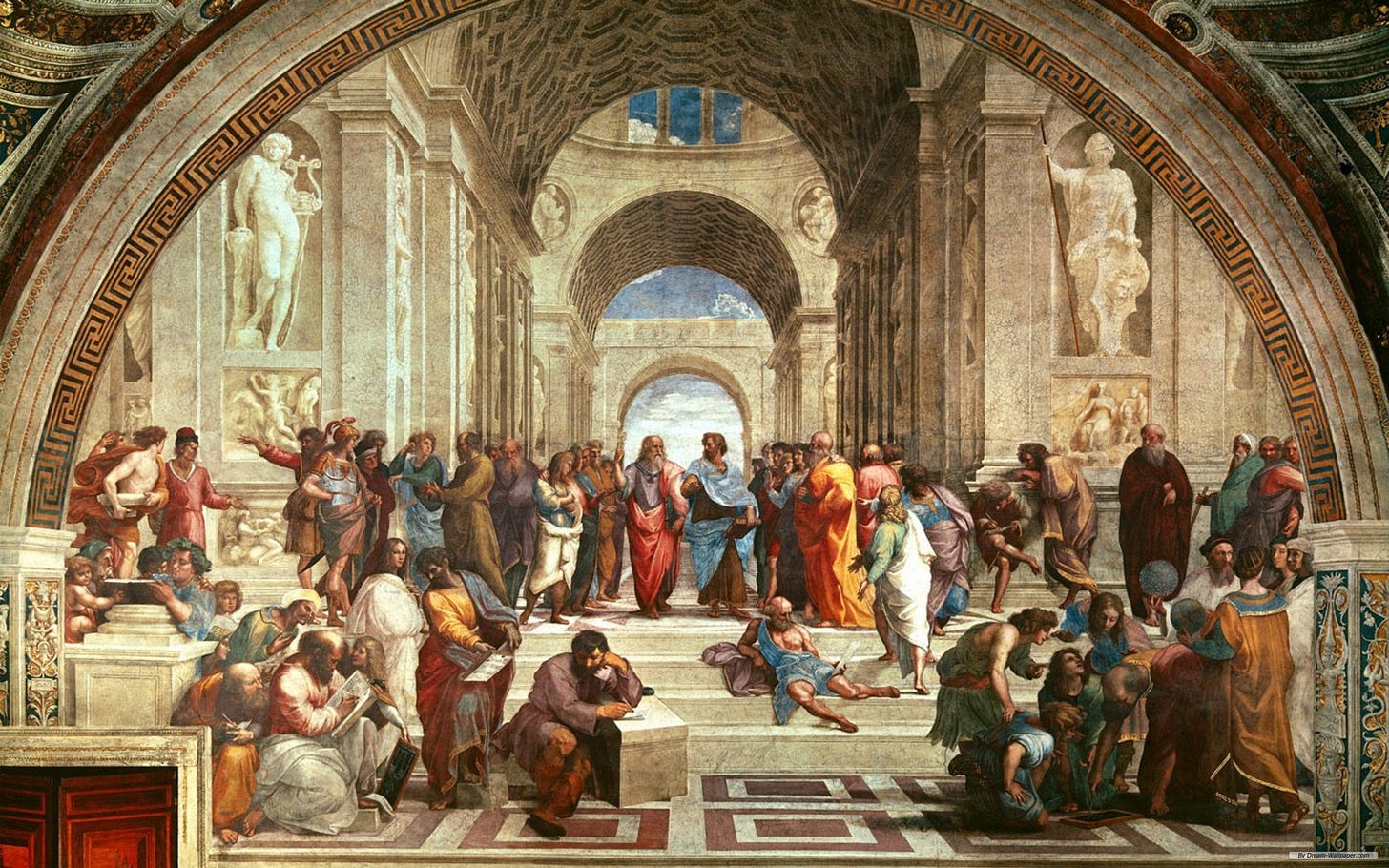
For commentary on Raphael’s painting see my Substack entry, A Battle of Titans.
_______________________
*Aristotle takes it for granted that there is a plurality of primary substances. Is that self-evident? Put the question to Spinoza, and he would say that there is exactly one primary substance, deus sive natura, and that what Aristotle takes to be primary substances are mere modes of God or nature. What would Plato say? Well he certainly would not say that Socrates and his toga are primary substances; they are merely phenomenal particulars, and insofar forth insubstantial, a blend of being and nonbeing. He would give the palm to the eide, which are many, and beyond them to the Good, which is one.
Aristotle also takes it for granted that there are primary substances. Is that self-evident? Not to the exponents of the Madhyamika system. See T. R. V. Murti, The Central Philosophy of Buddhism.
Our great founders understood that immigrants bring their culture with them, and that some cultures are toxic to our own. They understood that there can be no comity without commonality, that immigration without assimilation is a recipe for disaster, and that unity, not diversity, is the source of our strength.
As Alexander Hamilton warned, America’s survival depends on “the preservation of a national spirit and a national character.”
“To admit foreigners indiscriminately to the rights of citizens the moment they put foot in our country … would be nothing less, than to admit the Grecian Horse into the Citadel of our Liberty and Sovereignty.”
Thomas Jefferson likewise warned that immigrants “will bring with them the principles of the governments they leave, imbibed in their early youth,” and that, as a result, they “will infuse into [our legislation] their spirit, warp and bias its direction.” Jefferson recognized that a careless approach to immigration would eventually reshape America away from her founding character.
If Americans want America to survive, they must reclaim the moral clarity of the Founders and say, without apology, that not every idea deserves a seat at the table and not every person who wants to be in America deserves to be here.
You decide. If you want my opinion, Dementocrat 'paranoia' is but a manifestation of TDS. Never forget: our political enemies are ever at work bringing Trump's 'inner Hitler' to light.
Related: No Entity without Identity
Addendum (8/22): Trump's One-Week D. C. Clean-Up. Does it show that the Dems are destroying their cities by choice? It may be like this: in their race-delusionality, they think that any crackdown on crime would be racist, and their greatest fear is to be called racists.
"We will not open or operate retail stores in California." (Marcus Lemonis, Bed, Bath, and Beyond)
Even Scarborough sees through the clown.
Now if you really want to learn something, please pay close attention to this nine minute video by Victor Davis Hanson entitled Gavin Newsom's 250 Mil Redistricting Power Grab.
The shape of things to come. Will human surgeons be out of a job?
"This advancement moves us from robots that can execute specific surgical tasks to robots that truly understand surgical procedures." Axel Krieger, Johns Hopkins medical roboticist.
Truly understand?
Julian Green, Diary 1928-1957, entry of 30 December 1940, p. 104:
Does our body never weary of desiring the same things? [. . .] There are only two types of humanity . . . the mystic and the profligate, because both fly to extremes , searching, each is his own way, for the absolute; but, of the two, the profligate is to my mind the most [more] mysterious, for he never tires of the only dish served up to him by his appetite and on which he banquets each times as though he had never tasted it before. Probably because of this, I have always had a tendency to consider an immoderate craving for pleasure as an accepted form of madness.
Only two types of humanity? No, but two types. Man is made for the Absolute, and some of us seek it. Mysticism and profligacy are two ways of seeking it. Eschewing the phony and conventional, some of us strive after the really real, τὸ ὄντως ὄν. Some by world-flight, others by immersion in sensual indulgence. An enlightened upward and a deluded downward seeking. The solid and stolid bourgeois type will consider both types of seekers mad. But only those who seek the really real in the pleasures of the flesh are truly mad. They are bound for a hell of their own devising as I suggest in A Theory of Hell. Excerpt:
To be in hell is to be in a perpetual state of enslavement to one's vices, knowing that one is enslaved, unable to derive genuine satisfaction from them, unable to get free, and knowing that there is true happiness that will remain forever out of reach. Hell would then be not as a state of pain but one of endless unsatisfying and unsatisfied pleasure. A state of unending gluttony for example, or of ceaseless sexual promiscuity. A state of permanent entrapment in a fool's paradise — think of an infernal counterpart of Las Vegas — in which one is constantly lusting after food and drink and money and sex, but is never satisfied. On fire with the fire of desire, endless and unfulfilled, but with the clear understanding that one is indeed a fool, and entrapped, and cut off permanently from a genuine happiness that one knows exists but will never experience.
Top o' the Stack.
Opinions differ.
On a podcast last week, Senate Minority Leader Chuck Schumer, D–NY, claimed, “I walk around all the time. I wake up early in the morning … And I feel perfectly safe.” He dismissed Republican concerns about safety as “full of it,” but, of course, Schumer doesn’t go anywhere without his security detail. In a similar vein, D.C. Councilmember Charles Allen called the federalization of law enforcement “unnecessary, unwarranted,” and the D.C. Council emphasized that crime rates are at “the lowest rates we’ve seen in 30 years.”
John Lott goes on to argue that "D.C.’s murder rate ran 169 percent higher than Louisiana’s, the deadliest state, and an astonishing 523 percent higher than that of the average state."
Lott is one of those who invariably talks sense in stark contrast to our political enemies.
The Dems are a contemptible bunch. I could easily list ten reasons. Two near the top are their breathtaking mendacity and their casual attitude toward criminality. And they lie about both.
The Dems are always going on about 'our democracy,' their noble defense of it, and the Republicans' nefarious assault upon it. But they never tell us what they mean by 'democracy.' One is left to speculate. Here is David Brooks commenting on the recent gerrymandering/redistricting contretemps:
I understand the argument. But let's do a little ethical experiment here. You're in World War I. The Germans use mustard gas on civilians, and it helps them. Do you then decide, 'Okay, we're going to use mustard gas on civilians?' What Trump ordered Abbott to do in Texas is mustard gas on our democracy. (emphasis added)
One gets the distinct impression that for Democrats, 'democracy' means our party, the Democrat party. Accordingly, to defend and preserve democracy is to defend, preserve, and enhance the power of the Democrat party by any and all means necessary including gerrymandering. After all, they are (in their own eyes) wonderful people; so whatever they do must be wonderful too. But when we do unto them what they have long done unto us, we are despicable 'fascists' out to destroy 'democracy.'
'Fascist' is the pejorative counterpart of the Dem's honorific 'democracy.' 'Fascist' is the Left's favorite F-word, although, thanks to Hunter Biden and others, the F-word itself may be coming to occupy the top slot in the depredatory Left's deprecatory lingo. Hunter and the benighted Beto O'Rourke seem incapable these days of uttering a sentence free of F-bomb ornamentation.
I should think that both the pejorative and the honorific, as used by the Dems, ought to enter retirement. For they know too little history to know what 'fascist' means, and their actions show that there is little that is democratic about them. Or do you think the coup against Joe Biden and his replacement on the 2024 Dem ticket by Kamala Harris was a democratic action? Quite the contrary!
The subversion of language is the mother of all subversion. The contemporary Dems are a pack of subversives out to destroy our republic. And yes, it is a republic, not a democracy , even when the word is used responsibly. It is a constitutionally-based republic and is democratic only to the extent that the people have a say in who shall represent them.
'Journo' is my term of disapprobation-unto-contempt for liberal-left journalists. It is on a par with 'shyster' as a term of abuse for a certain sort of lawyer. Dig this from today's news:
NEW YORK (AP) — A club shooting in the New York City borough of Brooklyn early Sunday morning has left three people dead and nine others wounded in a year of record-low gun violence in the city.
NYC is quite the craphole these days, both above and under ground, and she seems bent on becoming the cesspool of the nation. Madman Mamdani the Islamo-commie-anti-semite, has a good shot at the mayoralty, I am told.
I've often wondered about the etymology of 'shyster.' From German scheissen, to shit? That would fit well with the old joke, "What is the difference between a lawyer and a bucket of shit?' "The bucket." I am also put in mind of scheusslich: hideous, atrocious, abominable. Turning to the 'shyster' entry in my Webster's, I read, "prob. fr. Scheuster fl. 1840 Am. attorney frequently rebuked in a New York court for pettifoggery."
According to Robert Hendrickson, Encyclopedia of Word and Phrase Origins, p. 659:
Shyster, an American slang term for a shady disreputable lawyer, is first recorded in 1846. Various authorities list a real New York advocate as a possible source, but this theory has been disproved by Professor Gerald L. Cohen of the University of Missouri-Rolla, whose long paper on the etymology I had the pleasure of reading. Shakespeare's moneylender Shylock has also been suggested, as has a racetrack form of the word shy, i.e., to be shy money when betting. Some authorities trace shyster to the German Scheisse, "excrement," possibly through the word shicir, "a worthless person," but there is no absolute proof for any theory.
A little further research reveals that Professor Cohen's "long paper" is in fact a short book of 124 pages published in 1982 by Verlag Peter Lang. See here for a review. Cohen argues that the eponymous derivation from 'Scheuster' that I just cited from Webster's is a pseudo-etymology. 'Shyster' no more derives from 'Scheuster' than 'condom' from the fictious Dr. Condom. Nor does it come from 'Shylock.' It turns out my hunch was right. 'Shyster' is from the German Scheisser, one who defecates.
The estimable and erudite Dr. Michael Gilleland, self-styled antediluvian, bibliomaniac, and curmudgeon, who possesses an uncommonly lively interest in matters scatological, should find all of this interesting. I see that the Arizona State University library has a copy of Gerald Leonard Cohen's Origin of the Term "Shyster." Within a few days it should be in my hands.
I'm a 'sixties guy but I can relate to some of the 'seventies stuff. When the 'seventies rolled around I began tuning out popular music and began giving myself an education in classical music, the original 'long-haired' music. Classical, however, with its dynamic variations, is no good for the road, leastways not in the Jeeps I drive. So, it's popular music for purposes of the road and Saturday night nostalgia.
Bellamy Brothers, Let Your Love Flow
Jackson Browne, Running on Empty
Eagles, Hotel California
Abba, Fernando
Gerry Rafferty, Baker Street
Warren Zevon, Carmelita
YouTuber interpretation:
After listening to this song for a while, I think that Carmelita is the heroin itself. Warren talks about being with "her in Ensenada" but he's alone in Echo Park playing "solitaire". Shooting heroin makes him feel like he's on the beach in Mexico with a woman that he loves. The song itself is a great representation of what addiction does. He knows that it's not good for him but he has given up on trying to get better and just looks towards "Carmelita" to hold him tighter.
Billy Joel, Piano Man