Dale Tuggy recently updated his article on the Trinity in the Stanford Encyclopedia of Philosophy.
Author: Bill Vallicella
Saturday Night at the Oldies: Days of the Week
Melina Mercouri, Never on Sunday
Mamas and Papas, Monday, Monday
Marianne Faithfull, Ruby Tuesday. Moodier than the Stones' original.
Simon and Garfunkel, Wednesday Morning 3 AM
Donovan, Jersey Thursday
Easybeats, Friday on My Mind
Sam Cooke, Another Saturday
Night
Bonus cut: Jerry Lee Lewis, Lonely Weekend
Existence-Blindness or Double-Vision?
I had the pleasure of meeting London Ed, not in London, but in Prague, in person, a few days ago. Ed, a.k.a. 'Ockham,' and I have been arguing over existence for years. So far he has said nothing to budge me from my position. Perhaps some day he will. The following entry, from the old Powerblogs site, whose archive is no more, was originally posted 25 May 2008. Here it is again slightly redacted.
…………….
I am racking my brains over the question why commenter 'Ockham' cannot appreciate that standard quantificational accounts of existence presuppose rather than account for singular existence. It seems so obvious to me! Since I want to put off as long as possible the evil day when I will have to call him existence-blind, I will do my level best to try to understand what he might mean.
Consider the following renditions of a general and a singular existence statement respectively, where 'E' is the 'existential' or, not to beg any questions, the particular quantifier:
1. Cats exist =df (Ex)(x is a cat)
2. Max (the cat) exists =df (Ex)(x = Max).
Objectually as opposed to substitutionally interpreted, what the right-hand sides of (1) and (2) say in plain English is that something is a cat and that something is (identical to) Max, respectively. Let D be the domain of quantification. Now the right-hand side (RHS) of (1) is true iff at least one member of D is a cat. And the RHS of (2) is true iff exactly one member of D = Max. Now is it not perfectly obvious that the members of D must exist if (1) and (2) are to be true? To me that is obvious since if the members of D were Meinongian nonexistent items, then (1) and (2) would be false. (Bear in mind that there is no logical bar to quantifying over Meinongian objects, whatever metaphysical bar there might be. Meinongians, and there are quite a few of them, do it all the time with gusto.)
Therefore, 'Something is a cat' is a truth-preserving translation of 'Cats exist' only if 'Something is a cat' is elliptical for 'Something that exists is a cat.' And similarly for 'Something is Max.' But here is where 'Ockham' balks. He sees no difference between 'something' and 'something that exists' where I do see a difference.
I am sorely tempted to call anyone who cannot understand this difference 'existence-blind' and cast him into the outer darkness, that place of fletus et stridor dentium, along with qualia-deniers, eliminative materialists, deniers of modal distinctions, and the rest of the terminally benighted. But I will resist this temptation for the moment.
And were I to label 'Ockham' existence-blind he might return the 'compliment' by saying that I am hallucinating, or suffering from double-vision. "You've drunk so much Thomist Kool-Aid that you see a distinction where there isn't one!" But then we get a stand-off in which we sling epithets at each other. Not good for those of us who would like to believe in the power and universality of reason. It should be possible for one of us to convince the other, or failing that, to prove that the issue is rationally undecidable.
The issue that divides us may be put as follows. (Of course, it may be that we have yet to locate the exact bone of contention, and in our dance around each other we have succeeded only in 'dislocating' it.)
BV: Because the items in the domain of quantification exist, there has to be more to existence than can be captured by the so-called 'existential' quantifier. Existence is not a merely logical topic. Pace Quine, it is not the case that "Existence is what existential quantification expresses." Existence is a 'thick' topic: there is room for a metaphysics of existence. One can legitimately ask: What is it for a concrete contingent individual to exist? and one can expect something better than the blatantly circular, 'To exist is to be identical to something.' To beat on this drum one more time, this is a circular explanation because D is a domain all of whose members exist. One moves in a circle of embarrassingly short diameter if one maintains that to exist is to be identical to something that exists. Note that I wrote circular explanation, not circular definition. Note also that I am assuming that there is such a thing as philosophical explanation, which is not obvious, and is denied by some.
O: Pace BV, the items in the domain of quantification admit of no existence/nonexistence contrast. Therefore, 'Something is a cat' is indistinguishable from 'Something that exists is a cat.' There is no difference at all between 'something' and 'something that exists,' and 'something' is all we need. Now 'something' is capturable without remainder using the resources of standard first-order predicate logic with identity. 'Exist(s)' drops out completely. There is no (singular) existence and there are no (singular) existents. There are just items, and one cannot distinguish an item from its existence.
Now if that is what O means, then I understand him, but only on the assumption that for individuals
3. Existence = itemhood.
For if to exist = to be an item, if existence reduces to itemhood, then there cannot be an existence/nonexistence contrast at the level of items. It is a logical truth that every item is an item, and therefore an item that is not an item would be a contradiction: 'x is an item' has no significant denial. Therefore, on the assumption that existence = itemhood, there is no difference between 'Some item is a cat' and 'Some item that exists is a cat.' And if there is no such difference, then existence is fully capturable by the quantifier apparatus.
But now there is a steep price to pay. For now we are quantifying over items and not over existents, and sentences come out true that ought not come out true. 'Dragons exist,' for example, which is false, becomes 'Some item is a dragon' which is true. To block this result, O would have to recur to a first-level understanding of existence as contrasting with nonexistence. He would have to say that every item exists, that there are no nonexisting items. But then he can no longer maintain that 'something' and 'something that exists' are indistinguishable.
In defiance of Ed's teacher, C. J. F. Williams, I deny that the philosophy of existence must give way to the philosophy of someness. (Cf. the latter's What is Existence? Oxford, 1981, p. 215) The metaphysics of existence cannot be supplanted by the logic of 'exist(s).' Existence is not a merely logical topic.
Here is an obituary of Williams written by Richard Swinburne.
Doctor Communis
Is Thomism the 'default position' among scholastics? I suggested as much and bolstered my assertion by adverting to the fact that Aquinas is sometimes referred to as doctor communis, Common Doctor. It was then claimed by someone, one of the Czech scholastics, I think, that this appellation was made up by Thomists to refer to and promote their man and is thus not neutral.
I'll have to look into this.
Good Reads
Roger Kimball, Racism, Inc.
Victor Davis Hanson, The Decline of College; The Late, Great Middle Class
Leon Wieseltier, Crimes Against Humanities
Edward Feser, Man is Wolff to Man. I was going to write this post, but Ed beat me to it. Ed beats down the superannuated Wolff for boarding the bandwagon of benighted bashers of Nagel. These lefties just can't stand Nagel even though he is a naturalist, an atheist, and a liberal. Why? Because he is not an extremist like they are. Because he could conceivably be interpreted by someone as giving aid and comfort to the enemy: the theists. For not toeing the party line. For thinking for himself. For being the Real Thing and not a leftist ideologue. It is sad to see professional philosophy ideologized like this.
Kirsten Powers, A Global Slaughter of Christians. The 'religion of peace' is at it again. But the PC-whipped churches stay silent.
By the way, I admire the hell out of Kirsten Powers, even though she's a Dem (why Lord, why?): she has beauty, brains, and (the female equivalent of) balls. And she puts up goodnaturedly with the sometimes obnoxious Bill O'Reilly. But I admire the hell out of him as well. That leftists despise a moderate such as him shows what contemptible extremists they are.
More Pictures from Prague
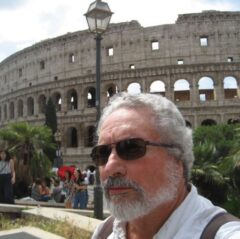
Peter Lupu wanted to see some pictures with me in them, so here we go: hiding one's vanity is perhaps a form thereof. But first a shot of Ed Buckner and his charming wife, Fiona. It was good to meet him in the flesh after many years of correspondence and weblog interaction. He has appeared in these pages under such pseudonyms as 'William of Woking,' 'ockham,' 'ocham,' and a few others.
The remaining shots were all taken by Dale Tuggy.
The Original Christian Revelation: The Bible or the Teaching of Jesus?
Richard Swinburne, Revelation, Oxford, 1992, pp. 102-103:
. . . there has been a strain in Protestantism, with its immense reverence for Scripture, to write of Holy Scripture itself as the original [propositional] revelation; what was given by God was the Bible. But that surely fits very badly with other things that those same Protestants wish to say: for example that there were Christians in the first four centuries AD. For the books of the New Testament were not written down until from twenty to seventy years after Christ taught on Earth, and were only put together and recognized as a New Testament in final form in the fourth century AD. If the books themselves were the revelation, how could there be Chrsitians when there were no books? [Footnote 6 not reproduced: it quotes Iraneus and Papias as quoted by Eusebius.] Holy Scripture must be regarded by Protestants as it is by Catholics, as no more than a true record of a revelation which existed before it.
Sweat, Perspire, Glow
It was a hot and humid September day, twenty years ago. I was sitting in a restaurant in Wuhan, China. There had been a power outage, so the air conditioning was off. The lady next to me was perspiring profusely. I somewhat crudely drew attention to the fact probably using some such expression as 'sweating bullets.'
The lady gave me an arch look and said, "Horses sweat, men perspire, women glow."
The good lady was glowing something fierce.
From the Museum of Communism, Prague
London Ed, whom I finally got to meet at the Prague conference, sends this from the Museum of Communism:
Once America had a leader resolute and real who knew totalitarian evil when he saw it and played a major role in putting it in the museum of horrors:
Some Favorable Citations of Suárez by Schopenhauer
During a delightful rural ramble outside Prague, I mentioned to Daniel Novotný that Arthur Schopenhauer had a high opinion of Francisco Suárez (1548-1617). Daniel said he had heard as much but wondered where Schopenhauer had indicated his high regard for the scholastic philosopher. Here are some passages, though I have the sense that I am overlooking a more striking quotation than any of the ones I have just now managed to locate.
1. There is a place in the early On the Four-Fold Root of the Principle of Sufficient Reason where Schopenhauer is speaking of the four causes mentioned by Aristotle at Analyt. Post., II, 11. Schopenhauer describes the Metaphysical Disputations of Suárez as diesem wahren Kompendio der Scholastik, "this true compendium of scholasticism." (Ueber die vierfache Wurzel des Satzes vom zureichenden Grunde, Zweites Kapitel, sec. 6, Felix Meiner Verlag, Hamburg, p. 15.)
If the index to Schopenhauer's magnum opus, The World as Will and Representation (two vols., tr. Payne, Dover) is to be trusted, there are exactly six references to Suárez all of them in the first volume.
2."It was known even to the scholastics [note 24: Suarez, Disputationes metaphysicae, disp. III, sect. 3, tit. 3.] that, because the syllogism requires two premisses, no science can start from a single main principle that cannot be deduced further; on the contrary, it must have several, at least two, of these." (p. 63)
3. "Consequently, time and space are the principium individuationis, the subject of so many subtleties and disputes among the scholastics which are found collected in Suárez (Disp. 5, sect. 3)." (p. 113)
4. "That which for man is his unfathomable character, presupposed in every explanation of his actions from motives, is for every inorganic body precisely its essential quality, its manner of acting, whose manifestations are brought about by impressions from outside, while it itself, on the other hand, is determined by nothing outside it, and is thus inexplicable. Its particular manifestations, by which alone it becomes visible, are subject to the principle of sufficient reason; it itself is groundless. In essence this was correctly understood by the scholastics, who described it as forma substantialis. (Cf. Suárez, Disputationes Metaphysicae, disp. XV, sect. 1.) (p. 124)
5. P. 152, fn. 21: "The scholastics therefore said quite rightly: Causa finalis movet non secundum suum esse reale, sed secundum esse cognitum. See Suárez, Disp. Metaph., disp. XXIII, sect. 7 et 8. ('The final cause operates not according to its real being, but only according to its being as that is known.' [Tr.]"
6. The following excerpt is from "Criticism of the Kantian Philosophy," an appendix to the first volume of WWR, pp. 422-423, emphasis added):
We may regard as the third point the complete overthrow of the Scholastic philosophy, a name by which I wish here to denote generally the whole period beginning with Augustine, the Church Father, and ending just before Kant. For the chief characteristic of Scholasticism is, indeed, that which is very correctly stated by Tennemann, the guardianship of the prevailing national religion over philosophy, which had really nothing left for it to do but to prove and embellish the cardinal dogmas prescribed [pg 013] to it by religion. The Schoolmen proper, down to Suárez, confess this openly; the succeeding philosophers do it more unconsciously, or at least unavowedly. It is held that Scholastic philosophy only extends to about a hundred years before Descartes, and that then with him there begins an entirely new epoch of free investigation independent of all positive theological doctrine. Such investigation, however, is in fact not to be attributed to Descartes and his successors, but only an appearance of it, and in any case an effort after it. Descartes was a man of supreme ability, and if we take account of the age he lived in, he accomplished a great deal. But if we set aside this consideration and measure him with reference to the freeing of thought from all fetters and the commencement of a new period of untrammelled original investigation with which he is credited, we are obliged to find that with his scepticism still lacking in true earnestness, and thus abating and passing away so quickly and so completely, he has the appearance of wishing to discard all at once all the fetters of the early implanted opinions belonging to his age and nation; but does so only apparently and for a moment, in order to assume them again and hold them all the more firmly; and it is just the same with all his successors down to Kant.
7. "The word 'Idea,' first introduced by Plato, has retained ever since, through twenty-two centuries, the meaning in which he used it; for not only all the philosophers of antiquity, but also all of the scholastics, and even the Church Fathers, and the theologians of the Middle Ages, used it only with that Platonic meaning, in the sense of the Latin word exemplar, as Suárez expressly mentions in his twenty-fifth Disputation, Sect. 1." (p. 488)
The Journal of Analytic Theology
I had the pleasure of meeting Trent Dougherty at the Prague conference on Analytic Theology. He informed me that he is an executive editor of a new on-line publication, The Journal of Analytic Theology.
The Journal of Analytic Theology is an open access, international journal that twice anually publishes articles, book reviews, and book symposia that explore theological and meta-theological topics in a manner that prizes terminological clarity and argumentative rigor. This includes historical studies that seek to elucidate conceptual challenges or explore strategies for addressing them.
Trent also had a limerick for me that I don't think he'll mind if I share:
I follow this really cool blog,
And I just met the author in Prague.
They call him a "Maverick,"
and act quite barbaric:
He leaves them indeed quite agog.
Popular Science: No Comments are Good Comments
Popular Science closes its combox.
A politically motivated, decades-long war on expertise has eroded the popular consensus on a wide variety of scientifically validated topics. Everything, from evolution to the origins of climate change, is mistakenly up for grabs again. Scientific certainty is just another thing for two people to "debate" on television. And because comments sections tend to be a grotesque reflection of the media culture surrounding them, the cynical work of undermining bedrock scientific doctrine is now being done beneath our own stories, within a website devoted to championing science.
Certainly, not everything is up for grabs, i.e., not everything is a topic of reasonable debate. But it is equally certain that some things are up for grabs, and also certain that what is up for grabs and what is not is up for grabs. (Think about it.)
So while I applaud the closing of the Popular Science combox as the closing of a repository for what in the main is the drivel of cyberpunks and know-nothings, I must express skepticism at the incipient dogmatism and incipient scientism that lurks beneath both the author's words and those of the author of the NYT piece to which he links.
To mention just one item, talk of "scientific certainty" with respect to climate change, its origins, and its effects is certainly unscientific. Natural science is not in the business of generating certainty on any topic, let alone something as difficult to study as climate change.
No gain accrues by replacing religious and political dogmatism with scientistic dogmatism.
To say it again: doubt is the engine of inquiry. Inside of science and out.
Unfortunately, too much of present day 'science' is ideologically-infected. Global warming alarmism is yet another ersatz religion for liberals. See here. Of course, I also condemn those conservatives and libertarians whose knee-jerk rejection of global warming is premised on hostility to any empirical finding that might lead to policies that limit the freedom of the market.
Companion post: Would Schopenhauer Allow Comments?
Prague Conference on Analytic Theology, September 2013
Dale Tuggy on our rural ramble outside of Prague.
Dale hoists a bottle of Pilsner Urquell. To his right, Daniel von Wachter, Daniel Novotny, Alexander Pruss, Michael Gorman, Piotr Dvorak. In the background, left to right, Jan Liska-Dalecki, Lukas Novak, and Trent Dougherty.
Right click to enlarge.
Lukas, Jan, and Vera.
Trent Dougherty with his arm around Vlastimil Vohanka.
One of the participants, fearful of objections, showed up in full armor.
Marvellous Czech cuisine and beer as our reward for exploring a medieval fastness and traipsing some 10-15 km through the woods on muddy trails. What looks like bread is Knedlik, a close relative of what the Germans call Knoedel. That amazing sauce with a dollop of sour cream and cranberry and lemon accents won't soon be forgotten, nor will the ebullient Czech waitress whose jokes inspired a large tip of Czech koruna and U. S. dollars.
The Vila Lanna conference room.
Travel Disruptive, but Good for the Soul
For me, travel is disruptive
and desolating. A little desolation, however, is good for the soul, whose
tendency is to sink into complacency. Daheim, empfindet man nicht so sehr die
Unheimlichkeit des Seins. Travel knocks me out of my natural orbit, out of the familiar with its gauzy filters, into the strangeness of things. Even an
overnighter can have this effect. And then time is wasted getting back on track.
I am not cut out to be a vagabond. I Kant hack it. I do it more from duty than
from inclination. But I'm less homebound than the Sage of Koenigsberg.
More on travel in the Travel category in which you will find Emersonian and Pascalian reasons against it.
Financial Advice: Short Form and Long Form
Source. Excellent advice, except for the last item. But the advice is incomplete. For a rather more complete analysis, see Some Principles of a Financial Conservative wherein I proffer advice that is rock-solid, absolutely free, and that also has the interesting property that few will follow it due to the social and moral decline of the nation.
The article from which I borrowed the above graphic sports this delightfully amphibolous construction: "It's really hard to be poor . . . ."
Reading those words, I thought to myself, yes, of course, you really have to work at being poor in this, the greatest and most prosperous nation ever to exist, a country that needs walls to keep people out unlike the commie states that need walls to keep people in. Anyone can avoid poverty if they practice he practices the old virtues and works hard. But then I realized that that cannot be the meaning intended in a sentence to be found in the left-leaning Washington ComPost.
A textbook example of amphiboly, then.