Explanatory rationalism is the view that there is a satisfactory answer to every explanation-seeking why question. Equivalently, it is the view that there are no propositions that are just true, i.e., true, contingently true, but without explanation of their being true. Are there some contingent truths that lack explanation? Consider the conjunction of all contingent truths. The conjunction of all contingent truths is itself a contingent truth. Could this contingent conjunctive truth have an explanation? Jonathan Bennett thinks not:
Let P be the great proposition stating the whole contingent truth about the actual world, down to its finest detail, in respect of all times. Then the question 'Why is it the case that P?' cannot be answered in a satisfying way. Any purported answer must have the form 'P is the case because Q is the case'; but if Q is only contingently the case then it is a conjunct in P, and the offered explanation doesn't explain; and if Q is necessarily the case then the explanation, if it is cogent, implies that P is necessary also. But if P is necessary then the universe had to be exactly as it is, down to the tiniest detail — i.e., this is the only possible world. (Jonathan Bennett, A Study of Spinoza's Ethics, Hackett 1984, p. 115)
Bennett's point is that explanatory rationalism entails the collapse of modal distinctions. To put it another way, the principle of sufficient reason, call it PSR, according to which every truth has a sufficient reason for its being true, entails the extensional equivalence of the possible, the actual, and the necessary. These modal words would then differ at most in their sense but not in their reference. If we assume, as most of us will, the non-equivalence of the possible, the actual, and the necessary, then, by modus tollens, we will infer the falsity of explanatory rationalism/PSR.
This is relevant to the God question. If PSR is false, then cosmological arguments for the existence of God which rest on PSR will be all of them unsound.
Now let's look at Bennett's argument in detail.
The world-proposition P is a conjunction of truths all of which are contingent. So P is contingent. Now if explanatory rationalism is true, then P has an explanation of its being true. Bennett assumes that this explanation must be in terms of a proposition Q distinct from P such that Q entails P, and is thus a sufficient reason for P. Now Q is either necessary or contingent. If Q is necessary, and a proposition is explained by citing a distinct proposition that entails it, and Q explains P, then P is necessary, contrary to what we have assumed. On the other hand, if Q is contingent, then Q is a conjunct of P, and again no successful explanation has been arrived at. Therefore, either explanatory rationalism is false, or it is true only on pain of a collapse of modal distinctions. We take it for granted that said collapse would be a Bad Thing.
Preliminary Skirmishing
Bennett's is a cute little argument, a variant of which impresses the illustrious Peter van Inwagen as well, but I must report that I do not find the argument in either version compelling. Why is P true? We can say that P is true because each conjunct of P is true. We are not forced to say that P is true because of a distinct proposition Q which entails P.
I am not saying that P is true because P is true; I am saying that P is true because each conjunct of P is true, and that this adequately and non-circularly explains why P is true. Some wholes are adequately and noncircularly explained when their parts are explained. In a broad sense of 'whole' and 'part,' a conjunction of propositions is a whole the parts of which are its conjuncts. Suppose I want to explain why the conjunction Tom is broke & Tom is fat is true. It suffices to say that Tom is broke is true and that Tom is fat is true. Their being conjoined does not require a separate explanation since for any propositions their conjunction automatically exists.
Suppose three bums are hanging around the corner of Fifth and Vermouth. Why is this threesome there? The explanations of why each is there add up (automatically) to an explanation of why the three of them are there. Someone who understands why A is there, why B is there, and why C is there, does not need to understand some further fact in order to understand why the three of them are there. Similarly, it suffices to explain the truth of a conjunction to adduce the truth of its conjuncts. The conjunction is true because each conjunct is true. There is no need for an explanation of why a conjunctive proposition is true which is above and beyond the explanations of why its conjuncts are true.
Bennett falsely assumes that "Any purported answer must have the form 'P is the case because Q is the case'. . ." This ignores my suggestion that P is the case because each of its conjuncts is the case. So P does have an explanation; it is just that the explanation is not in terms of a proposition Q distinct from P which entails P.
Going Deeper
But we can and should go deeper. P is true because each of its conjuncts is true. But why are they true? Each is true because its truth-maker makes it true. A strong case can be made that there are truth-makers and that truth-makers are concrete facts or states of affairs. (See D. M. Armstrong, et al.) A fact is not a proposition, but that which makes a contingently true proposition true. My being seated, for example, makes-true 'BV is seated.' The sentence (as well as the proposition it is used to express) cannot just be true: there must be something external to the sentence that makes it true, and this something cannot be another sentence or anyone's say-so. As for Bennett's "great proposition P," we can say that its truth-maker is the concrete universe. Why is P true? Because the concrete universe makes it true. 'Makes true' as used in truth-maker theory does not mean entails even though there is a loose sense of 'makes true' according to which a true proposition makes true any proposition it entails. Entailment is a relation defined over propositions: it connects propositions to propositions. It thus remains within the sphere of propositions. Truth-making, however, connects non-propositions to propositions. Therefore, truth-making is not entailment.
We are now outside the sphere of propositions and can easily evade Bennett's clever argument. It is simply not the case that any purported answer to the question why P is the case must invoke a proposition that entails it. A genuine explanation of why a contingent proposition is true cannot ultimately remain within the sphere of propositions. In the case of P it is the existence and character of the concrete universe that explains why P is true.
Going Deeper Still
But we can and should go deeper still. Proposition P is true because the actual concrete universe U — which is not a proposition — makes it true. But what makes U exist and have the truth-making power? If propositional truth is grounded in ontic truth, the truth of things, what grounds ontic truth? Onto-theological truth?
Theists have a ready answer: the contingent concrete universe U exists because God freely created it ex nihilo. It exists because God created it; it exists contingently because God might not have created it or any concrete universe. The ultimate explanation of why P is true is that God created its truth-maker, U.
Now consider the proposition, God creates U. Call it G. Does a re-run of Bennett's argument cause trouble? G entails P. G is either necessary or contingent. If G is necessary, then so is P, and modal distinctions collapse. If G is contingent, however, it is included as a conjunct within P. Does the explanation in terms of divine free creation therefore fail?
Not at all. For it is not a proposition that explains P's being true but God's extra-propositional activity, which is not a proposition. God's extra-propositional activity makes true P including G and including the proposition, God's extra-propositional activity makes true P.
Conclusions
I conclude that Professor Bennett has given us an insufficient reason to reject the Principle of Sufficient Reason.
I apply a similar critique to Peter van Inwagen's version of the argument in my "On An Insufficient Argument Against Sufficient Reason," Ratio, vol. 10, no. 1 (April 1997), pp. 76-81.
Arguments to God a contingentia mundi that rely on PSR are not refuted by the Bennett argument.
Apparently, nine out of ten American Indians are not offended by the Redskins name, thereby demonstrating that they have more sense than the typical liberal. This calls for a reposting of an entry from August 2013. Enjoy!
'Redskin' Offensive? What About 'Guinea Pig'?
Apparently, the online magazine Slate will no longer be referring to the Washington Redskins under that name lest some Indians take offense. By the way, I take offense at 'native American.' I am a native Californian, which fact makes me a native American, and I'm not now and never have been an Indian.
But what about 'guinea pig'? Surely this phrase too is a racial/ethnic slur inasmuch as it suggests that all people of Italian extraction are pigs, either literally or in their eating habits. Bill Loney takes this (meat) ball and runs with it.
And then there is 'coonskin cap.' 'Coon' is in the semantic vicinity of such words as: spade, blood, spear chucker, spook, and nigger. These are derogatory words used to refer to Eric Holder's people. In the '60s, southern racists expressed their contempt for Martin Luther King, Jr. by referring to him as Martin Luther Coon. Since a coonskin cap is a cap made of the skin of a coon, 'coonskin cap' is a code phrase used by creepy-assed crackers to signal that black folk ought to be, all of them, on the wrong end of a coon hunt.
'Coonskin cap' must therefore be struck from our vocabulary lest some black person take offense.
But then consistency demands that we get rid of 'southern racist.' The phrase suggests that all southerners are racists. And we must not cause offense to the half-dozen southerners who are not racists.
But why stop here? 'Doo wop' is so-called because many of its major exponents were wops such as Dion DiMucci who was apparently quite proud to be a wop inasmuch as he uses the term five times in succession starting at :58 of this version of 'I Wonder Why' (1958). The old greaseball still looks very good in this 2004 performance. Must be all that pasta he consumes.
'Wop' is from the sound pasta makes when thrown against a wall, something excitable greaseballs often do when tanked up on dago red. Either that, or it means With Out Papers.
I could go on — this is fun — but you get the drift, and the serious politically incorrect point of this exercise — unless you are a stupid liberal.
William E. Mann, God, Modality, and Morality (Oxford University Press, 2015), ix + 369 pp.
This is a book philosophers of religion will want on their shelves. It collects sixteen of William E. Mann's previously published papers and includes “Omnipresence, Hiddenness, and Mysticism” written for this volume. These influential papers combine analytic precision with historical erudition: in many places Mann works directly from the classical texts and supplies his own translations. Mann ranges masterfully over a wealth of topics from the highly abstract (divine simplicity, aseity, sovereignty, immutability, omnipresence) to the deeply existential (mysticism, divine love, human love and lust, guilt, lying, piety, hope). As the title suggests, the essays are grouped under three heads, God, Modality, and Morality.
A somewhat off-putting feature of some of these essays is their rambling and diffuse character. In this hyperkinetic age it is a good writerly maxim to state one's thesis succinctly at the outset and sketch one's overall argument before plunging into the dialectic. Mann typically just plunges in. “The Guilty Mind,” for example, begins by juxtaposing the Matthew 5:28 commandment against adultery in the heart with the principle of mens rea from the criminal law. From there we move to a certain view of intentional action ascribed to a character Mann has invented. This is then followed with a rich and penetrating discussions of lying, strict criminal liability, the doctrine of Double Effect (307-9) and other topics illustrated with a half-dozen or so further made-up characters. One realizes one is in the presence of a fertile mind grappling seriously with difficult material, but after a couple of dense pages, one asks oneself: where is this going? What is the thesis? Why is the author making me work so hard? Some of us need to evaluate what we study to see if we should take it on board; this is made difficult if the thesis or theses are not clear.
I had a similar difficulty with the discussion of love in “Theism and the Foundations of Ethics.”
Central to Christian moral teaching are the two greatest commandments. “Thou shalt love the Lord thy God with thy whole heart, and with thy whole soul, and with thy whole mind” and “Thou shalt love thy neighbor as thyself.” (Matthew 22:35-40) Mann raises the question whether love can be reasonably commanded. Love is an emotion or feeling. As such it is not under the control of the will. And yet we are commanded to love God and neighbor. How is this possible? An action can be commanded, but love is not an action. If love can be commanded, then love is an action, something I can will myself to do; love is not an action, not something I can will myself to do, but an emotional response; ergo, love cannot be commanded.
One way around the difficulty is by reinterpreting what is meant by 'love.' While I cannot will to love you, I can will to act benevolently toward you. And while it makes no sense to command love, it does make sense to command benevolent behavior. "You ought to love her" makes no sense; but "You ought to act as if you love her" does make sense. There cannot be a duty to love, but there might be a duty to do the sorts of things to and for a person that one would do without a sense of duty if one were to love her. One idea, then, is to construe "Thou shalt love thy neighbor as thyself" as "Thou shalt act towards everyone as one acts toward those few whom one loves" or perhaps "Thou shalt act toward one's neighbor as if one loved him." The above is essentially Kant's view as Mann reports it (236 ff.) .
As for love of God, to love God with one's whole heart, mind, and soul is to act as if one loves God with one's whole heart, mind, and soul. But how does one do that? One way is by acting as if one loves one's neighbor as oneself. So far, so good. Mann, however, rejects this minimalist account as he calls it. And then the discussion becomes murky for this reviewer despite his having read it four or five times carefully. The murkiness is not alleviated by a segue into a rich and detailed discussion of eros, philia, and agape.
“Modality, Morality, and God” is written in the same meandering style but is much easier to follow. It also has the virtue of epitomizing the entire collection of essays. Its topic is the familiar Euthyphro dilemma: Does God love right actions because they are right, or are they right because God loves them? On the first horn, God is reduced to a mere spokesman for the moral order rather than its source, with negative consequences for the divine sovereignty. On the second horn, the autonomy of the moral order is compromised and made hostage to divine arbitrarity. If the morally obligatory is such because God commands it, then, were God to command injustice, it would be morally obligatory. And if God were to love injustice that would surely not give us a moral reason for loving it. Having set up the problem, Mann should have stated his solution and then explained it. Instead, he makes us slog through his dialectic. Mann's solution is built on the notion that with respect to necessary truths and absolute values God is not free to will otherwise than he wills. In this way the second horn is avoided. But how can God be sovereign over the conceptual and moral orders if he cannot will otherwise than he wills? If I understand the solution, it is that sovereignty is maintained and the first horn is avoided if the constraint on divine freedom is internal to God as it would be if “absolute values are the expression of that [God's] rational autonomy.” (168) Thus God is not free as possessing the liberty of indifference with respect to necessary truths and absolute values, but he is free as the rationally autonomous creative source of necessary truths and absolute values. Thus God is the source of necessary truths and absolute values, not their admirer. Does Mann's solution require the doctrine of divine simplicity? I dont think so. But it is consistent with it. If knowing and willing are identical in God, then the truth value and modal status of necessary truths cannot be otherise in which case God cannot will them to be otherwise.
Divine Simplicity
At the center of Mann's approach to God is the doctrine of divine simplicity (DDS). But as Mann wryly observes, “The DDS is not the sort of doctrine that commands everyone's immediate assent.” (260) It is no surprise then that the articulation, defense, and application of the doctrine is a recurrent theme of most of the first thirteen essays. Since DDS is the organizing theme of the collection, a critical look at Mann's defense of it is in order.
One of the entailments of the classical doctrine of divine simplicity is that God is what he has. (Augustine, The City of God, XI, 10.) Thus God has omniscience by being (identical to) omniscience. And similarly for the other divine attributes. The Platonic flavor of this is unmistakable. God is not an all-knowing being, but all-knowing-ness itself; not a good being, or even a maximally good being, but Goodness itself; not a wise being or the wisest of beings, but Wisdom itself. Neither is God a being among beings, an ens among entia, but ipsum esse subsistens, self-subsistent Being. To our ordinary way of thinking this sounds like so much nonsense: how could anything be identical to its attributes? It seems obvious that something that has properties is eo ipso distinct from them. But on another way of thinking, DDS makes a good deal of sense. How could God, the absolute, self-sufficient reality, be just one more wise individual even if the wisest? God is better thought of as the source of all wisdom, as Wisdom itself in its prime instance. Otherwise, God would be dependent on something other than himself for his wisdom, namely, the property of being wise. As Mann points out, the Platonic approach as we find it is the Augustinian and Anselmian accounts of DDS leads to difficulties a couple of which are as follows:
D1. If God = wisdom, and God = life, then wisdom = life. But wisdom and life are not even extensionally equivalent, let alone identical. If Tom is alive, it doesn't follow that Tom is wise. (23)
D2. If God is wisdom, and Socrates is wise by participating in wisdom, then Socrates is wise by participating in God. But this smacks of heresy. No creature participates in God. (23)
Property Instances
Enter property instances. It is one thing to say that God is wisdom, quite another to say that God is God's wisdom. God's wisdom is an example of a property instance. And similarly for the other divine attributes. God is not identical to life; God is identical to his life. Suppose we say that God = God's wisdom, and God = God's life. It would then follow that God's wisdom = God's life, but not that God = wisdom or that wisdom = life.
So if we construe identity with properties as identity with property instances, then we can evade both of (D1) and (D2). Mann's idea, then, is that the identity claims made within DDS should be taken as Deity-instance identities (e.g., God is his omniscience) and as instance-instance identities (e.g., God's omniscience is God's omnipotence), but not as Deity-property identities (e.g., God is omniscience) or as property-property identities (e.g., omniscience is omnipotence). Support for Mann's approach is readily available in the texts of the doctor angelicus. (24) Aquinas says things like, Deus est sua bonitas, "God is his goodness."
But what exactly is a property instance? If the concrete individual Socrates instantiates the abstract property wisdom, then two further putative items come into consideration. One is the (Chisholmian-Plantingian as opposed to Bergmannian-Armstrongian) state of affairs, Socrates' being wise. Such items are abstract, i.e., not in space or time. The other is the property instance, the wisdom of Socrates. Mann rightly holds that they are distinct. All abstract states of affairs exist, but only some of them obtain or are actual. By contrast, all property instances are actual: they cannot exist without being actual. The wisdom of Socrates is a particular, an unrepeatable item, just as Socrates is, and the wisdom of Socrates is concrete (in space and/or time) just as Socrates is. If we admit property instances into our ontology, then the above two difficulties can be circumvented. Or so Mann maintains.
Could a Person be a Property Instance?
But then other problems loom. One is this. If the F-ness of God = God, if, for example, the wisdom of God = God, then God is a property instance. But God is a person. From the frying pan into the fire? How could a person be a property instance? The problem displayed as an inconsistent triad:
a. God is a property instance.
b. God is a person.
c. No person is a property instance.
Mann solves the triad by denying (c). (37) Some persons are property instances. Indeed, Mann argues that every person is a property instance because everything is a property instance. (38) God is a person and therefore a property instance. If you object that persons are concrete while property instances are abstract, Mann's response is that both are concrete. (37) To be concrete is to be in space and/or time. Socrates is concrete in this sense, but so is his being sunburned.
If you object that persons are substances and thus independent items while property instances are not substances but dependent on substances, Mann's response will be that the point holds for accidental property instances but not for essential property instances. Socrates may lose his wisdom but he cannot lose his humanity. Now all of God's properties are essential: God is essentially omniscient, omnipotent, etc. So it seems to Mann that "the omniscience of God is not any more dependent on God than God is on the omniscience of God: should either cease to be, the other would also." (37) This is scarcely compelling: x can depend on y even if both are necessary beings. Both the set whose sole member is the number 7 and the number 7 itself are necessary beings, but the set depends on its member both for its existence and its necessity, and not vice versa. Closer to home, Aquinas held that some necessary beings have their necessity from another while one has its necessity in itself. I should think that the omniscience of God is dependent on God, and not vice versa. Mann's view, however, is not unreasonable. Intuitions vary.
Mann's argument for the thesis that everything is a property instance involves the notion of a rich property. The rich property of an individual x is a conjunctive property the conjuncts of which are all and only the essential and accidental properties, some of them temporally indexed, instantiated by x throughout x's career. (38) Mann tells us that for anything whatsoever there is a corresponding rich property. From this he concludes that "everything is a property instance of some rich property or other." (38) It follows that every person is a property instance. The argument seems to be this:
A. For every concrete individual x, there is a corresponding rich property R. Therefore,
B. For every concrete individual x, x is a property instance of some rich property or other. Therefore,
C. For every concrete individual x, if x is a person, then x is a property instance.
I am having difficulty understanding this argument. The move from (A) to (B) smacks of a non sequitur absent some auxiliary premise. I grant arguendo that for each concrete individual x there is a corresponding rich property R. And I grant that there are property instances. Thus I grant that, in addition to Socrates and wisdom, there is the wisdom of Socrates. Recall that this property instance is not to be confused with the abstract state of affairs, Socrates' being wise. From what I have granted it follows that for each x there is the rich property instance, the R-ness of x. But how is it supposed to follow that everything is a property instance? Everything instantiates properties, and in this sense everything is an instance of properties; but this is not to say that everything is a property instance. Socrates instantiates a rich property, and so is an instance of a property, but it doesn't follow that Socrates is a property instance. Something is missing in Mann's argument. Either that, or I am missing something.
There is of course no chance that Professor Mann is confusing being an instance of a property with being a property instance. If a instantiates F-ness, then a is an instance of the property F-ness; but a is not a property instance as philosophers use this phrase: the F-ness of a is a property instance. So what do we have to add to Mann's argument for it to generate the conclusion that every concrete individual is a property instance? How do we validate the inferential move from (A) to (B)? Let 'Rs' stand for Socrates' rich property. We have to add the claim that there is nothing one could point to that could distinguish Socrates from the property instance generated when Socrates instantiates Rs. Rich property instances are a special case of property instances. Socrates cannot be identical to his wisdom because he can exist even if his wisdom does not exist. And he cannot be identical to his humanity because there is more to Socrates that his humanity, even though he cannot exist wthout it. But since Socrates' rich property instance includes all his property instances, why can't Socrates be identical to this rich property instance? And so Mann's thought seems to be that there is nothing that could distinguish Socrates from his rich property instance. So they are identical. And likewise for every other individual. But I think this is mistaken. Consequently, I think it is a mistake to hold that every person is a property instance. I give three arguments.
Rich Properties and Haecceity Properties
Socrates can exist without his rich property; ergo, he can exist without his rich property instance; ergo, Socrates cannot be a rich property instance or any property instance. The truth of the initial premise is fallout from the definition of 'rich property.' The R of x is a conjunctive property each conjunct of which is a property of x. Thus Socrates' rich property includes (has as a conjunct) the property of being married to Xanthippe. But Socrates might not have had that property, whence it follows that he might not have had R. (If R has C as a conjunct, then necessarily R has C as a conjunct, which implies that R cannot be what it is without having exactly the conjuncts it in fact has. An analog of mereological essentialism holds for conjunctive properties.) And because Socrates might not have had R, he might not have had the property instance of R. So Socrates cannot be identical to this property instance.
What Mann needs is not a rich property, but an haecceity property: one that individuates Socrates across every possible world in which he exists. His rich property, by contrast, individuates him in only the actual world. In different worlds, Socrates has different rich properties. And in different worlds, Socrates has different rich property instances. It follows that Socrates cannot be identical to, or even necessarily equivalent to, any rich property instance. An haecceity property, however, is a property Socrates has in every world in which he exists, and which he alone has in every world in which he exists. Now if there are such haecceity properties as identity-with-Socrates, then perhaps we can say that Socrates is identical to a property instance, namely, the identity-with-Socrates of Socrates. Unfortunately, there are no haecceity properties as I and others have argued.1 So I conclude that concrete individuals cannot be identified with property instances, whence follows the perhaps obvious proposition that no person is a property instance, not God, not me, not Socrates.
The Revenge of Max Black
Suppose we revisit Max Black's indiscernible iron spheres. There are exactly two of them, and nothing else, and they share all monadic and relational properties. (Thus both are made of iron and each is ten meters from an iron sphere.) There are no properties to distinguish them, and of course there are no haecceity properties. So the rich property of the one is the same as the rich property of the other. It follows that the rich property instance of the one is identical to the rich property instance of the other. But there are two spheres, not one. It follows that neither sphere is identical to its rich property instance. So again I conclude that individuals are not rich property instances.
If you tell me that the property instances are numerically distinct because the spheres are numerically distinct, then you presuppose that individuals are not rich property instances. You presuppose a distinction between an individual and its rich property instance. This second argument assumes that Black's world is metaphysically possible and thus that the Identity of Indiscernibles is not metaphysically necessary. A reasonable assumption!
The Revenge of Josiah Royce
Suppose Phil is my indiscernible twin. Now it is a fact that I love myself. But if I love myself in virtue of my instantiation of a set of properties, then I should love Phil equally. For he instantiates exactly the same properties as I do. But if one of us has to be annihilated, then I prefer that it be Phil. Suppose God decides that one of us is more than enough, and that one of us has to go. I say, 'Let it be Phil!' and Phil says, 'Let it be Bill!' So I don't love Phil equally even though he has all the same properties that I have. I prefer myself and love myself just because I am myself. My Being exceeds my being a rich property instance.
This little thought-experiment suggests that there is more to self-love than love of the being-instantiated of an ensemble of properties. For Phil and I have the same properties, and yet each is willing to sacrifice the other. This would make no sense if the Being of each of us were exhausted by our being instances of sets of properties. In other words, I do not love myself solely as an instance of properties but also as a unique existent individual who cannot be reduced to a mere instance of properties. I love myself as a unique individual. And the same goes for Phil: he loves himself as a unique individual. Each of us loves himself as a unique individual numerically distinct from his indiscernible twin.
Classical theism is a personalism: God is a person and we, as made in the image and likeness of God, are also persons. God keeps us in existence by knowing us and loving us. God is absolutely unique and each of us is unique as, and only as, the object of divine love. The divine love penetrates to the very ipseity and haecceity of me and my indiscernible twin, Phil. God loves us as individuals, as essentially unique (Josiah Royce). But this is not possible if we are reducible to rich property instances. I detect a tension between the personalism of classical theism and the view that persons are property instances.
The Dialectic in Review
One of the entailments of DDS is that God is identical to his attributes, such defining properties as omniscience, omnipotence, etc. This view has its difficulties, so Mann takes a different tack: God is identical to his property instances. This implies that God is a property instance. But God is a person and it is not clear how a person could be a property instance. Mann takes the bull by the horns by boldly arguing that every concrete individual is a property instance — a rich property instance — and that therefore every person is a property instance, including God. The argument was found to be uncompelling for the three reasons given. Mann's problems stem from an attempt to adhere to a non-constituent ontology in explication of a doctrine that was developed within, and presumably only makes sense within, a constituent ontology. Too much indebted to A. Plantinga's important but wrong-headed critique of DDS in Does God Have a Nature?, Mann thinks that a shift to property instances will save the day while remaining within Plantinga's nonconstituent ontological framework.2 But God can no more be identical to a concrete property instance than he can to an abstract property.
1 William F. Vallicella, A Paradigm Theory of Existence, Kluwer Philosophical Studies Series #89, 2002, pp. 99-104. See also Hugh J. McCann, Creation and the Sovereignty of God, Indiana UP, 2012, pp. 86-87. See my review article, "Hugh McCann on the Implications of Divine Sovereignty," American Catholic Philosophical Quarterly, vol. 88, no. 1 (Winter 2014), pp. 149-161.
2 See my Stanford Encyclopedia of Philosophy entry, “Divine Simplicity,” section 3.
Every morning I find a new batch of anti-Trump articles by so-called conservatives. These anti-Trumpsters clearly see the man's many negatives, but most of them refuse to come clean on the question: "Do you advocate not voting for Trump thereby aiding and abetting a Clinton victory? Yes or no?"
Conservatives latched on to the GOP as an instrument to express their ideals. Now loyalty to party is causing many to abandon their ideals. Conservatism is not misogyny. Conservatism is not nativism and protectionism. Conservatism is not religious bigotry and conspiracy theories. Conservatism is not anti-intellectual and anti-science. For the sake of partisanship — for a mess of pottage — some conservatives are surrendering their identity.
Here is a little fair and balanced commentary on Gerson's outburst.
True, conservatism is not misogyny. And it is true that Trump has stupidly made misogynistic statements. By alienating the distaff half of the electorate, it is is a good bet that the foolish man has sealed his fate. We shall see. But whether he is fairly described as a misogynist is not clear given his appointment of women to high positions in his organization.
'Nativism' and 'protectionism,' like 'isolationism' are not neutral words. They are pejoratives. Suppose someone sees the failures and false assumptions of U. S. foreign policy and appreciates that some U. S. interventions make things worse instead of better. If you wanted to describe such a person fairly and neutrally you would call him a non-interventionist, not an isolationist. There are paleo-cons and neo-cons. A paleo-conservative non-interventionism, which need not exclude judicious and well-thought-out interventions, has arguably a better claim on the honorific 'conservative' than neo-conservative interventionism.
The same goes for 'protectionist' and 'nativist.' They are pejoratives. People interested in a serious discussion ought to use neutral terminology.
Suppose you are neither a libertarian nor a leftist. You appreciate that the U. S. is neither a shopping mall nor a job market. It is a nation with a culture, a long tradition, and a commitment to a set of values including liberty, self-reliance, self-determination, and constitutionally-based limited government. You appreciate that a nation has a right to preserve and protect its culture and resist its dilution let alone its "fundamental transformation." Having this right, a nation has the right to protect itself from illegal immigration and a right to select those groups which it will allow to immigrate. A nation has no obligation to allow immigration at all, let alone immigration of groups of people whose values are antithetical to the nation's values. True, immigration can enrich a nation if the immigrants are willing to assimilate and embrace the values and traditions of the host country. Ask yourself: are sharia-supporting Muslims immigrants of this kind? The answer is obviously in the negative.
There is no net benefit to Muslim immigation. Of course there are are wonderful individual Muslims. See my high praise for Zuhdi Jasser. But policies cannot cater to individuals.
'Nativism,' like 'racism,' is a term used by leftists and other destructive types to slander their opponents and pre-empt rational debate.
When people like Gerson employ the 'nativism' epithet they play the same filthy game as leftists. So how conservative are people like him? A conservative is not a leftist. Nor is a conservative a libertarian.
Is it "religious bigotry" to insist that subversive, sharia-supporting Muslims with no intention of assimilating and every intention of "fundamentally transforming America" not be allowed to immigrate? Of course not. It is just common sense.
Money, power, sex, and recognition form what I call the Mighty Tetrad of human motivators, the chief goads to action here below. Hillary specializes in the inordinate love of the first two, Bill in the inordinate love of the second.
Fr. Aidan Kimel asked me to comment on a couple of divine simplicity entries of his. When I began reading the first, however, I soon got bogged down in a preliminary matter concerning wonder at the existence of the world, its contingency, and whether its contingency leads us straightaway to a causa prima. So I will offer some comments on these topics and perhaps get around to divine simplicity later.
Fr. Kimel writes,
Why is it obvious to [David Bentley] Hart, when it is not obvious to so many modern theologians and philosophers, that a proper understanding of divinity entails divine simplicity? Earlier in his book Hart invites us to consider with wonder the very fact of existence. “How odd it is, and how unfathomable,” he muses, “that anything at all exists; how disconcerting that the world and one’s consciousness of it are simply there, joined in a single ineffable event. … Every encounter with the world has always been an encounter with an enigma that no merely physical explanation can resolve” (pp. 88-89). The universe poses the question “why?” and in so posing this question, it reveals to us its absolute contingency. The universe need not have been. [Emphasis added.]“Nothing within the cosmos contains the ground of its existence” (p. 92):
All things that do not possess the cause of their existence in themselves must be brought into existence by something outside themselves. Or, more tersely, the contingent is always contingent on something else. This is not a difficult or rationally problematic proposition. The complications lie in its application. Before all else, however, one must define what real contingency is. It is, first, simply the condition of being conditional: that is, the condition of depending upon anything external or prior or circumambient in order to exist and to persist in being. It is also mutability, the capacity to change over time, to move constantly from potential to actual states, and to abandon one actual state in favor of another. It is also the condition of being extended in both space and time, and thus of being incapable of perfect “self-possession” in some absolute here and now. It is the capacity and the tendency both to come into and pass out of being. It is the condition of being composite, made up of and dependent upon logically prior parts, and therefore capable of division and dissolution. It is also, in consequence, the state of possessing limits and boundaries, external and internal, and so of achieving identity through excluding—and thus inevitably, depending upon—other realities; it is, in short, finitude. (pp. 99-100)
And now some comments of mine.
Strictly speaking, the universe does not pose any questions; we pose, formulate, and try to answer questions. I share with Hart, Wittgenstein, et al. the sense of wonder that anything at all exists. But this sense of wonder is ours, not the universe's. We sometimes express this sense of wonder in a grammatically interrogative sentence, 'Why does/should anything at all exist?'
But please note that this expression of wonder, although grammatically interrogative, is not the same as the explanation-seeking why-question, Why does anything at all exist? And again, this is a question we ask; it is not one that the universe asks.
Nor does the universe reveal to us its absolute contingency by asking this question: it does not ask the question. We ask the explanation-seeking why-question, and in asking it we presuppose that the universe is contingent, that it "need not have been," that it is not necessary. For if the universe were necessary, it would make little or no sense to ask why it exists.
But is the universe contingent? Its contingency does not follow from the fact that we presuppose it to be contingent. But for the sake of this discussion I will just assume that the universe is contingent. It is, after all, a reasonable assumption.
But what is it to be contingent? There seems to be two nonequivalent definitions of 'contingency' at work above. I will call them the modal definition and the dependency definition.
X is modally contingent =df x exists in some but not all metaphysically (broadly logically) possible worlds. But since possible worlds jargon is very confusing to many, I will also put the definition like this: X is modally contingent =df x is possibly nonexistent if existent and possibly existent if nonexistent. For example, I am modally contingent because I might not have existed: my nonexistence is metaphysically possible. Unicorns, on the other hand, are also modally contingent items because they are possibly existent despite their actual nonexistence. This is what Aquinas meant when he said that the contingent is what is possible to be and possible not to be. Note that the contingent and the actual are not coextensive. Unicorns are contingent but not actual, and God and the number 9 are actual but not contingent. If you balk at the idea that unicorns are contingent, then I will ask you: Are they then necessary beings? Or impossible beings? Since they can't be either, then they must be contingent.
Now for the dependency definition. X is dependently contingent =df there is some y such that (i) x is not identical to y; (ii) necessarily, if x exists, then y exists; (iii) y is in some sense the ground or source of x's existence. We need something like the third clause in the definiens for the following reason. Any two distinct necessary beings will satisfy the first two clauses. Let x be the property of being prime and y the number 9. The two items are distinct and it is necessarily the case that if being prime exists, then 9 exists. But we don't want to say that the the property is contingently dependent upon the number.
The two definitions of 'contingency' are not equivalent. What is modally contingent may or may not be dependently contingent. Bertrand Russell and others have held that the universe exists as a matter of brute fact. (Cf. his famous BBC debate with Fr. Copleston.) Thus it exists and is modally contingent, but does not depend on anything for its existence, and so is not dependently contingent, contingent on something. It is not a contradiction, or at least not an obvious contradiction, to maintain that the universe is modally contingent but not depend on anything distinct from itself. 'Contingent' and 'contingent upon' must not be confused. On the other hand, Aquinas held that there are two sorts of necessary beings, those that have their necessity from another and those that have their necessity in themselves. God, and God alone, has his necessity in himself, whereas Platonica have their necessity from God. That is to say that they derive their esse from God; they depend for their existence of God despite their metaphysical necessity. If, per impossibile, God were not to exist, then the denizens of the Platonic menagerie would not exist either. It follows that Platonica are dependently contingent.
So I would urge that it is not the case that, as Hart says, "the contingent is always contingent on something else." Or at least that is not obviously the case: it needs arguing. Hart appears to be confusing the two senses of 'contingency' and making things far too easy on himself. The following is a bad argument: The universe is contingent; the contingent, by definition, is contingent on something else; ergo the universe is contingent on something else, and this all men call God. It is a bad argument because it either equivocates on 'contingency,' or else the second premise is false. I am not sure that Hart endorses this argument. I am sure, however, that it is a bad argument.
The lion said to the turtle, "Come out of your shell, and join the party!" The turtle said to the lion, "OK, Leo, after you have had yourself declawed and defanged."
Defense mechanisms, both physical and psychological, serve a good purpose even as they limit relations with others. But too much armor, psychic and otherwise, will stunt your life. Too little may end it.
Among a body politic's defense mechanisms are secure borders and a wise immigration policy.
The USA at present has neither. You know what to do.
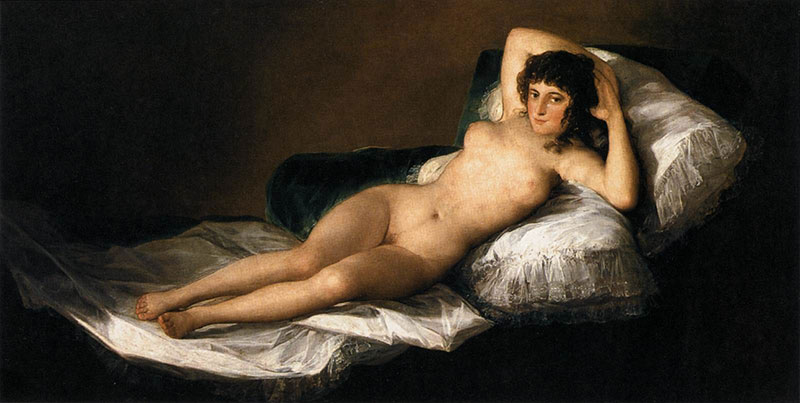
Let me give just one example of political correctness run amok in campus women’s studies in the U.S. In 1991, a veteran instructor in English and women’s studies at the Schuylkill campus of Pennsylvania State University raised objections to the presence in her classroom of a print of Francisco Goya’s famous late-18th-century painting, Naked Maja. The traditional association of this work with the Duchess of Alba, played by Ava Gardner in a 1958 movie called The Naked Maja, has been questioned, but there is no doubt that the painting, now owned by the Prado in Madrid, is a landmark in the history of the nude in art and that it anticipated major 19th-century works like Manet’s Olympia.
The instructor brought her case to a committee called the University Women’s Commission, which supported her, and she was offered further assistance from a committee member, the campus Affirmative Action officer, who conveyed her belief that there were grounds for a complaint of sexual harassment, based on the “hostile workplace” clause in federal regulations. The university, responding to the complaint, offered to change the teacher’s classroom, which she refused. She also refused an offer to move the painting to a less visible place in the classroom or to cover it while she was teaching. No, she was insistent that images of nude women must never be displayed in a classroom — which would of course gut quite a bit of major Western art since ancient Greece.
To make good use of your time in this world, think of your life above all as a quest, a seeking, a searching, a striving. For what? For the ultimate in reality, truth, value, and for their existential appropriation.
One appropriates reality by being authentic, truth by being truthful, values and norms by living them.
It may all be absurd in the end, a "tale told by an idiot, full of sound and fury, signifying nothing." But one cannot live well on the assumption that it is.
So assume that it is not and explore the question along all avenues of advance.
When macro-aggression is no more, when wrongs have been righted and justice has been promoted and protected to the extent that it can be by government, it is then that leftists invent micro-aggressions to keep themselves in business and assure themselves of an ever-expanding clientele of victims and losers.
Leftists have lost their minds. To the extent that they have willfully destroyed their own thinking capacity, they deserve our contempt and condemnation. To the extent that they have succumbed to suggestions and forces beyond their control, they deserve our pity and help. Thomas Sowell on micro-aggression. Two examples from Sowell:
If you just sit in a room where all the people are white, you are considered to be guilty of "micro-aggression" against people who are not white, who will supposedly feel uncomfortable when they enter such a room.
At UCLA, a professor who changed the capitalization of the word "indigenous" to lower case in a student's dissertation was accused of "micro-aggression," apparently because he preferred to follow the University of Chicago Manual of Style, rather than the student's attempt to enhance the importance of being indigenous.
Next stop: The Twilight Zone. Sowell's analysis:
The concept of "micro-aggression" is just one of many tactics used to stifle differences of opinion by declaring some opinions to be "hate speech," instead of debating those differences in a marketplace of ideas. To accuse people of aggression for not marching in lockstep with political correctness is to set the stage for justifying real aggression against them.
This tactic reaches far beyond academia and far beyond the United States. France's Jean-Paul Sartre has been credited — if that is the word — with calling social conditions he didn't like "violence," as a prelude to justifying real violence as a response to those conditions. Sartre's American imitators have used the same verbal tactic to justify ghetto riots.
Word games are just one of the ways of silencing politically incorrect ideas, instead of debating them. Demands that various conservative organizations be forced to reveal the names of their donors are another way of silencing ideas by intimidating people who facilitate the spread of those ideas. Whatever the rationale for wanting those names, the implicit threat is retaliation.
This same tactic was used, decades ago, by Southern segregationists who tried to force black civil rights organizations to reveal the names of their donors, in a situation where retaliation might have included violence as well as economic losses.
In a sense, the political left's attempts to silence ideas they cannot, or will not, debate are a confession of intellectual bankruptcy. But this is just one of the left's ever-increasing restrictions on other people's freedom to live their lives as they see fit, rather than as their betters tell them.
Current attempts by the Obama administration to force low-income housing to be built in middle class and upscale communities are on a par with forcing people to buy the kind of health insurance the government wants them to buy — ObamaCare — rather than leaving them free to buy whatever suits their own situation and preferences.
The left is not necessarily aiming at totalitarianism. But their know-it-all mindset leads repeatedly and pervasively in that direction, even if by small steps, each of which might be called "micro-totalitarianism."
Tommy Johnson, Canned Heat Blues, 1928. Interesting guitar work and an eerie falsetto. Sterno may light your fire but don't drink the stuff. And now you know where Canned Heat got their name.
The argument of people like Prager is that we know how Mrs. Clinton would govern if she were president: as a person of the left. In addition, she’s an ethical mess. The Trump-over-Clinton crowd also argue that Mrs. Clinton is sure to nominate Supreme Court justices that will lock in a liberal court for a generation. Trump may do that, too, but he may not. He might put an actual conservative on the Supreme Court. At least the chances of getting some good things done are better under a President Trump than a President Clinton.
I disagree with this bottom line judgment for several reasons. The first is that in considering those who run for the presidency, one needs to look beyond which candidate correctly checks the preferred policy boxes. That matters, but it’s not all that matters. And it may not even be what matters most.
Judgment, wisdom, temperament, and prudence are the most important qualities by which to evaluate a potential president. It’s obvious to me that Mr. Trump is not only temperamentally unsuited for the Oval Office; I think he’s quite dangerous—emotionally unstable, erratic, narcissistic, impulsive, cruel and vindictive. He is appealing to our darker impulses. He’s also stunningly uninformed and shallow, at least on matters of policy and philosophy. Even when running for president, he has shown no interest in even acquainting himself with the issues, let alone mastering them.
But there’s something else as well: Mr. Trump, if he were to win the presidency, would redefine the Republican Party and conservatism in ways that Hillary Clinton or Bernie Sanders never could. As president, he and the Republican Party would essentially become one. Trump and Trumpism would be definitional, and therefore discrediting. As Bret Stephens puts it:
Trumpism isn’t just a triumph of marketing or the excrescence of a personality cult. It is a regression to the conservatism of blood and soil, of ethnic polarization and bullying nationalism. Modern conservatives sought to bury this rubbish with a politics that strikes a balance between respect for tradition and faith in the dynamic and culture-shifting possibilities of open markets. When that balance collapses—under a Republican president, no less—it may never again be restored, at least in our lifetimes.
“The conservative movement can wait out a Clinton presidency intact,” added Jonah Goldberg. “A Trump presidency is a ride straight to perdition, with a capital H.”
That is where I have been and where I remain. Like other conservative commentators, I will continue to speak out against Trump during this campaign, despite the fact—and in some respects because of the fact—that he’s running as a Republican. It matters to me that he’s soiling the party of Lincoln and Reagan. I have higher expectations for my side than the other side.
I count three arguments here.
First, the argument from bad character. It is true: Trump does have a bad character, but then so does Hillary, who is an "ethical mess" as Wehner admits. Is there some algorithm by which we can compute who is worse? No. What criteria would you use? How would you weight them? Is it worse to store state secrets on a home server or to be a vulgarian who gratuitously insults women and references in public the efficacy of his primary male characteristic?
It looks to be a wash. Both are liars. And both are opportunists who quite plainly place their own personal ambitions above all else. Proof of that is that both readily change their positions when it is expedient to do so. Hillary is famous for her 'flip flops' or policy reversals. Here is a list of 20. Perhaps some of these reversals are justified. But an objective observer would have to conclude that Mrs. Clinton is not 'principled,' not rooted in carefully thought-through principles that guide her decisions. Personal ambition and the needs of the moment guide her decisions. In this respect she is surely not better than Trump. And let's not forget that she is staring at a federal indictment, which is not something that could be said of Mr. Trump. Furthermore, what has Hillary accomplished on her own? What qualifies her for the presidency? Being a woman? Trump inherited a pile, true, but he did something with it and lot of people get a paycheck because of him.
So I reject the first argument. I see no good reason to think that Trump is ethically worse than Hillary. Both are bad people. Neither is really presidential. But who else is there who is electable? Given that Trump and Hillary are equally bad character-wise, policy considerations ought to push a conservative over to the Trump camp.
Wehner's second argument is hard to make out, but it has something do with altering the Republican Party beyond recognition. But unless one's livelihood is tied to the preservation of this feckless, joke of a political party, why should anyone care about its continuance? Clearly, we don't need two left-wing parties, the liberal Republicans and the hard-left Dems. If you are headed for a cliff it is better to be riding an elephant than a jackass, but you are going over the cliff all the same.
The third argument is the Goldberg argument I refuted the other day. As I said,
Hillarious appointments to SCOTUS will damage the country irrepararably. I am told there might be as many as three.
Suppose I am becoming weaker by the day and you are becoming stronger by the day. You are my sworn enemy and I must defeat you. Does it make sense for me to wait four years to fight you?
Think about it. Can conservatism remain "intact" during four to eight more years of a hard-left administration? Yes it can — as a debating society, which is essentially what the boys in the bow ties have going. But meanwhile in the real world we will still have sanctuary cities, a flood of illegal immigrants, a.k.a. 'undocumented Democrats,' the destruction of the universities, the state assault on religious liberties . . . . While the bow tie boys talk, the country moves ever Left-ward.
I see no reason to abandon the Prager argument. Trump is bad, but Hillary is worse. Hold your nose and vote for Trump. Because Hillary is worse, abstention is not the right course.
There is more to be said. In particular, we need to discuss whether there can be a conservatism that avoids both the impotence of the go-along-to-get-along Republican establishmentarians but also does not descend into a Blut und Boden nativism that certain neo-reactionaries seems to be slouching towards.
By the way, there is something very strange about fearing a merely potential Trumpian fascism when actual left-wing fascism is being imposed upon the country by Barack Hussein Obama. Latest outrage: Obama's Transgender Edict.
I Ain't Superstitious, leastways no more than Howlin' Wolf, but two twin black tuxedo cats just crossed my path. All dressed up with nowhere to go. Nine lives and dressed to the nines. Stevie Ray Vaughan, Superstition. Guitar solo starts at 3:03. And of course you've heard the story about Niels Bohr and the horseshoe over the door:
A friend was visiting in the home of Nobel Prize winner Niels Bohr, the famous atomic scientist.
As they were talking, the friend kept glancing at a horseshoe hanging over the door. Finally, unable to contain his curiosity any longer, he demanded:
“Niels, it can’t possibly be that you, a brilliant scientist, believe that foolish horseshoe superstition! ? !”
“Of course not,” replied the scientist. “But I understand it’s lucky whether you believe in it or not.”