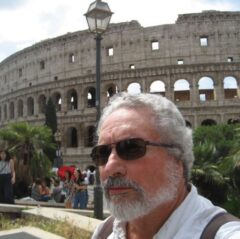
One difference between the two is that friendship is mutual: A and B are not friends unless A is B's friend, and B is A's. Not so with enmity. It suffices for A and B to be enemies that just one party be the enemy of the other.
Author: Bill Vallicella
Why Would Anyone Want to Come to the USA?
Heather Mac is a national treasure. As long as we of the Coalition of the Sane have people like her to speak for us there is hope. A taste:
But why should social-justice warriors want to subject these potential asylees to the horrors of America? In coming to the U.S., if you believe the dominant feminist narrative, the female aliens would simply be exchanging their local violent patriarchy for a new one. Indeed, it should be a mystery to these committed progressives why any Third World resident would seek to enter the United States. Not only is rape culture pervasive in the U.S., but the very lifeblood of America is the destruction of “black bodies,” in the words of media star Ta-Nehesi Coates. Surely, a Third World person of color would be better off staying in his home country, where he is free from genocidal whiteness and the murderous legacy of Western civilization and Enlightenment values.
Another Leftist Assault on Merit
New York's Bozo de Blasio goes after a great high school,
Stuyvesant High School, the crown jewel of the New York City school system.
In a better world, we wouldn’t care about the racial and ethnic composition of the Stuyvesant student body. That it’s the strongest it can be, in academic terms, would be all that mattered.
Here, for purposes of the world we actually live in, is the breakdown of the entering freshman class at Stuyvesant:
Asian — 613
White — 151
Hispanic — 27
Black — 10These numbers don’t sit well with Mayor Bill de Blasio. Interestingly, though, his son just graduated from Brooklyn Tech, another elite high school with a similar racial and ethnic balance.
De Blasio proposes to do away with the entrance exam altogether. As Richard Cohen, a liberal columnist for the Washington Post writes, this would destroy a system that “epitomized the American dream and — as [President] Trump might say — made America great.”
Is the Burqa a Mere Fashion Accessory?
William Kilpatrick:
You may look upon the wearing of the burqa as a civil rights issue, but many Muslims look upon it as key element in the Islamization process. Like the Ku Klux Klan hood or the Guy Fawkes mask, the burqa works, in part, through intimidation. Suppose a burqa clad woman (or is she a woman?) enters the bus you are riding. Do your thoughts turn to the riches of diversity, or do you begin to wonder if you just bought a bus ticket to eternity? Do you reflexively think that multiculturalism makes life more interesting, or do you think that it may be time to move to another neighborhood? Oh sure, you know that, realistically, the chances of having drawn the short straw are remote … but still.
The burqa, in short, is not just a personal fashion preference; rather, it’s one way that fundamentalist Muslims have of staking a territorial claim. Where burqas abound, sharia, no-go-zones, and virtue patrols soon follow. And non-Muslims begin to move out. So the burqa is far more than a statement of modesty. It’s a statement on the part of the Muslim community that these streets belong to us. Thus, the burqa can become an effective weapon for advancing Islamic law and culture.
Read the whole of this penetrating essay by Kilpatrick the courageous.
Man Does Not Live by Bread Alone
The recent suicide of Anthony Bourdain, celebrity chef and 'foodie,' offers food for thought. Why would so apparently successful and well-liked a man suddenly hang himself in his hotel room? One can only speculate on the basis of slender evidence, and it is perhaps morally dubious to do so.
On the other hand, not to wonder about a culture in which apparently sane and mature individuals throw away their lives on impulse is also dubious. But the problem lies deeper than culture. It lies in man's fallen nature.
It is clear to me that we are, all of us, morally sick and most of us spiritually adrift. If Bourdain had a spiritual anchor, would he have so frivolously offed himself, as he apparently did?
His 1999 New Yorker essay Don't Eat Before Reading This opens as follows:
Good food, good eating, is all about blood and organs, cruelty and decay. It’s about sodium-loaded pork fat, stinky triple-cream cheeses, the tender thymus glands and distended livers of young animals. It’s about danger—risking the dark, bacterial forces of beef, chicken, cheese, and shellfish. Your first two hundred and seven Wellfleet oysters may transport you to a state of rapture, but your two hundred and eighth may send you to bed with the sweats, chills, and vomits.
This is what good eating is all about? Seriously?
Bourdain displays the requisite decadent New Yorker cleverness, but he also betrays a failure to grasp the moral side of eating and drinking. There is first of all his moral obliviousness to the questions that divide carnivores from vegetarians, an obliviousness in evidence farther down:
Even more despised than the Brunch People are the vegetarians. Serious cooks regard these members of the dining public—and their Hezbollah-like splinter faction, the vegans—as enemies of everything that’s good and decent in the human spirit. To live life without veal or chicken stock, fish cheeks, sausages, cheese, or organ meats is treasonous.
I am taking no position at the moment on the morality of meat-eating. I am merely pointing out that there is a moral question here that cannot be dismissed — especially not with the cavalier stupidity of the quotation's final sentence.
But much more important is the moral question of gluttony.
Gluttony is a vice, and therefore a habit. (Prandial overindulgence now and again does not a glutton make.) At a first approximation, gluttony is the habitual inordinate consumption of food or drink. To consume food is to process it through the gastrointestinal tract, extracting its nutrients, and reducing it to waste matter. Now suppose a man eats an excessive quantity of food and then vomits it up in order to eat some more. Has he consumed the first portion of food? Arguably not. But he is a glutton nonetheless. So I tentatively suggest the following (inclusively) disjunctive definition:
D1. Gluttony is either the habitual, quantitatively excessive consumption of food or drink, or the habitual pursuit for their own sakes of the pleasures of eating or drinking, or indeed any habitual over-concern with food, its preparation, its enjoyment, etc.
If (D1) is our definition of gluttony, the vice has not merely to do with the quantity of food eaten but with other factors as well. The following from Wikipedia:
In his Summa Theologica (Part 2-2, Question 148, Article 4), St. Thomas Aquinas reiterated the list of five ways to commit gluttony:
- Laute - eating food that is too luxurious, exotic, or costly
- Nimis - eating food that is excessive in quantity
- Studiose - eating food that is too daintily or elaborately prepared
- Praepropere - eating too soon, or at an inappropriate time
- Ardenter - eating too eagerly.
It is clear that one can be a glutton even if one never eats an excessive quantity of food. The 'foody' who fusses and frets over the freshness and variety of his vegetables, wasting a morning in quest thereof, who worries about the 'virginity' of the olive oil, the presentation of the delectables on the plate, the proper wine for which course, the appropriate pre- and post-prandial liqueurs, who dissertates on the advantages of cooking with gas over electric . . . is a glutton.
In short, gluttony is the inordinate consumption of, and concern for, food and drink, where 'inordinate' does not mean merely 'quantitatively excessive.' It is also worth pointing out that there is nothing gluttonous about enjoying food: there is nothing morally wrong with enjoying the pleasures attendant upon eating nutritious, well-prepared food in the proper quantities.
Someone with a proper sense of values needn't go to the ascetic Augustinian extreme of viewing food as medicine. (This is not to say that fasting and other forms of prandial self-denial are not valuable and perhaps necessary from time to time.) One ought to think of food as fuel, albeit fuel the consumption of which is a source of legitimate pleasure.
We don't live to eat, we eat to live. And we don't live by bread (food) alone. Why not? Because we are not merely animals but spiritual animals whose life is not a merely animalic life but an embodied spiritual life.
There is something wrong with someone who becomes 'rapturous' (see initial quotation above) over Wellfleet oysters. It is spiritually obtuse so to secularize religious language. And it smacks — forgive the pun– of idolatry. Why not just enjoy your oysters without attribting to them transcendent meaning? Spiritual hunger cannot be sated in so gross a way.
Curiously, the attempt to do so is a sort of 'proof' that man is not a mere animal.
And please don't say that some piece of crud is to 'die for.'
Plugged In and Posting
The Big Unplug 2018
The 2018 Big Unplug starts now.
I hope to be back in about three weeks. I will be incommunicado during this period so please don't send me any e-mail or leave any comments.
Bang on the link below for a little of the 'theory' of the Big Unplug.
Sick of politics? Take a gander at Maverick Philosopher: Strictly Philosophical.
All the best to my readers!
A Similar Pattern of Argument in Buddhism and Benatar
On Buddhism the human (indeed the animalic/sentient) condition is a profoundly unsatisfactory predicament from which we need extrication. The First Noble Truth is that fundamentally all is ill, suffering, unsatisfactory, dukkha. That there is some sukha (joy, happiness) along with the dukkha is undeniable, but the little sukha is fleeting and unsatisfying and leads to dukkha which is primary. Desire breeds desire endlessly with no satisfaction being finally satisfactory. You may satisfy your sexual craving, but the satisfaction is impermanent and gives rise to further desires upon desires and temporary satings upon temporary satings which become increasingly habitual but never finally satisfactory. So not only is frustration of desire unsatisfactory, satisfaction of it is as well. Either way dukkha is the upshot. This is the deep and radical meaning of the First Noble Truth.
Now this, bhikkhus, is the noble truth of suffering: birth is suffering, aging is suffering, illness is suffering, death is suffering; union with what is displeasing is suffering; separation from what is pleasing is suffering; not to get what one wants is suffering; in brief, the five aggregates subject to clinging are suffering.
The Second Noble Truth is that suffering has its origin in desire or craving (tanha). The natural pursuit and possession of the ordinary objects of desire such as name and fame, pleasure and pelf, property and progeny, power and position all breed attachment, and this attachment breeds misery. Why? Because the ordinary objects of desire are impermanent (anicca) and insubstantial (anatta). They lack the power to satisfy us. Desire or craving (tanha) drives us to cling to the fleeting and unreal that cannot last and cannot ultimately satisfy. In this sense sukha, which is derivative, leads to dukkha which is primitive and fundamental.
Now this, bhikkhus, is the noble truth of the origin of suffering: it is this craving which leads to re-becoming, accompanied by delight and lust, seeking delight here and there; that is, craving for sensual pleasures, craving for becoming, craving for disbecoming.
Should we then re-direct desire to what is permanent and possesses self-nature, God for example? You would think so, right?
No!
For on original, radical, Pali Buddhism nothing is permanent and nothing possesses self-nature. All is impermanent and insubstantial. This is the nature of things and cannot be otherwise. The task cannot be to re-direct desire to the Eternal in the manner of a Christian Platonist such as St. Augustine who turns away from this deceitful world of time and change and misery and seeks salvation in God. The problem is desire itself, not mis-directed desire. The task, then, must be to uproot desire. The task is to step off of the wheel of samsara and achieve cessation or nirvana.
Now this, bhikkhus, is the noble truth of the cessation of suffering: it is the remainderless fading away and cessation of that same craving, the giving up and relinquishing of it, freedom from it, non-reliance on it.
How do we extirpate desire and end our delusive attachment to the insubstantial and unreal and unsatisfactory?
Now this, bhikkhus, is the noble truth of the way leading to the cessation of suffering: it is this noble eightfold path; that is, right view, right intention, right speech, right action, right livelihood, right effort, right mindfulness, right concentration.
Critical Question
How can the entire samsaric realm, including us and the manifold objects of our desire, be devalued relative to a nonexistent and indeed impossible standard? If nothing is permanent and nothing can be permanent how can impermanence be a negative axiological feature of what alone exists? And if nothing is and can be a self or substance, how is it any argument against samsaric items that they are devoid of self-nature?
I am assuming that there cannot be impossible ideals. Either an ideal is realized or it is not. If the former, then it is possible. If the latter then it must be realizable. Ideals must be realizable if they are to be ideals. What is realizable is possible. So if permanence is an ideal, then it must be possible. But it is not possible on early Buddhist principles. So it is not an ideal. Since it is not an ideal, nothing samsaric falls short of it. It follows that ordinary objects of desire cannot, all of them, be unsatisfactory on the ground of their impermanence.
To appreciate my point, suppose God as classically conceived exists. Think of the God of Augustine and Aquinas. He is permanent, a self (in excelsis) and absolutely and finally satisfying to himself and to those who share his life. If such a God exists, then it makes perfect sense to consider of lower or even of no value the objects of ordinary mundane desire such as money and property and the paltry pleasures of the flesh.
The great Spanish mystic, St. Teresa of Avila, is supposed to have said to the nuns in her care, "Sisters, we have but one night to spend in this bad inn."
To liken the world to a bad inn makes sense as a claim purporting to be objectively true only if there is a heavenly home to which it is possible to go. But if there is no God, no soul, and this life is all there is, then this world of time and change cannot be objectively assessed to be of little or no value. Any such assessment could then be subjective only, and if Nietzsche is right, a slandering of life that merely reflects the physiological decadence of the sick slanderers who are too sick to face reality and must in compensation invent hinterworlds.
As Nietzsche remarks in Twilight of the Idols, in the section entitled "The Problem of Socrates," if there is no true world, then there is no merely apparent world either : this world objectively lacks plenary reality and value and is rightly assessed as lacking such only if there is a true world it falls short of.
I spoke to a hermit monk a couple of summers ago. I said, "This world is a vanishing quantity." He agreed wholeheartedly, having abandoned a millionaire's life as a super-successful Wall Street bond trader for the austerities of a monkish, and indeed eremitic, existence with its vows of poverty, chastity, and obedience. But my assertion and his agreement could make no sense as an objective negative appraisal of the reality and value of this world except on the assumption that there is an Unseen Order that is not impermanent to its core, but the opposite, the source of all intelligibility, reality, and value, and the summum bonum, the highest good, of human striving. And if the assumption is true, then the negative appraisal is true.
A Similar Pattern in Benatar
One source of David Benatar's anti-natalism is his conviction that human life, on balance, is objectively bad for all despite how well-placed one is. There is some good, of course, but the bad so preponderates that it is morally wrong to perpetuate this life by procreation. But the standards and ideals Benatar invokes to show the objectively bad quality of human life are impossible as I try to show in this preliminary draft. My thought is that to fall short of an impossible standard is not to fall short. Benatar's radical pessimism and anti-natalism do not comport well with his naturalism.
To this extent my critique of Pali Buddhism and of Benatar is 'Nietzschean.' Impossible standards do not permit a devaluation of what actually exists.
But I share Nietzsche's naturalism and atheism as little as I share Benatar's. And of course I reject Nietzsche's psycho-physiological reductionism: the deep sense of philosophers and sages from time immemorial that this life is no good cannot be dismissed as a merely subjective response of the sick and decadent. Thus a No to Nietzsche's reading of Phaedo 118:
Concerning life, the wisest men of all ages have judged alike: it is no good. Always and everywhere one has heard the same sound from their mouths — a sound full of doubt, full of melancholy, full of weariness of life, full of resistance to life. Even Socrates said, as he died: "To live — that means to be sick a long time: I owe Asclepius the god of healing a rooster." Even Socrates was tired of it. [. . .] "At least something must be sick here," we retort.
If the appearance of life's low quality is real, because life falls short of the ideal, then the ideal must itself be real — elsewhere, not here below, but in the Unseen Order.
Rachel Dolezal Up Against the Limits of Self-Construction
Is there anything about a person that lies beyond his power to self-identify, self-interpret, self-construe? Well, obviously, yes: that one is a person and a self in the first place with the power to identify as this or that is not a matter of self-identification. I cannot identify myself into existence or into selfhood. I cannot increase my powers by any process of self-identification. I may like the idea of being a necessary being, but I cannot slough off my contingent modal status by any self-construction. And of course the same goes for sex and race. Not even God could bring himself into existence by pretending to exist or by identifying as existent. And the same goes for the divine nature, unless you are a radical theological voluntarist who thinks that God is sovereign over his own nature.
And yes, Dolezal has been charged with welfare fraud if you can believe The New York Times.
Related:
Rachel Dolezal, The Black White Woman. I make a mistake at the end of this post that I will now correct. I represent Elizabeth Warren as the author of Pow Wow Chow when in fact she is merely a contributor to that by-now-famous recipe book. Her contribution, however, a recipe for lobster bisque — Cherokees were into haute cuisine? — was plagiarized!
Elizabeth Warren could be called the Rachel Dolezal of American politics. Never forget that Warren is a fraud. It is a known fact that she is not of Cherokee ancestry.
Happy Birthday, Bob
Bob Dylan turns 77 today. Scott Johnson offers two fine columns in celebration.
Thanks, Bob, for all the music and all the memories, and for your wonderfully individual and self-reliant appropriation and celebration of Americana. It wouldn't have been the long strange trip it's been without you. May you die with your boots on.
Not Dark Yet (the 1997 lament)
How Much Socialism is There in Cultural Marxism?
It is a mistake to confuse 'classical' Marxism with cultural Marxism.
The former is characterized by the labor theory of economic value; the call for the abolition of private property; collective ownership of the means of production, i.e., socialism in the strict sense of the term; historical materialism (HISTOMAT) and dialectical materialism (DIAMAT); belief in objective truth (see V. I. Lenin); the Hegel-inspired belief that history is being driven in a definite direction by an in-built nisus towards a secular eschaton*, in the case of Marx & Co., the dictatorship of the proletariat and the classless society . . . You know the drill.
But as Paul Gottfried points out, cultural Marxism is a horse of a different color. In particular, it is not usefully or reasonably labelled socialist. Gottfried's insights (in this article) need to be taken on board, not that I agree with everything the man says elsewhere.
____________________
*A really deep understanding of secular eschatology such as we find it in Marx requires a critical retrieval of Christian eschatology. Please forgive my 'critical retrieval.' Back in old Boston town, in the early-to-mid-seventies, I was a bit of a Continental philosopher. I sipped a little of the Leftist Kool-Aid, but never got drunk on it, despite all the Habermas, Horkheimer, and Adorno I read. Gott sei dank!
Perhaps I can thank Heidegger for saving me. My intense occupation with his writings and his Seinsfrage drove me back to Aquinas for the onto-theological approach to Being and to Frege and the boys for the logical approach.
Political Circularity
The Democrats, under party discipline, circle the wagons.
The Republicans, with their obstructionist 'mavericks,' form a circular firing squad.
The Libertarians, bent on irrelevance, engage in a 'circle jerk.'
Joseph Sobran: Notes for the Reactionary of the Future
Don't be put off by the title.
This essay, which William F. Buckley published in December, 1985 in National Review, is bristling with insights and distinctions essential for clear thinking about political matters. (HT: Malcolm Pollack)
The late Lawrence Auster offers a sympathetic but critical perspective.
I'm very busy now. Commentary on Sobran's dazzling essay will have to wait.
Related: Lawrence Auster on Dylan
Is the Pope Catholic?
McCain the ‘Maverick’
The Democrat leadership knows how to enforce party discipline, and their members toe the line and vote as a bloc. The Republicans, however, include mavericks, the most prominent of them being Senator John McCain of Arizona:
It’s become a cliché to label McCain a “maverick” for his dramatic, and increasingly frequent, breaks with the Republican Party line. But it’s a cliché because the label fits: Over nearly four decades in Washington, McCain has given a master class in maverickism, and it is for this he will be most remembered. So it is fitting, perhaps that the inveterate fighter is taking on Trump—another Republican politician who rose by bucking GOP orthodoxy—in his final battle, and bequeathing to the nation a bookful of advice on how to be the right kind of maverick. To Trump, McCain writes in his new memoir, The Restless Wave: Good Times, Just Causes, Great Fights and Other Appreciations, the mere appearance of toughness “seems to matter more than any of our values.” He suggests the president is jeopardizing those values by undermining the free press with regular accusations of “fake news”—a tactic “copied by autocrats,” McCain writes—supporting torture, branding immigrants criminals and opening the door to moral equivalence with Vladimir Putin by saying, “We have a lot of killers too.” That, McCain writes, “was a shameful thing to say, and so unaware of reality.”
The problem congressional mavericks can pose is well-illustrated by McCain's slanderous, ill-considered, and personally-motivated attack on Donald Trump. Trump was elected to push a populist, Jacksonian agenda; instead of getting with the program, McCain plays the obstructionist, objecting like a Democrat, talking like a liberal, while the opposition party maintains a unified front. This is why true conservatives consider it a good thing, not that he is dying, but that will no longer be able to obstruct.
I wonder if the typical liberal can understand the distinction I just invoked. Probably not, in this Age of Feeling.
Suppose someone is a serious impediment to your flourishing. You will want his opposition, interference, harassment to stop. Should the opponent die, then his opposition will stop. If the person dies you can legitimately take satisfaction in the cessation of his wrongful and petty opposition without taking satisfaction in his dying. And that is what you ought to do, difficult as it is to avoid all Schadenfreude on the death of an enemy.
As for McCain's slanders, the worst of the ones mentioned above is the egregious falsehood that Trump "brands immigrants criminals." This is a constantly repeated leftist smear. That McCain would repeat it is appalling. Anyone with a modicum of intelligence and decency would understand Trump to have said that some illegal immigrants are criminals, which is certainly true, and an additional reason why the nation's borders must be secured. But McCain hates the president and his hate blinds him. I understand why the former hates the latter, but the fact remains.
I'll finish this later. It is 4:50 AM. I have already this morning written philosophy in my journal from 2:00 to 3:30; done my spiritual exercises from 3:30 to 4:10, eaten a little breakfast, two rice cakes smeared with jam and almond butter, drunk two cups of seriously strong java, and uploaded this entry to my blog. It is now first light and time to hit the trails before Old Sol becomes too uppity.
The strenuous life is best by test.