
Truth and Falsity from a Deflationary Point of View

The following equivalence is taken by many to support the deflationary thesis that truth has no substantive nature, a nature that could justify a substantive theory along correspondentist, or coherentist, or pragmatic,  or other lines.  For example, someone who maintains that truth is rational acceptability at the ideal (Peircean) limit of inquiry is advancing a substantive theory of truth that purports to nail down the nature of truth.  Here is the equivalence:

1)  <p> is true iff p.

The angle brackets surrounding a declarative sentence make of it a name of the proposition the sentence expresses. For example, <snow is white> –  the proposition that snow is white — is true iff snow is white. (1) suggests that the predicate ' ___ is true' does not express a substantive property.  We can dispense with the predicate and say what we want without it. It suggests that there is no such legitimate metaphysical question as: What is the nature of truth?  Having gotten rid of truth, can we get rid of falsity as well?

A false proposition is one that is not true.  This suggests that 'false,' as a predicate applicable to propositions and truth-bearers generally, is definable in terms of 'true' and 'not.' Perhaps as follows:

2) <p> is false iff <p> is not true.

From (2) we may infer

2*) <p> is false iff ~(<p> is true)

and then, given (1),

2**) <p> is false iff ~p.

This suggests that if we are given the notions of 'proposition' and 'negation,' we can dispense with the supposed properties of truth and falsity. (1) shows us how to dispense with 'true' and (2**) show us how to dispense with 'false.'

But we hit a snag when we ask what 'not' means.  Now the standard way to explain the logical constants employs truth tables. Here is the truth table for the logician's 'not' which is symbolized by the tilde, '~'.
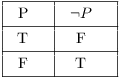
$$\vbox{\offinterlineskip \halign{& \vrule # & \strut \hfil \quad # \quad \hfil \cr \noalign{\hrule} height2pt & \omit & & \omit & \cr & P & & $\lnot P$ & \cr height2pt & \omit & & \omit & \cr \noalign{\hrule} height2pt & \omit & & \omit & \cr & T & & F & \cr height2pt & \omit & & \omit & \cr \noalign{\hrule} height2pt & \omit & & \omit & \cr & F & & T & \cr height2pt & \omit & & \omit & \cr \noalign{\hrule} }} $$

But now we see that our explanation is circular. We set out to explain the meaning of 'false' in terms of 'not' only to find that 'not' cannot be explained except in terms of 'false.' We have moved in a circle.

The Ostrich has a response to this:

. . . we can define negation without reaching for the notions of truth and falsity. Assume that the notion of ‘all possible situations’ is coherent, and suppose it is coherent for any proposition ‘p’ to map onto a subset of that set. Then ‘not p’ maps onto the complement. The question is whether the very idea of a complement of a subset covertly appeals to the concept of negation. But then that suggests that negation is a primitive indefinable concept, rather than what you are claiming (namely that it is truth and falsity which are primitive).

So let's assume that there is a set S of possible worlds,and that every proposition (except impossible propositions)  maps onto to an improper or a proper subset of S. The necessary propositions map onto the improper subset of S, namely S itself. Each contingent proposition p maps onto a proper subset of S, but a different proper subset for different propositions. If so, ~p maps onto the complement of the proper subset that p maps onto.  And let's assume that negation can be understood in terms of complementation.

The most obvious problem with the Ostrich response is that it relies on the notion of a proposition. But this notion cannot be understood apart from the notions of truth and falsity.  Propositions are standardly introduced as the primary vehicles of the truth-values. They alone are the items appropriately characterizable as either true or false. Therefore, to understand what a proposition is one must have an antecedent grasp of the difference between truth and falsity. 

To understand the operation of negation we have to understand that upon which negation operates, namely, propositions, and to understand propositions, we need to understand truth and falsity.

A second problem is this. Suppose contingent p maps onto proper subset T of S.  Why that mapping rather than some other? Because T is the set of situations or worlds in which p is true . . . . The circularity again rears its ugly head.

The Ostrich, being a nominalist, might try to dispense with propositions in favor of declarative sentences. But when we learned our grammar back in grammar school we learned that a declarative sentence is one that expresses a complete thought, and a complete thought is — wait for it — a proposition or what Frege calls ein Gedanke: not a thinking, but the accusative of a thinking. 

Truth and falsity resist elimination.

Language Rant: Verbal Inflation and Deflation

The visage of Jeff Dunham's 'Walter' signals the onset of a language rant should you loathe this sort of thing.

WalterWhy use ‘reference’ as a verb when ‘refer’ is available? Why not save bytes? Why say that Poindexter referenced Wittgenstein when you can say that he referred to the philosopher? After all, we do not say that X citationed Y, but that X cited Y. (And please don’t confuse ‘site,’ ‘sight,’ and ‘cite.’)

You will not appear learned to the truly learned if you use ‘reference’ as a verb; you will appear pseudo-learned or pretentious. Of course, if enough people do it, it will become accepted. But what is accepted ought not be confused with the acceptable in the normative sense of the latter term. Admittedly, using ‘reference’ as a verb is no big deal. But it is uneconomical, and linguistic bloat, like other forms, is best avoided. This rule, like all my rules and recommendations, is to be understood ceteris paribus. Thus there may be an occasion on which a bit of bloat is what is needed for some rhetorical purpose. Good writing cannot be reduced to the mechanical application of a set of rules. You won’t find an algorithm for it. Language Nazis like me need to remind ourselves not to become too pedantic and persnickety.

Curiously enough, the same people who are likely to engage in verbal inflation will also fall for the opposite mistake. They will speak of Nietzsche quotes when they mean Nietzsche quotations. ‘Quote’ is a verb; ‘quotation’ a noun. ‘Nietzsche quotes’ is a sentence; ‘Nietzsche quotations’ is not. Perhaps I should be grateful that no one, so far, has used ‘quotation’ as a verb: Poindexter referenced Nietszche in his footnotes, and quotationed him in his text.

Now consider ‘criticize,’ ‘criticism,’ and ‘critique.’ One verb and two nouns. Don’t say: She critiqued my paper; say she criticized it. And don’t confuse a criticism with a critique. A correspondent once made a pusillanimous criticism of an article of mine, but referred to it as a critique. That’s a case of objectionable verbal inflation.

On a more substantive note, realize that to criticize is not to oppose or contradict, but to sift, to assay, to separate the good from the bad, the beautiful from the ugly, the true from the false, the demonstrated from the undemonstrated and the indemonstrable.

Note also that the Left does not own critique. There is critique from the Right, from the Left, and from the Middle. Resist the hijacking of semantic vehicles. We need them to get to the truth, which is not owned by anyone.

Excluded Middle, Presentism, Truth-Maker: An Aporetic Triad

Suppose we acquiesce in the conflation of Excluded Middle and Bivalence.  The conflation is not unreasonable.  Now try this trio on for size:

Excluded Middle: Every proposition is either true, or if not true, then false.
Presentism: Only what exists at present, exists.
Truth-Maker: Every contingent truth has a truth-maker.

The limbs of the triad are individually plausible but collectively inconsistent. Why inconsistent?

I will die. This future-tensed sentence is true now. It is true that I will die. Is there something existing at present that could serve as truth-maker? Arguably yes, my being mortal. I am now mortal, and my present mortality suffices for the truth of 'I will die.' Something similar holds for my coat. It is true now that it will cease to exist.  While it is inevitable that I will die and that my coat will cease to exist, it is not inevitable that my coat will be burnt up (wholly consumed by fire).  For there are other ways for it to cease to exist, by being cut to pieces, for example, or by just wearing out.

By 'future contingent,' I mean a presently true future-tensed contingent proposition.  The following seems to be a clear example: BV's coat will sometime in the future cease to exist by being wholly consumed in a fire. To save keystrokes: My coat will be burnt up.

By Excluded Middle, either my coat will be burnt up or my coat will not be burnt up. One of these propositions must be true, and whichever one it is, it is true now. Suppose it is true now that my  coat will be burnt up. There  is nothing existing at present that could serve as truth-maker for this contingent truth.  And given Presentism, there is nothing existing at all that could serve as truth-maker.  For on Presentism, only what exists now, exists full stop.  The first two limbs, taken in conjunction, entail the negation of the third, Truth-Maker.  The triad is therefore inconsistent.

So one of the limbs must be rejected. Which one?

An Objection

You say that nothing that now exists could serve as the truth-maker of the presently true future-tensed  contingent proposition BV's coat will be burnt up. I disagree.  If determinism is true, then the present state of the world together with the laws of nature necessitates every later state.   Assuming the truth of the proposition in question, there is a later state of the world in which your shabby coat is burnt up. The truth-maker of the future contingent proposition would then be the present state of the world plus the laws of nature.  So if determinism is true, your triad is consistent, contrary to what you maintain, and we will not be forced to give up one of the very plausible constituent propositions.

Question: Is there a plausible reply to this objection? No. I'll explain why later.

The State of the Union

President Trump gave a great speech last night. I agree with Malcolm Pollack's commentary.

Obviously you can’t please everyone, and there will be many of us who will take issue with some of what Mr. Trump put forward last night. (In particular, I think he is far too enthusiastic about increasing legal immigration, for reasons I won’t go into here.)

That excess of enthusiasm struck me as well, for reasons I too won't go into now.  I have plenty to say in my Immigration category.

Excluded Middle, Bivalence, and Disquotation

LEM: For every  p, p v ~p.

BV: Every proposition is either true or false.

These principles are obviously not identical.  Excluded Middle is syntactic principle, a law of logic, whereas Bivalence is a semantic principle. The first says nothing about truth or falsity. The second does. (See Michael Dummett, Truth and Other Enigmas, Harvard UP, 2nd ed. , 1980, p. xix; Paul Horwich, Truth, Oxford UP, 2nd ed., 1998, p. 79) Though not identical they might nonetheless be logically equivalent.  Two propositions are logically equivalent iff each entails the other.  Entailment is the necessitation of material implication. Can it be shown that (LEM) and (BV)  entail each other? Let's see.

The logical equivalence of the two principles can be demonstrated if we assume the disquotational schema:

DS: p is true iff p.

For example, snow is white is true iff snow is white. Or, if you insist, 'snow is white' is true iff snow is white. In the latter forrmulation, which does not involve reference to propositions, the truth predicate  — 'is true' — is merely a device of disquotation or of semantic descent. On either formulation, 'is true' adds no sentential/propositional content:  the sentential/propositional content is the same on both sides of the biconditional.  The content of my assertion is exactly the same whether I assert that snow is white or I assert that snow is white is true.  But if (DS) is granted, then so is:

DS-F: p is false iff ~p.

For example, snow is white is false iff ~(snow is white).    

Now if the disquotational schemata exhaust what it is to be true and what it is to be false, then (LEM) and (BV) are logically equivalent.

Given (DS) and (DS-F), we can rewrite (LEM) as

LEM-T: For every p, p is true v p is false.

Now (LEM-T) is simply a restatement of (BV). The principles are therefore logically equivalent given the disquotational schemata. 

But this works only if falsehood can be adequately explained in terms of the merely logical operation of negation.  This will NOT work if negation can only be explained in terms of falsehood.  For then we would enter  an explanatory circle of embarrassingly short diameter. 

Ask yourself: when is one proposition the negation of another? The negation of p is the proposition that is true iff p is false and false iff p is true.  To explain the logico-syntactic notion of negation we have to reach for the semantic notions of truth and falsehood.  But then falsehood cannot be exhaustively understood or reduced to negation.

It is telling that to explain negation and the other logical connectives we use TRUTH tables.  Such explanation is satisfactory.  But it would not be if the redundancy or disappearance or disquotational schemata gave the whole meaning of 'true' and 'false.'  (The point is made by M. Dummett, Truth and Other Enigmas, p. 7)

I take this explanatory circle to show that there is more to truth and falsehood than is captured in the above disquotational schemata.

Conclusion: if one's reason for accepting the logical equivalence of (LEM) and (BV) is (DS) then that is a bad reason.

Are there counterexamples to (DS)?  It seems to fail right-to-left if 'Sherlock Holmes is a detective' is plugged in for 'p' on the RHS of (DS).  Arguably, Holmes is a detective, but it is not true that Holmes is a detective.  For it to be true that Holmes is a detective, 'Holmes' would have to refer to something that exists.  But this requirement is not satisfied in the case of purely fictional items.  I am assuming that veritas sequitur esse, that truth 'follows' or supervenes upon being (existence):

VSE:  There are no true predications about what does not exist.

Since Holmes does not exist, 'Holmes is a detective' appears to express a proposition that is neither true nor false. Likewise for its negation, 'Holmes is not a detective.'  (LEM) is not violated since either Holmes is a detective or Holmes is not a detective. But (BV) is violated since the two Holmes propositions are neither true nor false.

It is worth noting that from 'Only propositions have truth-values' one cannot validly infer 'All propositions have truth-values.'  

Proof that I am a Native American

A while back a front page story in the  local rag of record, The Arizona Republic, implied  that one is either a native American, a black, or an Anglo. Now with my kind of surname, I am certainly no Anglo. And even though I am a 'person of color,' my color inclining toward a sort of tanned ruddiness, I am undoubtedly not black either.

It follows that I am a native American. This conclusion is independently supported by the following argument:

1. I am a native Californian.
2. California is in America.
3. If x is native to locality L, and L is within the boundaries of M, then x is a native M-er.
Therefore
4. I am a native American.

This argument is impeccable in point of logical form, and sports manifestly true premises. What more do you want?

Note that (2) is true whether 'America' is taken to refer to the USA or to the continent of North America.

Let us also observe that since I am a native American, it cannot be the case that "we are all immigrants" as far too many 'liberal' knuckleheads like to claim.

We need more mockery of 'liberals.' There is little point in attempts to engage them on the plane of reason, for that is not the plane they inhabit.

Slavoj Zizek remarks (jokingly I think) that  ‘native Americans’ hate this term, mentioning one who preferred to be call an ‘Indian’ on the ground that ‘native’ American is racist. For it means that someone so denominated  is part of nature, and is therefore beneath the cultural American. The Indian in question prefers to be called an ‘Indian’ for this moniker implies the white man's stupidity.

Saturday Night at the Oldies: Metals and Mining

Springfields, Silver Threads and Golden Needles

Neil Young, Heart of Gold

Connie Francis, Oh My Darling Clementine

Lee Dorsey, Working in a Coal Mine

Marty Robbins, That Silver-Haired Daddy of Mine

Joan Baez, Silver Dagger

Miranda Lambert, Gunpowder and Lead

James Taylor, Copperline

Allman Bros., Silver Dollar

Bob Dylan, Cold Irons Bound

YouTuber comments:

There's something about not having a perfect voice that lends so much authenticity, sincerity and soul to a particular song. Dylan has it, Leonard Cohen, Tom Waits, Janis Joplin, Kris Kristofferson, Johnny Cash, Willie Nelson, John Prine, Shane McGowan, Billie Holiday and yeah — even Dean Martin….none are perfect — yet, they are legends. Ha. Because there's a thrill factor to it all. This is one of Dylan's best…this is rock and roll. Don't forget the word "roll" at the end. That guarantees it's the real thing. (There are other singers too…I can't list them all).

Amazing! The concentrated precision on their faces, every note delivered on time, These guys are so tight makes my teeth hurt. Accompanying the most enigmatic, musical artist on the planet, and doing it with grace and style. Of the hundred times I've watched this video masterpiece a percentage has been just for the ending. After the last chord stops reverberating (I can't help but read into the moment) a small but enthusiastic applause breaks out there is a look of enjoyment on their faces, an understated sense of accomplishment. Something has happened here. Something greater than the sum of it's parts.

READERS' RECOMMENDATIONS (2/3)

Keith Richards, You Got the Silver

Loretta Lynn, Coal Miner's Daughter.  This one goes out to Hillary Clinton.

Bill Mize, The Silverplume Waltz. Great solo acoustic guitar.

The Eagles, Silver Dagger

Joan Baez, Silver Dagger (live)

Is the Philosophical Life the Best?

This from a reader:
I have a concern about the philosophical life. While I do think philosophy is intrinsically valuable, and while I do deny that one is obligated to "do the most good" with one's life (I'm not a consequentialist), I wonder if there are better ways to live than to devote one's life to philosophy. Prima facie, devoting one's life to solving global poverty or curing cancer seems better than focusing on philosophy. If so, then even if one isn't obligated to solve global poverty or cure cancer, why not devote one's life to these causes instead?
 
Perhaps the philosophical life is better than these other options, but that isn't clear to me. It seems more plausible that, all things being equal, a life that saves countless lives is better lived than a life that doesn't save a single life. Again, I'm not saying we're obligated to save lives, I'm just making a comparative judgment.
I can't refute what you say, but I can offer an alternative point of view.  If you consider it, it may help you better understand your own point of view even if it does not motivate any modification of it.
 
One question concerns the best life humanly possible.  Aristotle discussed it in his Nicomachean Ethics. He considered lives devoted to pleasure, material acquisition, politics, and philosophy. I set forth his answer here.
 
But the best life possible for humans might not be the best life  for a particular human.  Whether or not the best life is the philosophical life, not everyone is 'philosophy material.'
 
Philosophy is a vocation, and only some are called to it. (I am speaking in ideal terms here: what passes for 'philosophy' in the 'universities' falls far short of the ideal.)
 
The best life for you will depend on your aptitudes, values, and worldview.   Everyone has a worldview of sorts even if unexamined and unarticulated.  Suppose your outlook is broadly secular.   And suppose you find secularism obvious.  Then you will not be inclined to question it and will have no need for philosophy.  You have 'your truth,' a worldview you believe is true, and therefore feel no need to investigate whether it is true in whole or in part.  Doubt is the engine of inquiry, but you have no doubts. For you philosophical inquiry would be idle.  You would be left cold by the Socratic, "The unexamined life is not worth living."
 
And if the people you associate with share your tacit worldview, then you will have no need to articulate and defend it.  The existence of competing worldviews might trouble you or then again it might not. You might be the sort of person who is not disturbed or given pause by the disagreement of others.
 
For me, disagreement is a goad to inquiry. I have a consuming need to know. And a life lived without examination is definitely worth little or nothing. Such a life remains on the animal level. A human life, speaking normatively, is a transcending life, a life of self-transcendence and aspiration.
 
Primum vivere deinde philosophari.  I agree. We must live and live fully to gather the grapes of experience from which to press the wine of wisdom.  We don't gather grapes to gather grapes, but for the wine. The vita activa subserves the vita contemplativa.
 
You say it is not clear to you that the philosophical life is superior to, say, cancer research.  Then I say you should leave philosophy alone.  The quest for the ultimate truth about the ultimate matters is the highest calling and it demands total commitment.  I can argue for this conviction, but I can't prove it, and I will persuade only those who already sense its truth.
 
In the early '80s I heard a speech by the American politician, Mario Cuomo, in which he touted the political life as the highest life. I thought to myself: "He can't really believe that!"  But I soon concluded  that he did believe it.  I can give my reasons why Cuomo is wrong, but these reasons, which suffice for me, will make no impression on those who think the political life the highest. (To me, politics is like taking out the garbage or unplugging the toilet: it's a dirty job and it has to be done and done properly; in an ideal world, however, there would be no State and no need for politicians. As things are, our fallen predicament makes the State  practically necessary, a necessary evil, along with its agents.)
 
My advice is, first of all, know thyself.  Having honestly assessed your abilities, do with your life what you think is the best, and what you are fit to do.
 
I realize that this advice is of very little practical value.  Listen to others, but keep your own counsel, and follow the urgings vouchsafed to you in the highest moments of existential clarity and discernment.

Is the Unexamined Life Worth Living?

Written in October of 2004.

Norman PodhoretzI recently read Norman Podhoretz's Ex-Friends: Falling Out with Allen Ginsberg, Lionel and Diana Trilling, Lillian Hellman, Hannah Arendt, and Norman Mailer (The Free Press, 1999). It is an enjoyable and stimulating analysis of the breakdown of friendship in the crucible of political disagreement. I recommend it.

But an early passage inspired me to fire up the old Pentium II. Describing "most people," Podhoretz says that "The ideas that underlie their way of life are mostly taken for granted and remain unexamined – luckily for them, since the biggest lie ever propagated by a philosopher was Socrates’ self-aggrandizing assertion that the unexamined life is not worth living." (p. 4)

Can a philosopher let this passage pass unexamined? The first thing that raised my critical hackles is the irresponsible use of the word ‘lie,’ a use that is unfortunately widespread these days. Does Podhoretz really mean to suggest that Socrates was lying when he made his famous statement at his trial? Does he mean to imply that the great Athenian knew the truth, but was bent on deceiving us? Of course not. Podhoretz knows that one can utter a falsehood without lying, as when one says what one believes to be true but is not true, and I am sure that he appreciates that Socrates was sincere in his belief that the unexamined life is not worth living. Charitably interpreted, Podhoretz is opining that Socrates was wrong in his belief, not that he was lying.

A second thing to question is whether the Socratic assertion is "self-aggrandizing." If I praise a certain way of life that happens to be my way of life, it does not follow that I praise this way of life simply because it happens to be mine. For there is also the possibility that I praise this way of life because I have objective reasons to believe that it is a good way of life, and that I have chosen it for these objective reasons. In the second case, the life is mine because I have objective grounds for praising it, not praised because it is mine. Only in the first case would we speak of Socrates’ assertion as self-aggrandizing. Given that Podhoretz has provided no evaluation of the Socratic reasons for the Socratic assertion, he is not justified in describing the latter as "self-aggrandizing."

But the main issue is this: Is an unexamined life worth living? If my way of life happens to be good, then one might argue that it is good whether I examine it or not, whether I can give objective reasons for its goodness or not. (Compare: if my roof is in good condition, it is so whether I examine it or not. It is no part of my roof’s being in good condition that it, or someone, know that it is in good condition or that it, or someone, raise the question of its condition.) In this sense, an unexamined life could very well be worth living. But a human life is not merely a biological process, but essentially involves the exercise of (not merely the capacity for) emotion, will, and reason. Thus no ‘fully human life’ (an unabashedly normative phrase used unabashedly!) is possible without the exercise of reason upon the ultimate objects, among which is one’s own life, its whence, whither, and wherefore. A fully human life, as a life necessarily involving the exercise of reason, requires the examination of such questions as how we should live. To live thoughtlessly, uncritically, without consideration of ultimates and without consideration of alternative ways of living – there is indeed something  contemptible about this,assuming that the person is in a position to conduct the examination. To that extent, Socrates was surely right, and Podhoretz is surely wrong.

But Socratic self-examination implies no rejection of traditional ways of life. Perhaps lurking in the background of Podhoretz’s mind is some such argument as this: (1) Socratic self-examination leads to the rejection of traditional mores; (2) traditional mores are sound; ergo, (3) Socratic self-examination is a mistake. I hope this is not the way Podhoretz is thinking, given the falsity of (1). Socratic examination may lead to the rejection of traditional mores, but it might also lead to their rational defense.

Excluded Middle, Bivalence, and Tertium Non Datur

Dave Gudeman comments:

I was surprised to see you distinguishing between bivalence and the LEM. As far as I can tell, in the traditional and most common formulations, they are identical.

Here is the way I understand it.  They are not identical.  Excluded Middle is a law of logic, whereas Bivalence is a semantic principle. (See Michael Dummett, Truth and Other Enigmas, Harvard UP, 2nd ed. , 1980, p. xix; Paul Horwich, Truth, Oxford UP, 2nd ed., 1998, p. 79) If 'p' is a place-holder for a proposition, any proposition, then Excluded Middle is:

LEM. p v ~p.

If 'p' is a propositional variable, and we quantify over propositions, then we have the universal quantification

LEM*. For all p, p v ~p.

It is understood that the wedge in the above formulae signifies exclusive disjunction. Why is that understood? Because both p and not-p is excluded by the Law of Non-Contradiction:

LNC. ~(p & ~p).  

If I may be permitted parenthetically to wax poetic in these aseptic precincts, (LNC) possesses a 'dignity' in excess of that possessed by (LEM). What I mean is that there are some fairly plausible counterexamples to (LEM), but none that are very plausible to (LNC).  Few philosophers are dialetheists; many more accept truth-value gaps.

The laws of logic are purely formal: they abstract from content or meaning. They are syntactic principles. Bivalence, by contrast, is a semantic principle. It goes like this:

BV. Every proposition is either true or false.

Tertium non datur means that a third is not given: there is no third truth value.  (TND) is also a semantic principle:

TND. No proposition is neither true nor false.

So the difference between (LEM) and (BV) is that the first is a syntactic principle and the second a semantic principle. But is this a difference that makes a difference? Is there a conceivable case where (LEM) is true but (BV) false?  I don't know the answers to these questions. Either that or I forgot them.

But if you conflate the two principles,  then you are in good company. W. V. O. Quine, Mathematical Logic, Harvard UP, 8th ed., 1976, p. 51: ". . . the law of excluded middle, which is commonly phrased as saying that every statement is either true or false . . . ."