More on Hylomorphic Dualism and the Distinctness of Souls Post Mortem

Edward Feser writes,

Hey Bill, many thanks for your Substack post on Immortal Souls.  I’ve written up a reply   As you’ll see, at the end I give a shout out to your book Life’s Path: Some Trail Notes which I have enjoyed and profited from.  You are the rare contemporary philosopher who has both technical chops and the virtue of wisdom in the broad sense that includes understanding of concrete human life.  It’s amazing and depressing how many academics are utterly devoid of the latter.

Thanks for the kind words, Ed.  Now on to your criticisms.

You say that on the A-T theory, “while each individual physical substance has its own substantial form, with physical substances of the same species their substantial forms are of the same kind.” You suggest that this is something I haven’t understood, but I don’t disagree with you.  Your point is that each physical substance has its own substantial form.  That’s right;  we all understand that Aristotelian forms are not Platonic Forms.  Unlike Platonic Forms, which enjoy a transcendent existence in a topos ouranios whether or not they are instantiated here below, Aristotelian forms  can exist only in concrete particulars.  Platonic Forms  are transcendent, Aristotelian forms  immanent. As I see it, Platonic Forms are transcendent in two senses: (i) they exist whether or not any concrete particulars participate in them; (ii) they do not enter into concrete particulars as constituents of them.  Aristotelian (substantial) forms, by contrast, are not transcendent but immanent, and in a two fold-sense: (iii) they cannot exist on their own but only  in concrete particulars; (iv) they exist in concrete particulars as their constituents.  Thus Platonic participation (methexis, μέθεξις) is very different from the relation that obtains between a complete Aristotelian primary substance and its ontological constituents or ‘principles’ which are not themselves substances. Plato and Aristotle thus offer two very different theoretical explications of the pre-analytic or pre-theoretical notion of instantiation.

As you say, and I agree, an Aristotelian substantial form “is a concrete principle intrinsic to a substance that grounds its characteristic properties and powers.”  You also say, and I agree, that on the A-T theory, “the soul is a substantial form of the kind that gives a physical substance the distinctive properties and powers of a living thing.” It follows from these two points that each living physical substance has its own soul or psyche, where the soul of a living thing is its life-principle.   This holds for both human animals such as Socrates and Plato and for non-human animals. We also agree that humans, unlike other living things, have both corporeal and noncorporeal properties and powers. So far, I believe we are ‘on the same page’ at least with respect to what the A-T theory says. I take it we agree on the content of the theory; our dispute concerns its coherence.

But let’s dig a little deeper. It seems to me that the A-T conception further implies that matter (materia signata) plays a dual role: it both individuates and differentiates.  These are different ‘ontological jobs’ even though on the A-T scheme  signate matter does both of them.  Two questions.

(Q1)  Why do Socrates and Plato each have their own individual substantial forms and thus — given that souls are substantial  forms — their own individual souls? Answer: because forms, which cannot exist Platonically, but only in concrete particulars,  are individuated or particularized  by  the  parcels of matter which they inform or in which they inhere.

(Q2) Why do Socrates and Plato differ numerically? Why are they two and not one? Because each is a numerically different hunk of matter.  So matter (designated matter) is the ground both of the individuation of forms — that which makes them individuals and not universals — and that which grounds the  numerical difference of the two complete physical substances.

So much for the pre-mortem situation of Socrates and Plato.  With respect to the pre-mortem  situation, Aristotle and Thomas pretty much agree about human beings (rational animals). Post-mortem, however, important differences surface due to Thomas’s Christian commitments which, needless to say, are not shared by Aristotle.  And so we need to ask how well these Christian commitments comport with the Aristotelian scheme.

For Thomas, human souls after death are (1) subsistent, (2) separable, (3) multiple, (4) incomplete,  (5) personal, and (6) such that the soul no longer functions as a life-principle but  only as a ‘seat’ of noncorporeal intellectual operations. I’ll explain these points seriatim.

Ad (1).  The souls of rational animals, unlike the souls of nonrational animals,  continue to exist after death.

Ad (2). The souls of rational animals can and do exist after death in a disembodied state, i.e., apart from  matter. So they don’t merely subsist; they subsist in an immaterial way.

Ad (3). Just as there are many human beings ‘on earth,’ i.e., in the physical realm, there are many disembodied human souls after death. Whatever the number is, it is neither one nor zero.  Moreover, for each human being that existed ‘on earth,’ there is exactly one soul after death (whether in heaven, hell, purgatory, or limbo) and this soul after death is numerically identical to the soul of the human before death. Thus the soul of Socrates after death is numerically the same as the soul he had before death.

Ad (4). Human souls after death, but before resurrection, are substances all right, but  incomplete substances in that they lack a body when it is their nature to exist in an embodied state.

Ad (5). Human souls after death are persons in that they are conscious and self-conscious, albeit in non-sensory ways. In Summa Contra Gentiles, Book IV, chs. 92-95, Aquinas elaborates on the will’s fixity after death: “souls immediately after their separation from the body become unchangeable in will with the result that the will of [a] man cannot further be changed, neither from good to evil, nor from evil to good.” (Ch. 92, top.)  Suppose you go straight to heaven after death.  Your will will be eternally fixed upon the good. This fixity of will is a modality of consciousness and also of self-consciousness inasmuch as the soul will be aware of its fixity of will.  That is, the soul is aware that it wills, and what it wills. What’s more, the souls in heaven presumably can ‘hear’ petitionary prayers from souls ‘on earth’ and ask God to grant those petitions.  This non-sensory ‘hearing’ is a modality of consciousness. The souls in heaven are aware of the petitions and formulate the intention to intercede with God for the benefit of the earthly petitioners.

Ad (6). Dead humans are no longer alive.   So the soul of a human after death and before resurrection does not function as a life-principle.  It can so function only if it is joined to an animal body that it enlivens or animates. But the soul of a human after death does function as the subject of conscious states such as the volitional state of willing only the good.  The soul of a human before death, however, functions in both ways, as an animating principle, and as that in a human which is aware when it is aware of this or that.  The difference is between the soul as life-principle and the soul as subject or ego or I.

I hope I have made clear that I really do understand what the A-T theory maintains.  My disagreements with Ed Feser are not about the content of the theory, but about its coherence and thus its tenability.

The point I was making in the Substack piece could be put like this.  After the death of a mortal man such as Socrates, and the dissolution of his material body, the soul he had can no longer be his soul. The reason for this is that the individuating or particularizing  factor, signate matter, which made the soul he had his soul, is no longer present after death. To appreciate this point you must not forget that the form of a  (primary) substance is not itself a (primary) substance, but a ‘principle’ — Ed uses this very word — or constituent of a substance which together with the material  constituent constitutes a (primary) substance. Thus the constituents or ‘principles’ of a substance are not themselves substances and therefore not themselves metaphysically capable of independent existence.  Bear in mind that for Aristotle, primary substances are basic entities in the sense that they do not depend on anything else for their existence in the way a smile depends on  face.  But what I have just argued — that the soul of Socrates after death cannot be his own soul — contradicts (3) which is a non-negotiable doctrinal commitment of Thomism.  The lesson to be learned from this is that Aristotelian hylomorphism is not consistent with the characteristic commitments of Thomism.  Note that I am not denying the doctrinal commitments listed above.  My point is that they cannot be rendered intelligible by the use of Aristotelian conceptuality, in particular, hylomorphism.

My point can also be made from the side of differentiation.  Thomas is committed to saying that Socrates and Plato are as soulically  or psychically distinct  in the afterlife as they are in this life.  But in the afterlife before resurrection they lack material bodies.  Lacking bodies, they lack that which could ground their numerical difference. So if the two men after death are two numerically different souls, then souls are not mere Aristotelian forms. They are substances in their own right.  This is why Richard Swinburne, no slouch of a philosopher, speaks plausibly and indeed correctly of “Thomist substance dualism.” (Are We Bodies or Souls? Oxford UP, 2019, p. 82)

Aristotle is not a substance dualist, but Thomas is.  This is not to say that Thomas is a substance dualist in the very same sense that Descartes is. But he is a substance dualist nonetheless.

I expect Ed to balk at this and reiterate the bit about ‘incomplete’ substances formulated above in point (4).  Let’s think this through as sympathetically as possible.  If a life-principle is actually functioning as such, then there must be a physical body it enlivens or animates. It therefore makes perfect sense for Thomas to say to say  that it is the nature of  a  life-principle to be joined to a body.  For a life-principle to be a life-principle of a material thing, there must be a material thing whose life-principle it is. So if human souls are life-principles, then it is the nature of the human soul to have a body. But post-mortem souls before resurrection are not functioning as life-principles. And yet Thomas insists that after death and before resurrection human souls continue to exist and are numerically the same as the souls that existed before death.   One survives one’s bodily death as a person, as a self, as a subject of conscious states. So is it not obvious that human souls before death and after death (but before the re-embodiment consequent upon resurrection) are not mere substantial forms but substances in their own right?  I say it is obvious and it puzzles me that what is obvious to me is not obvious to Ed.  Try this syllogistic chain on for size.

  1. No forms for Aristotle are substances.
  2. All souls for Aristotle are forms. Therefore:
  3. No souls for Aristotle are substances. (1, 2)
  4. All and only substances for Aristotle are capable of independent existence. Therefore:
  5. No souls for Aristotle are capable of independent existence. (3, 4)
  6. Some souls for Aquinas are capable of independent existence. Therefore:
  7. Some souls for Aquinas are not souls in Aristotle’s sense of ‘soul.’ (5,6)

I conclude that Aquinas’s conception of the soul is not hylomorphic sensu stricto but substance-dualist. Hylomorphism does not render the angelic doctor’s doctrinal commitments intelligible.  And that was my point.

I have heard it said that Thomas is an Aristotelian on earth, but a Platonist in heaven.  That is an approximation to the truth, but it just now occurred to me that it is not quite right, and may be more clever than truthful.   For Aquinas is committed to the diachronic numerical identity of the person or self both in this life and on into the after life. So even in this life there has to be more to the soul than a life-principle. I conclude that even in this life Thomas is not wholly Aristotelian.  If Thomas is a substance-dualist in heaven, he must also be one on earth as well .A follow-up post will make this more clear.

Addendum (10/29).  This morning I found a section  on Aquinas in John W. Cooper, Body, Soul, and Life Everlasting, Eerdmans 1989, p. 11-13.   Cooper makes points that support what I argue above. He states that Thomas “combined important features of the Aristotelian body-soul relation with a basically Augustinian dualistic framework.” Although “Thomas uses Aristotle to emphasize the unity of human nature,” he “remains with Augustine in affirming that the soul is a distinct substance which can survive biological death.” Cooper appreciates that a Christian cannot take an Aristotelian  approach to the soul. “For Aristotle’s soul is only the form of the body and not a substance as such. Therefore it cannot survive death as an individual entity.” (13) Thomas abandons Aristotle by holding that “the soul is both the form of the body and an intellectual substance in its own right.” 

Swinburne, Cooper, and I are saying the same thing.
Is Classical Theism a Type of Idealism?

I return an affirmative answer in my latest Substack entry. Opening two paragraphs:

If God creates ex nihilo, and everything concrete other than God is created by God, and God is a pure spirit, then one type of metaphysical realism can be excluded at the outset. This type of realism asserts that there are radically transcendent uncreated concrete things other than God. ‘Radically transcendent’ means ‘transcendent of any mind, finite or infinite.’ On this view, radically transcendent items exist and have most of their properties independently of any mind, including the divine mind. Call this realism-1. We could also call it extreme metaphysical realism.

No classical theist could be a realist-1. For on classical theism, everything other than God is created by God, created out of nothing, mind you, and not out of Avicennian mere possibles or any cognate sort of item. God creates out of nothing, not out of possibles. (’Out of nothing’ is a privative expression that means ‘not out of something.’ It does not mean ‘out of something called nothing.’) We also note that on classical theism God is not merely an originating cause of things other than himself, but a continuing cause that keeps these things in existence moment-by-moment. He is not a mere cosmic starter-upper. That would be deism, not classical theism. Whom do I have in mind? Thomas Aquinas for one. But I am not interested in playing the exegete with respect to his texts. I am thinking things through for myself. Unlike the mere scholar, a philosopher thinks for himself.

Kerouac and Castellano

Lost Kerouac story found among assassinated mafioso’s belongings.

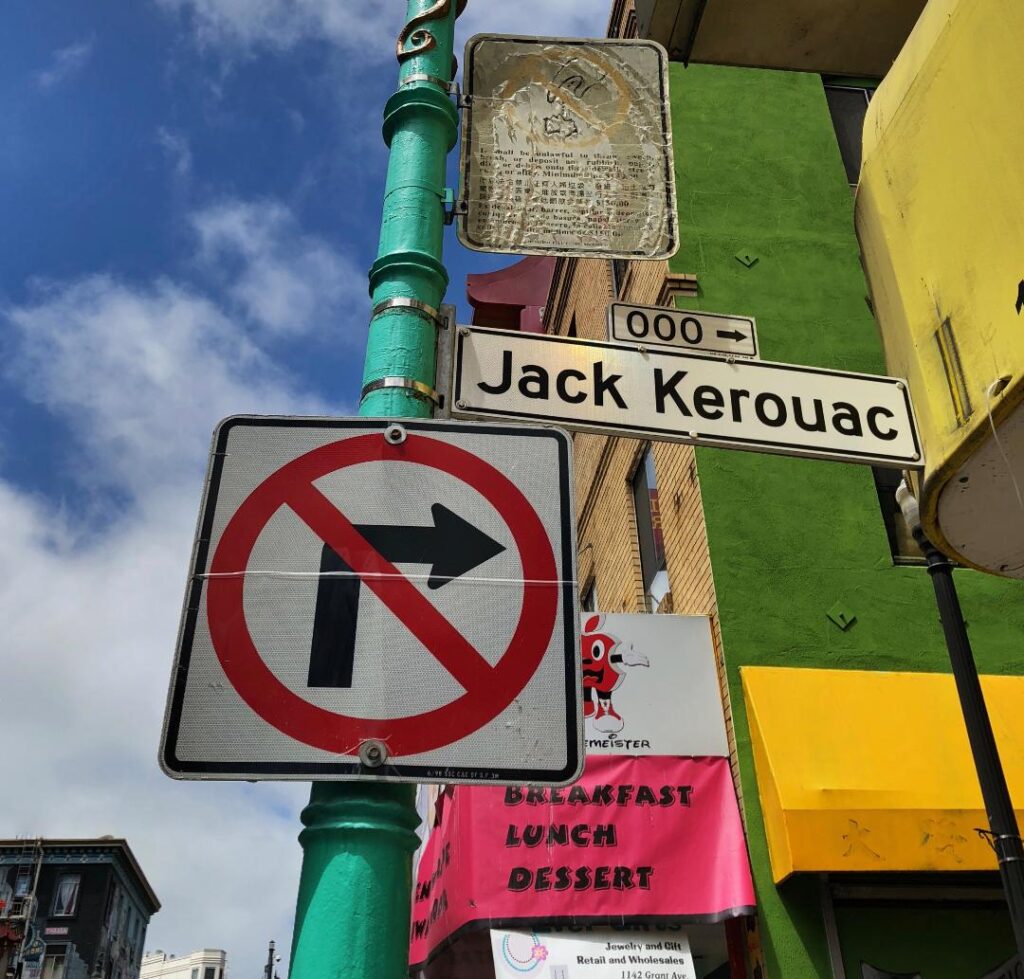
It was a sanitized version of OTR that came out in ’57. Compare the edgier style of the lost story. Bang on the link and you’ll see another shot of Kerouac Alley near the Vesuvio coffee house. I distinctly recall quaffing one or more espressos there on the day I visited Ferlinghetti’s City Lights Bookstore.

Kerouac Alley

This just in from Thomas Carroll:

I saw the note on your blog about losing all those photos. Wanted to make sure this one made it over to the new platform — see below. Take care and merry October.

Thanks, Tom. Talk about synchronicity! I thought about that photo of yours just a minute before finding your e-mail message.  Here is what I posted on 8 October 2018:

……………………..

A Northern California reader sends this photo of a street scene in the vicinity of City Lights Bookstore, San Francisco. I made a ‘pilgrimage’ to Lawrence Ferlinghetti‘s famous bookstore in the early ’70s. That was before the Kerouac street sign was up.

Some of Ferlinghetti’s poetry can be read here.  To my surprise, Ferlinghetti is still alive at 99. By contrast, old Kerouac quit the mortal coil and “the slaving meat wheel” at age 47.  He is, we hope, “safe in heaven, dead.”

The Brothers Black

Manny K. Black and his brother and litter mate Max.  Their names honor two philosophers, one great, the other merely distinguished.

I transferred this one via Copy Image as opposed to Copy Image Address. Now if I am not mistaken, this one should ‘stick,’ i.e., remain on this WordPress site even if Ice Drive goes down or they throw me off.

The techno-details are interesting, but I’d really rather just write, write, and write some more.

Eat, Drink, and Beat Harry


Crazy Harry

There are cartoons we never forget. One in Chess Life some years back depicted two intense guys bent over a chess board. The caption read, “Eat, drink, and beat Harry.”

Emmanuel Lasker would have liked that. He was always going on about the role of Kampf, stuggle, in chess. Lasker would also have liked this quotation lifted from Michael Gilleland’s erudite weblog:

After all, what would life be without fighting, I should like to know? From the cradle to the grave, fighting, rightly understood, is the business, the real highest, honestest business of every son of man. Every one who is worth his salt has his enemies, who must be beaten, be they evil thoughts and habits in himself, or spiritual wickednesses in high places, or Russians, or Border-ruffians, or Bill, Tom, or Harry, who will not let him live his life in quiet till he has thrashed them. (Thomas Hughes, Tom Brown’s Schooldays, Part II, Chapter V.)

Next time I’m paired with Crazy Harry, I’m going to thrash that meshuggeneh patzer and I’m going to thrash him good.

A Buddhist Scholar Swims the Tiber

Dmitri writes,

Hope all is well. I am reading yet another book of a convert to Catholicism. This one is written by a British professor Paul Williams who is a scholar of Buddhism. Besides the interesting personal story the book contains a few interesting arguments with a few fundamental Buddhist conceptions such as rebirth. Williams states that his return to Christianity and conversion to Catholicism was rational and in part based on the incoherence of the Buddhist concept of rebirth. There is a short chapter dedicated to this topic at the end of the book that can be read standalone. An online religious community shared a copy of Williams’ book  if you would want to preview before deciding whether it is worth your time and money.
Great to hear from you, my friend. Conversions (22 entries) and deconversions fascinate me. I ‘ve read a bit of the pdf you’ve kindly sent: the book is engaging from the start. Amazon wants 79 USD which is a bit steep. I’ll read more. These days, the problem’s not lack of loot but of space. Italian frugality has paid off. And while books can burn in a fire, they are less fragile all things considered than online materials.

After what I said yesterday about the left-ward transmogrification unto insipidity of the RCC, a process that began with Vatican II (1962-1965), as Dr. Caiati documents in a comment below, it is somewhat strange that anyone should still want to swim the Tiber. Buddhism has its problems, but Christianity does not? Is Williams serious?

Buddhism, Suffering, and One Reason I am not a Buddhist 

People convert and deconvert to and from the strangest things:

Harry Binswanger’s Conversion

Son of Atheist Neo-Positivist David Stove Converts to Catholicism

Sometimes the apple falls very far from the tree.

The Stove ‘Dilemma’ and the Lewis ‘Trilemma’


No Ammo to the Enemy: Defund the Left — and the RCC

Here:

“For fostering a true consciousness in liturgical matters, it is also important that the proscription against the form of liturgy in valid use up to 1970 [the older Latin Mass] should be lifted. Anyone who nowadays advocates the continuing existence of this liturgy or takes part in it is treated like a leper; all tolerance ends here. There has never been anything like this in history; in doing this we are despising and proscribing the Church’s whole past. How can one trust her at present if things are that way?”

Joseph RatzingerGod and the World: A Conversation with Peter Seewald (San Francisco: Ignatius Press, 2002), p. 416.

This is precisely right.

However, there are bishops who do despise the Church’s whole past. They want the past erased and buried. They want a new morality, especially. That way they can be popular. 

Bowman also quotes Edward Feser:

Preference for the Traditional Latin Mass is massively correlated with orthodoxy. This is precisely why certain people want it suppressed. They call the TLM “divisive” but the reality is, it’s TLM ‘s opponents who want to divide the Church from her liturgical and doctrinal past.

Unlike my friend Feser, I have serious reservations about elements of traditional RCC doctrine. But I have far stronger reservations and outright objections to the destructive Left, in particular, to their trademark erasure of the historical record. Pedant that I am, I will point out once again that the past cannot be erased or  buried, for it remains, tenselessly, what it was.  But the past can be sent into oblivion which is, practically speaking, the same thing: what has been sent down the memory hole can no longer inform or guide our action in the present.

The RCC should stand as a bulwark against the leftist insanity all around us.  So, to the extent that it becomes just another piece of leftist cultural junk, the RCC must be defunded. You are therefore a fool complicit with the forces of the anti-civilizational Left to the extent that you contribute to the RCC monetarily, in the same way that you are complicit fool and a useful idiot if you continue to contribute to those of your alma maters who refuse to  renounce publicly the destructive DEI agenda.

But what if the particular church you attend needs repairs, a new roof say, and a collection is taken up within that church for the funds needed. Go ahead, make a contribution despite the theological ignorance of the priests, their homosexual vibe, and the defective Novus Ordo liturgy.  If you need services on Sundays, Novus Ordo is better than nothing. If you take a harder line, and shun Novus Ordo, you may convince me.

Hitler or Caesar? William Shakespeare on Donald J. Trump

Julius Caesar, Act I, Scene II (emphases added)

William Shakespeare

1564 – 1616

Cassius speaks to Brutus

Why, man, he doth bestride the narrow world
Like a Colossus, and we petty men
Walk under his huge legs and peep about
To find ourselves dishonorable graves.
Men at some time are masters of their fates.
The fault, dear Brutus, is not in our stars,
But in ourselves, that we are underlings.
“Brutus” and “Caesar”—what should be in that “Caesar”?
Why should that name be sounded more than yours?
Write them together, yours is as fair a name;
Sound them, it doth become the mouth as well;
Weigh them, it is as heavy; conjure with ’em,
“Brutus” will start a spirit as soon as “Caesar.”
Now, in the names of all the gods at once,
Upon what meat doth this our Caesar feed
That he is grown so great? Age, thou art shamed!
Rome, thou hast lost the breed of noble bloods!
When could they say, till now, that talked of Rome,
That her wide walks encompassed but one man?
Now is it Rome indeed, and room enough
When there is in it but only one man.
O, you and I have heard our fathers say
There was a Brutus once that would have brooked
Th’ eternal devil to keep his state in Rome
As easily as a king.

But: “Pride goeth before destruction, and an haughty spirit before a fall.” Proverbs, 16:18. May the Lord spare him Caesar’s fate. “Yon Cassius hath a lean and hungry look.”

His enemies are coming around, albeit partially and grudgingly.  Are we mortals too much impressed by success and power? But so far, so good. Can you imagine any Democrat, let alone the foolish Kamala Harris standing up to alpha males such as Xi and Putin?  Politics is not performative but practical: not a matter of perfect versus imperfect, but of better versus worse. He who lets the best become the enemy of the good will get neither. 

Age, thou art shamed!  Old age or this historical period? Both?

That silly goose Nancy Pelosi foolishly opined that Joey Biden is Mt. Rushmore material.  No Nancy, but Trump is.  Third in line behind Washington and Lincoln as historian Newt Gingrich has plausibly opined. But time will tell. 

Mind without Consciousness?

David Brightly in a recent comment writes,

[Laird] Addis says,

The very notion of language as a representational system presupposes the notion of mind, but not vice versa.

I can agree with that, but why should it presuppose consciousness too?

In a comment under this piece you write,

Examples like this cause trouble for those divide-and-conquerers who want to prise  intentionality apart from consciousness with its qualia, subjectivity, and what-it-is-like-ness,  and work on the problems separately, the first problem being supposedly tractable while the second is called the (intractable) Hard Problem (David Chalmers). Both are hard as hell and they cannot be separated. See Colin McGinn, Galen Strawson, et al.

Could you say a bit more on this?

I’ll try.  You grant that representation presupposes mind, but wonder why it should also presuppose consciousness.  Why can’t there be a representational system that lacks consciousness?  Why can’t there be an insentient, and thus unconscious, machine that represents objects and states of affairs external to itself? Fair question! 

Here is an example to make the problem jump out at you. Suppose you have an advanced AI-driven robot, an artificial French maid, let us assume, which is never in any sentient state, that is, it never feels anything.  You could say, but only analogically, that the robot is in various ‘sensory’ states, states  caused by the causal impacts of physical objects against its ‘sensory’ transducers whether optical, auditory, tactile, kinaesthetic . . . but these ‘sensory’ states  would have no associated qualitative or phenomenological features.  Remember Herbert Feigl? In Feiglian terms, there would be no ‘raw feels’ in the bot should her owner ‘feel her up.’  Surely you have heard of Thomas Nagel. In Nagelian terms, there would be nothing it is like for the bot to have her breasts fondled.  If her owner fondles the breasts of his robotic French maid, she feels nothing even though she is programmed to respond appropriately to the causal impacts via her linguistic and other behavior.   “What are you doing, sir? I may be a bot but I am not a sex bot! Hands off!” If the owner had to operate upon her, he would not need to put her under an anaesthetic. And this for the simple reason that she is nothing but an insensate machine.

I hope Brightly agrees with me that verbal and nonverbal behavior, whether by robots or by us, are not constitutive of  genuine sentient states. I hope he rejects analytical (as opposed to methodological) behaviorism, according to which feeling pain, for example,  is nothing more than exhibiting verbal or nonverbal pain-behavior.  I hope he agrees with me that the bot I described is a zombie (as philosophers use this term) and that we are not zombies.  

But even if he agrees with all that, there remains the question: Is the robot, although wholly insentient, the subject of mental states, where mental states are intentional (object-directed) states?  If yes, then we can have mind without consciousness, intrinsic intentionality without subjectivity, content without consciousness.

Here are some materials for an argument contra.

P1 Representation is a species of intentionality. Representational states of a system (whether an organism, a machine, a spiritual substance, whatever) are intentional or object-directed states.

P2 Such states involve contents that mediate between the subject of the state and the thing toward which the state is directed.  Contents are the cogitata in the following schema: Ego-cogito-cogitatum qua cogitatum-resNote that ‘directed toward’ and ‘object-directed’ are being used here in such a way as to allow the possibility that there is nothing in reality, no res, to which these states are directed.  Directedness is an intrinsic feature of intentional states, not a relational one.  This means that the directedness of an object-directed state is what it is whether or not there is anything in the external world to which the state is directed. See Object-Directedness and Object-Dependence for more on this.

As for the contents, they present the thing to the subject of the state. We can think of contents as modes of presentation, as Darstellungsweisen in something close to Frege’s sense.     Necessarily, no state without a content, and no content without a state.  (Compare the strict correlation of noesis and noema in Husserl.) Suppose I undergo an experience which is the seeing as of  a tree.  I am the subject of the representational state of seeing and the thing to which the state is directed, if it exists, is a tree in nature.  The ‘as of‘ locution signals that the thing intended in the state may or may not exist in reality.

P3 But the tree, even if it exists in the external world, is not given, i.e., does not appear to the subject, with all its aspects, properties, and relations, but only with some of them. John Searle speaks of the “aspectual shape” of intentional states. Whenever we perceive anything or think about anything, we always do so under some aspects and not others.  These aspectual features are essential to the intentional state; they are part of what make intentional  states the states that they are. (The Rediscovery of the Mind, MIT Press, 1992, pp. 156-157) The phrase I bolded implies that no intentional state that succeeds in targeting a thing (res) in external world is such that every aspect of  the thing is before the mind of the person in the state.

P4 Intentional states are therefore not only necessarily of something; they are necessarily of something as something.  And given the finitude of the human mind, I want to underscore the fact that  even if every F is a G, one  can be aware of x as F without being aware of  x as G.   Indeed, this is so even if necessarily (whether metaphysically or nomologically) every F is a G. Thus I can be aware of a moving object as a cat, without being aware of it as spatially extended, as an animal, as a mammal, as an animal that cools itself by panting as opposed to sweating, as my cat, as the same cat I saw an hour ago, etc.  

BRIGHTLY’S THEORY (as I understand it, in my own words.)

B1. There is a distinction between subpersonal and personal contents. Subpersonal contents exist without the benefit of consciousness and play their mediating role in representational states in wholly insentient machines such as the AI-driven robotic maid.  

B2. We attribute subpersonal contents to machines of sufficient complexity and these attributions are correct in that these machines really are intentional/representational systems.

B3. While it is true that the only intentional (object-directed) states of which we humans are aware are conscious intentional states, that they are  conscious is a merely contingent fact about them. Thus, “the conditions necessary and sufficient for content are neutral on the question whether the bearer of the content happens to be a conscious state. Indeed the very same range of contents that are possessed by conscious creatures could be possessed by creatures without a trace of consciousness.” (Colin McGinn, The Problem of Consciousness, Blackwell 1991, p. 32.

MY THEORY

V1. There is no distinction between subpersonal and personal contents. All contents are contents of (belonging to) conscious states. Brentano taught that all consciousness is intentional, that every consciousness is a consciousness of something.  I deny that, holding as I do that some conscious states are non-intentional. But I do subscribe to the Converse Brentano Thesis, namely, that all intentionality is conscious. In a slogan adapted from McGinn though not quite endorsed by him, There is no of-ness without what-it-is-like-ness. This implies that only conscious beings can be the subjects of original or intrinsic intentionality.  And so the  robotic maid is not the subject of intentional/representational states. The same goes for the cerebral processes transpiring  in us humans when said processes are viewed as purely material: they are not about anything because there is nothing it is like to be them.  Whether one is a meat head or a silicon head, no content without consciousness! Let that be our battle cry.

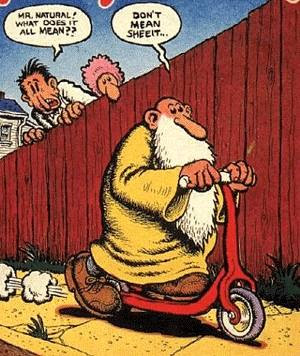
And so, when the robotic maid’s voice synthesizer ‘says’ ‘This shelf is so dusty!’ it is only AS IF ‘she’ is thereby referring to a state of affairs and its constituents, the shelf and the dust.  ‘She’ is not saying anything, sensu stricto, but merely making sounds to which we original-Sinn-ers, attribute meaning and reference. Thinking reference (intentionality) enjoys primacy over linguistic reference. Cogitation trumps word-slinging. The latter is parasitic upon the former.  Language without mind is just scribbles, pixels, chalk marks, indentations in stone, ones and zeros. As Mr. Natural might have said, “It don’t mean shit.” An sich, und sensu stricto.

V2. Our attribution of intentionality to insentient systems is merely AS IF.  The robot in my example behaves as if it is really cognizant of states of affairs such as the dustiness of the book shelves and as if it really wants to please its boss while really fearing his sexual advances.  But all the real intentionality is in us who makes the attributions.  And please note that our attributing of intentionality to systems whether silicon-based or meat-based that cannot host it is itself real intentionality. It follows, pace Daniel Dennett, that intentionality cannot be ascriptive all the way down (or up). But Dennett’s ascriptivist theory of intentionality calls for a separate post.

V3. It is not merely a contingent fact about the intentional state that we our introspectively aware of that they are conscious states; it is essential to them.

NOW, have I refuted Brightly ? No! I have arranged a standoff.  I have not refuted but merely neutralized his position by showing that it is not rationally coercive.  I have done this by sketching a rationally acceptable alternative. We have made progress in that we now both better understand the problems we are discussing and our different approaches to them.

Can we break standoff? I doubt it, but we shall see.

Whatever Happened to Unconditional “Welcome the Stranger?”

Vatican City has one of the strictest immigration laws in the whole world. I seem to recall the Bergoglio-Prevost tag team — now known as BergoLEO — going on and on about unconditional “Welcome the Stranger.”  Suicidal leftist folly on stilts.

I am all for welcoming the stranger, but only under certain conditions.  Immigration must be to the benefit of the host country. The depredatory Dems refuse to countenance that simple truth.  Interesting to speculate why.Vatican City's immigration law, one of the strictest in Europe - ZENIT - English

Europe in Trouble

Malcolm Pollack, back from Britain, reports:

I have to say, though, that the trip was ultimately rather depressing: it would be hard to overstate how utterly doomed the ancient British nation and people are. Among the staff of the shops, hotels, and restaurants we visited, we hardly ever even heard a British accent. (In particular, I’d been looking forward to hearing Scottish accents in Edinburgh, and hardly heard a one.)

In London, the cab drivers were still mostly English, and to a one they asked me what I thought about Trump; once I said that I was glad he’d won the election, and that he was a necessary correction to the damage that had been done over the past few decades, they felt free to unburden themselves about the moribund state of England. The tone was unvarying: weary, hopeless resignation, and mourning for the homeland they had lost.

The British people have annihilated not only their own future, but also the magnificent, thousand-year legacy that all of their ancestors had bequeathed to them as stewards for generations yet unborn. All of it is just gone, destroyed. In a generation or two, Britain will be an Islamic nation; the only thing that can possibly prevent this is a furious awakening of the virile and indomitable spirit that once ruled the world, and it would have to happen now.

But it won’t. The only ones who seem to care enough, or even to realize what has been lost, are now too old — and as far as I can tell, they’ve already given up.

The West seems bent on destroying itself, with the RCC under the ‘leadership’ of BergoLEO in the lead. (I owe the clever coinage to Vito Caiati.) Rod Dreher:

De Montbrial has a new book coming out in France next week, about what he regards as his country’s “emergency” situation. I suppose the talk he gave yesterday, in English, is part of it. He warned that western Europeans should prepare themselves for mass violence at the level the continent (minus the 1990s Balkans) hasn’t seen since the end of World War II. That is to say (though he didn’t use this term), civil wars. If you see this man’s Wikipedia page, you realize that he is in a position to know what he is talking about. He explained that Islamists have managed to infiltrate both public and private institutions all over Europe, and are using it to their advantage.

How did all this happen? De Montbrial, a practicing Catholic, said that the core of the problem is cultural — namely, that France (and Europe) has lost all sense of who and what it is. It has forgotten its past, and any sense of connection to it, and has lost its identity. (This is what Renaud Camus calls “The Great Deculturation”). How do you expect young people to resist people (Muslims) who are hostile to Western civilization, and who have a strong culture, if you have produced a generation, or generations, of people who have no culture? He said that in France, Muslim activists are even succeeding in winning over the hearts and minds of no small number of native-born French, by telling them, basically: “Look around you at what a nihilistic, pornified disaster modern Europe has become. Is that really what you want? Convert, join the ummah, and gain a story. Become part of the glorious march through history of the sons and daughters of the Prophet.”

Family Medicine circa 1692

Medicinal Experiments

Maynard Mack (1909-2001), Alexander Pope: A Life (New York: W.W. Norton & Company, 1985), pp. 15-16:

But even such prescriptions pale beside many of those receiving sanction from the distinguished chemist Robert Boyle in his Medicinal Experiments of 1692, one of the most popular family handbooks of the period. Among other recipes more palatable, one for sore throat, as common an ailment among children then as now, proposes “a drachm of white dog’s turd” worked up with honey of roses into “a linctus, to be very slowly let down the throat.” Another—”For Convulsions, especially in Children”—requires ground dried earthworms fortified with “a pretty number of grains of ambergrease” to moderate the stench. A third—”For the Cholic and diverse other Distempers”—features an infusion made of “four or five balls of fresh stone-horse dung” steeped in a pint of white wine, to be drunk “from a quarter to half a pint” at a dose. Easily the Mount Everest and Mona Lisa among these unappealing remedies is the following, used “To clear the Eyes, even of films”: Take human fecal matter “of good Colour and consistence,” dry it slowly “till it be pulverable,” then reduce it “into an impalpable powder, which is to be blown once, twice, or thrice a day … into the patient’s Eyes.”